
Common UCAS Application Mistakes to Avoid for 2026 Entry
In the 2024 admissions cycle, UCAS processed over 3 million applications, yet a single technical oversight remains one of the most frequent reasons for a missed offer. What if a single unchecked box on your 2026 UCAS form could outweigh three years of academic excellence? We know you’ve put in the work to earn your grades and build a profile that reflects your unique potential. It’s frustrating to think that technical hurdles or confusion over international qualification equivalence could silence your voice before an admissions officer even reads your personal statement. You deserve a process that’s fair and transparent, not one that feels like a minefield of hidden traps.
We’re here to ensure your application carries the impact it deserves. By identifying the common ucas application mistakes to avoid, you can transform a stressful administrative task into a powerful platform for your future. This guide provides the clarity you need to submit a flawless application for 2026 entry. We’ll break down the subtle errors in references, the reality of how universities view AI-generated content today, and the technical data points that often lead to automatic rejections. Let’s work together to secure your seat at a top-tier UK university and make your voice heard in the competitive 2026 pool.
Key Takeaways
- Shift your perspective on the 2026 cycle by viewing your application as a holistic data-matching exercise rather than a simple essay.
- Secure your impact by avoiding the AI pitfalls and overused clichés that compromise the authenticity of your personal statement.
- Identify the common ucas application mistakes to avoid regarding technical data and reference tracking to ensure your hard work isn’t overlooked.
- Navigate the complexities of international equivalence and English proficiency to ensure your global qualifications carry the weight they deserve.
- Maintain your seat at the table after submission by actively managing your UCAS Hub and preparing for strategic opportunities in Extra and Clearing.
The Evolving UCAS Landscape: Why 2026 is Different
The 2026 application cycle marks a significant shift in how the Universities and Colleges Admissions Service (UCAS) manages student data. It’s no longer accurate to view the process as a simple digital filing cabinet for your personal statement. Instead, the system functions as a sophisticated, holistic data-matching exercise. Every entry you make must align perfectly with the specific requirements of your chosen institutions. With UCAS forecasting a 30 percent increase in total applicants by the end of the decade, the 2026 entry window is set to be one of the most competitive on record. Universities are already responding to this volume by raising their entry requirements and tightening their selection criteria.
This increased pressure has transformed the role of technology in admissions. We are seeing a move toward digital-first verification and automated screening tools that scan applications for specific markers before they ever reach an admissions officer. If your data doesn’t match the required format, you risk being filtered out instantly. This complexity is why many applicants now seek the guidance of uk university admission consultants. These professionals act as advocates, helping you navigate the systemic hurdles and ensuring your application reflects your true potential. Understanding these technical shifts is the first step in identifying the common ucas application mistakes to avoid.
The High Stakes of Small Errors
In a digital-first system, minor oversights carry heavy consequences. A single typo in a qualification code or a misreported grade can trigger an automatic rejection from a university’s internal management software. These systems are designed for efficiency, not empathy. Beyond the data, your “voice” and “representation” are vital. In a crowded pool of applicants with identical predicted grades, how you present your story determines your impact. You must ensure your application isn’t just a list of facts, but a persuasive case for your place on the course. Tariff Points are the currency of UK admissions, translating diverse qualifications into a single numerical value for university entry.
2026 Admissions Trends to Watch
The 2026 landscape is defined by multi-format applications. Many courses now require a combination of the UCAS form, specialized entrance exams, and digital interviews. You must stay ahead of the curve by tracking early deadlines; October 15, 2025, remains the firm cutoff for Oxbridge, Medicine, and Veterinary Science. Universities are also prioritizing representation more than ever. They are looking for diverse cohorts that bring unique perspectives to their campuses. Failing to highlight your unique background or extracurricular impact is one of the common ucas application mistakes to avoid in this modern era. We believe that every student deserves a seat at the table, but securing that seat requires precision and a clear understanding of these emerging trends.
Personal Statement Pitfalls: Clichés, AI, and Authenticity
Your personal statement is the most direct way to establish your voice within the admissions process. It’s your chance to move from being a set of grades on a screen to a person with real potential for impact. However, many applicants lose this opportunity by falling into common ucas application mistakes to avoid, particularly when they prioritize convenience over character. We believe that your individual story is your strongest asset, and protecting its authenticity is vital for a successful 2026 entry.
The AI Detection Reality in 2026
UCAS uses sophisticated similarity detection software, known as Copycatch, to scan every single submission against a massive database of previous statements and online sources. By the 2026 cycle, these tools will be even more adept at identifying the predictable linguistic patterns of generative AI. If you use ChatGPT to ghostwrite your statement, you risk an immediate flag for plagiarism. Beyond the technical risk, over-reliance on digital tools strips away your authentic voice. AI cannot replicate your specific lived experiences or your unique motivations for choosing a course. Use AI as a tool for brainstorming or structuring your thoughts, but ensure every sentence is crafted by you. Your perspective deserves to be heard, not automated.
Clichés That Make Admissions Officers Cringe
Admissions tutors at high-demand universities often review more than 200 statements in a single week. Starting your essay with a tired phrase makes your application feel like background noise. To stand out, you must replace generic claims with evidence-based interest. Avoid these five overused openings in your 2026 application:
- “Since I was a child…”
- “I have always been passionate about…”
- “From a young age…”
- “I am a highly motivated individual…”
- “For as long as I can remember…”
Instead of claiming you are passionate, prove it by discussing a specific book, a recent lecture, or a 5-day work placement that challenged your thinking. You should aim to follow the 80/20 rule, which dictates that 80 percent of your content must focus on your academic suitability while only 20 percent covers extracurricular activities. This balance ensures the focus remains on your subject expertise. If you want to ensure your voice carries the weight it deserves in every application you make, join the conversation with our community of advocates.
Another frequent error is treating the statement as a “list of achievements.” Listing five different awards without context provides no insight into your character. You should focus on the impact of those experiences. Explain what you learned from a specific challenge and how it prepares you for the rigours of a degree. Finally, remember that your statement is sent to all five of your university choices. Tailoring your text to one specific campus rather than the broader subject is one of the most common ucas application mistakes to avoid, as it can alienate the other four institutions on your list.
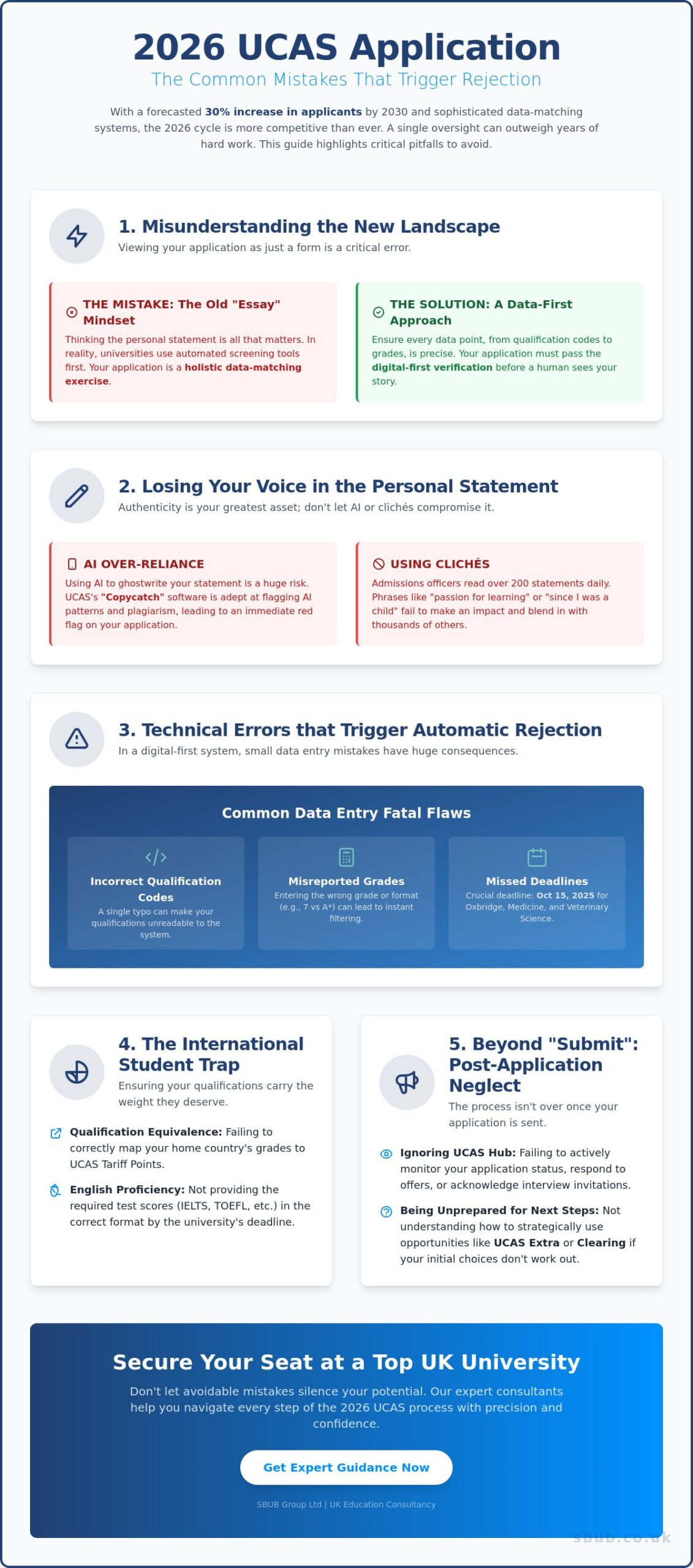
Technical Errors That Trigger Automatic Rejection
Your application is more than a list of achievements; it’s your professional pitch to the academic community. Even the most compelling personal statement can’t save an application that fails the initial technical screening. Admissions teams process thousands of forms for 2026 entry, and administrative inconsistencies often lead to immediate disqualification. We want to ensure your voice is heard, which means your data must be flawless from the start.
One of the most common ucas application mistakes to avoid involves basic contact details. Using an unprofessional email address or failing to update your phone number can result in missed interview invitations or critical Hub notifications. Check your spam filters daily. A missed 48-hour response window for an offer is a tragedy that’s entirely preventable. If you’ve faced significant personal or medical challenges, don’t leave the “Extenuating Circumstances” section blank. This isn’t about making excuses; it’s about providing the context necessary for a fair assessment of your potential.
Managing the Reference Process
The reference is the secret engine of a successful application. It provides the third-party validation that turns your claims into facts. Many students treat this as a passive process, but you must take an advocacy-driven approach. Your referee needs to highlight your specific impact in the classroom or community. Don’t just assume they’ll submit it on time. Reach out early to ensure they understand your goals for the 2026 cycle. An “invisible reference” is a silent killer; if your teacher misses the deadline, UCAS will not forward your application to your chosen universities. You have the right to chase this politely but firmly to protect your future.
Qualification and Grade Misreporting
Accuracy in your academic history is non-negotiable. Universities verify every entry against your official certificates. A frequent error is confusing “pending” grades with “achieved” grades, or misaligning the dates of your exams. If you’re an international student, navigating the uk school system requirements for GCSEs and A-Levels can be complex, so take the time to match your entries exactly to your transcripts.
- List every sitting: You must include all attempts at a qualification, even if you’re unhappy with the result.
- Report “U” grades: Omitting a failing grade is considered a fraudulent entry and can lead to a total ban from UCAS.
- Check the awarding body: Ensure you select the correct exam board (AQA, OCR, Pearson, etc.) for every subject.
These technical hurdles shouldn’t stand in your way. By treating the data entry with the same urgency as your personal statement, you create a level playing field for yourself. Precision in these details ensures that when admissions tutors look at your file, they see your potential rather than your paperwork errors. This is one of the most vital common ucas application mistakes to avoid to ensure your journey to university remains on track.
The International Student Trap: Visas and Equivalence
Applying from abroad adds layers of complexity that UK-based students simply don’t face. You aren’t just selling your academic potential; you’re proving your eligibility to live and study in a different legal system. We believe that every student, regardless of their origin, deserves a level playing field. Your international background is an asset, not a barrier, yet the system often treats it as a series of hurdles. One of the most common ucas application mistakes to avoid is failing to verify if a university accepts your specific country’s high school diploma before submitting your choices.
Qualification Equivalence Errors
UK universities maintain strict lists of global equivalencies. We see many students assume their local grades translate directly to UK A-levels. It doesn’t work that way. You should use UK ENIC, formerly NARIC, to verify your standing. If your original transcripts aren’t in English, you must provide certified translations immediately. For students from US-curriculum schools, understanding sat scores is vital for the 2026 entry cycle, as these results often bridge the gap between different educational standards.
English Language Test Oversights
Don’t fall for the myth that “English-medium” schooling automatically waives the need for an IELTS or PTE. Even if you’ve studied in English for years, many institutions still demand a formal test to satisfy Home Office requirements. You must check specific sub-score requirements. For instance, a university might require an overall 7.0 but specifically insist on a 6.5 in Writing. Missing these details can result in a conditional offer you can’t fulfill. If you’re struggling with the documentation, you can find expert student visa assistance in birmingham to help you meet these 2026 standards. Understanding these common ucas application mistakes to avoid ensures you maintain control over your academic journey.
The “Visa Timing” trap is perhaps the most heartbreaking error. You can’t start your visa application without a Confirmation of Acceptance for Studies (CAS). Universities often issue these in July or August, leaving you a narrow window before the September term begins. You also need to prove you have sufficient funds. Under current Home Office rules, you must hold the required maintenance funds in your account for 28 consecutive days. If you don’t plan for this timeline, your 2026 start date will vanish before you even reach the border.
Beyond the Submit Button: Post-Application Management
Hitting the submit button feels like a finish line, but for the 2026 entry cycle, it is actually the start of a critical management phase. One of the most common ucas application mistakes to avoid is falling into “radio silence.” You cannot afford to stop checking the UCAS Hub. Universities often send interview invitations or requests for additional portfolios with response windows as short as five working days. If you miss that notification, your application effectively stalls. We understand the weight of this waiting period. At SBUB, we act as your empathetic champion, helping you manage post-submission anxiety and ensuring your voice remains clear throughout the entire process.
International students face the additional hurdle of the “Credibility Interview” for visa purposes. Recent figures suggest that lack of preparation for these 30 minute sessions is a primary cause of CAS (Confirmation of Acceptance for Studies) delays. You must be ready to discuss your course choice and financial standing with absolute clarity. Failing to prepare for these “Extra” or “Clearing” opportunities because you didn’t expect to need them is a risk you don’t have to take. We believe in being proactive rather than reactive, turning potential setbacks into managed transitions.
Responding to Offers and Deadlines
When the offers arrive, you must choose your Firm and Insurance options. Your Firm choice is your primary goal. Your Insurance choice should always have lower grade requirements; picking two universities with the same entry criteria is a strategic error that leaves you without a safety net. If you miss your reply deadline, UCAS will automatically record a “Decline by Default,” withdrawing your application from all five choices. For those with conditional offers who narrowly miss their grades, don’t lose hope. In the 2023 cycle, thousands of students were still accepted by their Firm choice despite being a few marks short because they communicated early and professionally.
Final Checklist Before You Click Send
Before that final click, apply the “Fresh Eyes” rule. This is your last chance to catch the common ucas application mistakes to avoid, such as simple typos or date errors. You need a third party to review your work because your brain often skips over mistakes it has seen twenty times. We recommend a meticulous check of your “Education History” section. Any unexplained gaps of three months or more can trigger a request for more information, slowing your progress. This level of detail ensures you are not just another number, but a serious candidate with a verified story.
Your journey to university is about claiming your space in a competitive system. Don’t let administrative slips silence your potential. Join the conversation with SBUB to ensure your application is flawless and your transition to higher education is handled with the professional advocacy you deserve.
Take Control of Your 2026 Academic Future
Your journey to a UK university shouldn’t be defined by a missed deadline or a generic personal statement. Understanding the common ucas application mistakes to avoid is the first step toward securing your place in the 2026 cohort. Authenticity matters more than ever. UCAS guidance for 2024 emphasized that statements must reflect a student’s unique voice to succeed. Technical precision and visa compliance are equally critical for international applicants who need to align their documents with current UK Home Office requirements.
Since 2018, we’ve empowered students to navigate these complex systems. We bridge the gap between your ambition and university expectations through our global network of partner institutions and expertise in complex visa documentation. Don’t let a minor technical error limit your impact or your future. You have the potential to shape the world. We’re here to ensure your voice is heard by the right admissions teams and that your application represents your true potential. Together, we can turn the daunting task of applying into a clear path toward your degree.
Secure your UK university place with SBUB’s expert admission support
Frequently Asked Questions
Can I change my UCAS personal statement after I have submitted it?
No, you can’t edit your personal statement once you’ve clicked submit. UCAS sends your application directly to your chosen universities immediately. If you notice a major error within 14 days of submitting, you can contact the UCAS Customer Experience Centre to cancel your entire application and start again, though you’ll have to pay the application fee a second time.
What happens if I make a mistake on my UCAS application and have already sent it?
You should contact the UCAS Customer Experience Centre at 0330 333 0230 as soon as you spot the error. Minor changes like your email address or phone number can be updated through your UCAS Hub account. For more significant errors regarding your qualifications or university choices, you must notify both UCAS and the admissions offices of your five chosen universities to ensure your record stays accurate.
Is it a mistake to use AI or ChatGPT for my personal statement in 2026?
Yes, relying on AI to write your statement is one of the most common ucas application mistakes to avoid for 2026 entry. UCAS uses Copycatch software to scan every submission for plagiarism and AI-generated patterns. If the software flags your work, UCAS notifies your chosen universities, which often leads to an immediate rejection. We want your unique voice to shine, not a programmed algorithm.
How do I know if my international qualifications are equivalent to UK A-Levels?
You can verify your qualifications through the UK ENIC database, which is the official agency for national recognition of international credentials. Most of the 24 Russell Group universities provide specific country-by-country entry requirements on their websites. We believe in a level playing field for all 700,000 annual applicants, so checking these official tables ensures your application meets the necessary academic benchmarks before you apply.
Can a bad teacher reference really cause my application to be rejected?
Yes, an inadequate or missing reference can stall your application indefinitely. UCAS data confirms that 100% of applications must include a completed reference before they are sent to universities. If your referee doesn’t provide specific evidence of your academic impact and potential, admissions tutors may overlook your application in favor of candidates with stronger professional backing. You should choose a referee who knows your work intimately.
What is the most common reason for a UCAS application being rejected?
Missing the specific grade requirements is the most frequent cause for rejection. However, failing to follow technical instructions is another of the common ucas application mistakes to avoid that catches people out. In the 2023 cycle, thousands of students missed out because they didn’t meet the June 30th deadline or failed to respond to offers by the June 6th deadline, effectively withdrawing themselves from the process.
Do I need to list every school I have attended on my UCAS form?
You must list every secondary school, college, and university you’ve attended from age 11 onwards. This includes any institution where you sat an exam, even if you didn’t finish the course or failed the test. Providing a full, transparent history ensures fairness in the system. Omitting a school can be seen as a fraudulent attempt to hide your academic history, which risks your entire application being cancelled.
How many universities can I apply to on UCAS?
You can apply to a maximum of five choices on your UCAS form. These five spots can be used for different courses at the same university or the same course at five different institutions. If you’re applying for medicine, dentistry, or veterinary science, you’re restricted to four choices for those specific subjects. You can then use your fifth choice for a different subject to provide a backup plan.