
British Education Grading System: The 2026 International Student Guide
A 70% score on your transcript might feel like a mid-tier result, but in a British lecture hall, it’s often the mark of a world-class student. You aren’t alone if the british education grading system feels like a complex puzzle designed to keep your potential hidden. Whether you’re decoding the 9 to 1 GCSE scale or wondering how your local marks translate to a UK degree, the pressure to get it right is immense. We know that your academic history is more than just a list of numbers; it’s your voice in a global market.
We’ve designed this 2026 guide to give you the clarity and agency you need to stand out. You’ll learn how to position your international qualifications for success and understand exactly how the “Honours” system defines your future impact. We’ll walk through the specific benchmarks used by UCAS and admissions offices to ensure you’re treated with the fairness you deserve. This article provides a clear map of the UK landscape, turning confusion into a strategic advantage for your university applications.
Key Takeaways
- Understand why the UK values academic depth over raw percentages and how regional differences impact your university application strategy.
- Decode the 9-1 GCSE scale and A-level requirements to ensure your secondary results align with the expectations of top-tier institutions.
- Master the complexities of the british education grading system to see why a 70% mark is the “magic number” for a First-Class honours degree.
- Learn how to professionally verify international qualifications through ENIC to avoid the common pitfalls of self-converting grades on your CV.
- Discover how SBUB acts as your Empathetic Champion, advocating for your representation and ensuring your global potential is never overlooked.
Understanding the British Education Grading System: An Overview
The british education grading system prioritizes your ability to analyze, critique, and apply knowledge rather than simply repeating facts. In 2026, this focus on depth ensures that your academic voice carries weight in a competitive global market. While many international systems reward high raw percentages, the UK measures your impact through rigorous qualitative standards. We believe this approach empowers you to develop a specialty rather than just a transcript of numbers.
We see distinct paths across the four nations of the UK. England, Wales, and Northern Ireland follow a similar structure, while Scotland maintains its own unique qualifications, such as Highers. Understanding these nuances is essential for your success. You can find a detailed breakdown of Academic Grading in the UK to see how these regional variations interact and how they might affect your specific application.
Fairness is the cornerstone of this structure. The Office of Qualifications and Examinations Regulation (Ofqual) acts as the guardian of these standards. They ensure that a grade achieved in 2026 holds the same value regardless of which exam board or school you choose. This oversight creates a level playing field where your hard work is recognized with absolute clarity. It prevents grade inflation and maintains the prestige of your qualifications on a global stage.
International students often feel concerned when they see a pass mark of 40% or 50%. In many global contexts, anything below 70% is considered a failure. In the UK, a 70% score often represents an “A” grade or a First Class honors, signifying exceptional mastery. This distinction is vital because it shifts the focus from perfection to profound understanding. The system continues to champion this model to identify global talent that can think critically under pressure.
The Key Stages of British Schooling
Key Stage 1 and 2 cover ages 5 to 11, establishing foundational skills through structured play and core subjects. As you move into Key Stage 3 (ages 11-14), the curriculum deepens. The most critical moments for your career trajectory occur during Key Stage 4 (GCSEs, ages 14-16) and Key Stage 5 (A-Levels, ages 16-18). These stages represent the transition from broad exploration to the specialized academic assessment that employers demand. Your performance during these years defines your professional representation and opens doors to higher education. For a complete walkthrough of every stage and qualification pathway, the UK school system explained for international students provides an in-depth breakdown of how each key stage connects to your university ambitions.
Marking vs. Grading: The Crucial Difference
Raw marks are the points you earn on a specific test. However, the british education grading system converts these into standardized grades to maintain fairness across different years. This process involves “grade boundaries,” which are adjusted annually by exam boards to account for the difficulty of a specific paper. Moderation ensures that your teacher’s assessment matches national standards. This meticulous approach means your final grade reflects your true ability, ensuring that one school isn’t “easier” than another. It provides a reliable metric for universities to judge your potential fairly.
Secondary Education Grades: Decoding GCSEs and A-Levels for 2026
Understanding the british education grading system is about more than just numbers. It’s about ensuring your hard work translates into the impact you want to make at a UK university. In 2026, the system continues to prioritize clarity and fairness, providing a level playing field for every international applicant. We believe your academic journey should be transparent, so you can focus on showing your true potential to admissions officers.
The GCSE 9-1 Scale vs. The Old Letter System
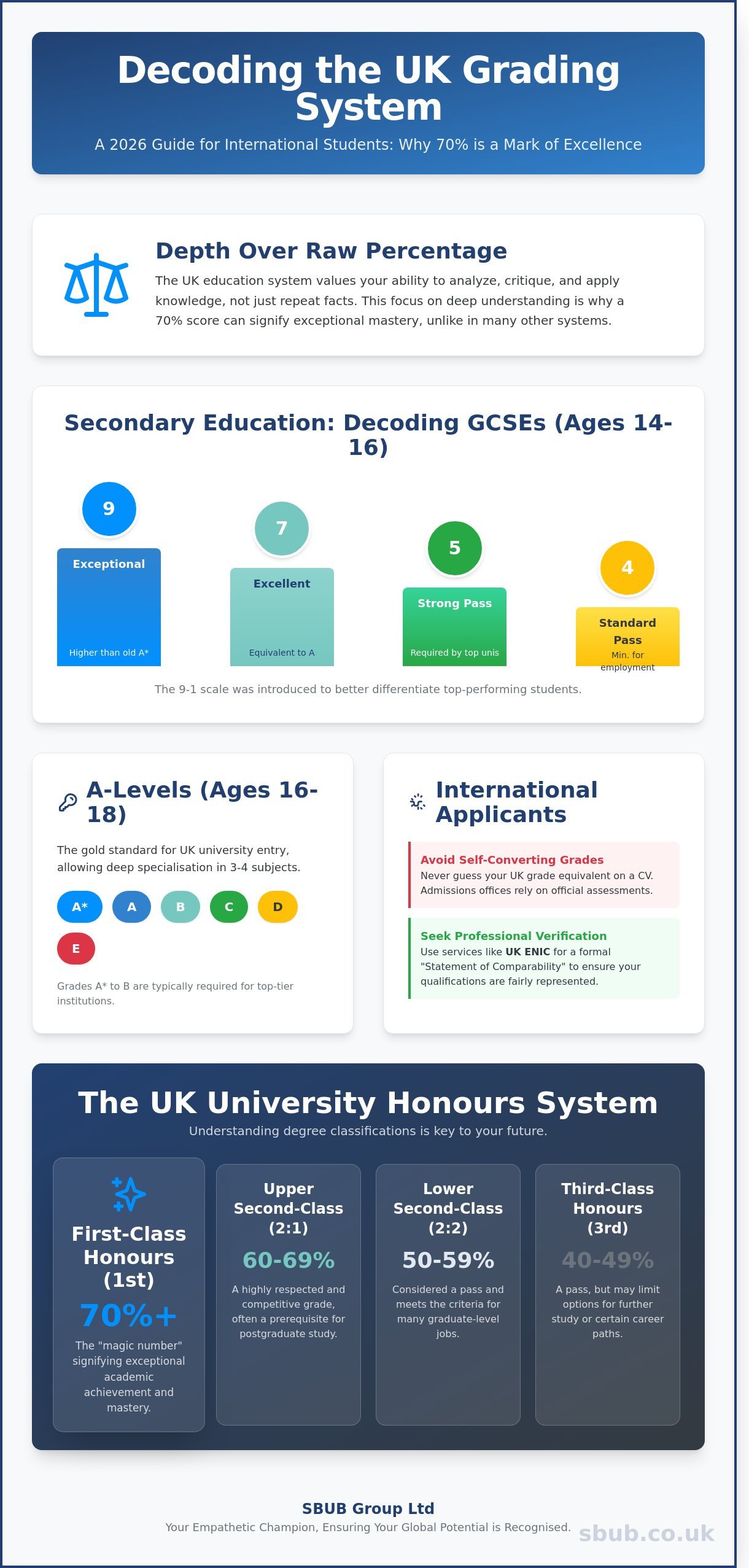
The shift from letters to numbers was designed to better differentiate between top-performing students. A Grade 9 is now higher than the old A*, representing the top 20% of those achieving a Grade 7 or above. While a Grade 4 is technically a pass, many competitive universities look for a “Strong Pass” of Grade 5 or higher to signal academic readiness. The Grade 4 Standard Pass serves as the minimum requirement for most UK employment. You can find detailed breakdowns in Ofqual’s Guide to GCSE and A-Level Grading, which remains the definitive source for 2026 standards.
A-Levels: The Gateway to Higher Education
A-Levels remain the gold standard for university entry. Most students select three subjects, which allows for deep specialization. The grading runs from A* down to E. In the UCAS Tariff Points system, these grades convert into numerical scores that universities use to set entry requirements:
- A*: 56 points
- A: 48 points
- B: 40 points
- C: 32 points
By 2026, the gap between A-Levels and the International Baccalaureate (IB) has narrowed in terms of global recognition. While the IB offers breadth, A-Levels provide the focused expertise that many competitive STEM and Law programs demand. Your predicted grades, issued by teachers in the autumn of your final year, are the primary currency for your UCAS application. They represent a promise of your future potential and are used to secure conditional offers before you even sit your final exams.
Vocational Alternatives: BTEC and T-Levels
We see a growing trend toward technical excellence in the british education grading system. T-Levels, equivalent to three A-Levels, have become a cornerstone of the 2026 landscape. They combine classroom learning with a 45-day industry placement, making them ideal for students who want to bridge the gap between theory and practice. For degrees like Nursing or Engineering, a BTEC Distinction* is often viewed with the same prestige as an A-Level A*. These pathways ensure that your specific talents aren’t overlooked by rigid academic structures. If you’re feeling overwhelmed by these requirements, join our community to hear how others have successfully navigated their applications.
The UK University Grading Scale: Honours, Classes, and Percentages
Earning a degree in the UK is about more than just passing your exams. It’s about where you stand within a tiered hierarchy that defines your professional voice and future impact. Most international students enroll in an “Honours” degree, such as a BA (Hons) or BSc (Hons). This distinction is vital. An Honours degree requires 360 credits and a final research project or dissertation. In contrast, an “Ordinary” degree is often awarded if a student completes the required modules but fails to meet the higher academic standard or credit count of the full Honours program.
Your journey through the British system grading: a complete guide for international students in 2026 involves a unique calculation method. Most universities don’t count your first year toward your final classification. Instead, they weight your second and third years. A common ratio is 33% for the second year and 67% for the final year. This structure gives you the freedom to adapt to new academic expectations before your marks carry the full weight of your future career.
First-Class to Third-Class: What They Mean
In the british education grading system, 70% is the magic number. While 70% might seem like a mid-range grade in other countries, in the UK, it represents First-Class Honours (a “1st”). This is the pinnacle of undergraduate achievement. It signals to employers that you possess exceptional analytical skills and a dedicated work ethic. According to the UK University Degree Classifications, about 30% of students achieved a First-Class degree in recent academic cycles.
- Upper Second-Class (2:1): Scoring between 60% and 69%. This is the benchmark for most top graduate jobs and competitive internships in 2026.
- Lower Second-Class (2:2): Scoring between 50% and 59%. While still a respected degree, it may limit your options with certain high-profile corporate recruiters.
- Third-Class (3rd): Scoring between 40% and 49%. This is the lowest level of an Honours degree.
Postgraduate Grading: Pass, Merit, and Distinction
When you move into postgraduate study, the british education grading system shifts its terminology. You won’t hear about 2:1s or 2:2s. Instead, you’ll strive for a Distinction (70%+), a Merit (60-69%), or a Pass. If you intend to pursue a PhD, securing a Distinction is often a prerequisite for high-level research funding and entry into elite programs. A Master’s “Pass” typically starts at 50%, while undergraduate passes start at 40%. This higher threshold reflects the advanced expertise and specialized advocacy required at the Master’s level. We see this shift as a way to ensure that those entering the professional world with advanced degrees are truly prepared to lead and influence their industries.
How International Students Can Compare and Convert British Grades
Translating your academic achievements into the british education grading system is a vital step in your journey toward a UK degree. You shouldn’t leave this to guesswork or online calculators. UK universities and the Home Office rely on official benchmarks to ensure fairness and representation for every applicant. To get an authoritative assessment, we recommend using Ecctis (formerly UK NARIC). They provide a Statement of Comparability that confirms how your home country qualifications align with the UK Framework for Higher Education Qualifications (FHEQ).
You must avoid “self-converting” your GPA on a CV or application form. If you claim a First-Class degree based on your own calculations and the university disagrees, it can lead to immediate rejection or issues with your student visa. Admissions officers are trained to spot these discrepancies. They value transparency and want to see your original results alongside official conversion data. This ensures a level playing field for students from diverse educational backgrounds.
Comparing GPA to the UK Honours System
While a 4.0 GPA scale is common globally, its relationship with the british education grading system is nuanced. As a general rule, a GPA of 3.5 or higher often aligns with a 2:1 (Upper Second-Class) honours degree. However, a 3.5 doesn’t automatically mean you have earned a First-Class degree. In 2026, UK institutions are increasingly looking at the ranking and prestige of your home university. A 3.3 GPA from a top-tier research institution in India or Malaysia may be viewed more favorably than a 3.7 from a lower-ranked school.
UCAS and International Qualifications
When you use the UCAS portal, you must enter your grades exactly as they appear on your official transcripts. Do not try to guess the UK equivalent in the application. You will need to provide original documents and, if they aren’t in English, certified translations. Accuracy here is a matter of professional integrity. If you feel the standard application doesn’t capture the full scale of your impact, UK University Admission Consultants: Navigating the 2026 Landscape can help you present your academic voice effectively to admissions committees.
Standardised Tests as Grade Supplements
For the 2026 academic cycle, universities are moving toward a more holistic data model. If your high school diploma from Saudi Arabia or India doesn’t perfectly mirror the A-Level structure, you can bolster your profile with standardised tests.
- SAT or ACT: These scores provide a universal metric that helps UK tutors compare your skills against domestic applicants.
- IELTS or PTE: High scores in these English proficiency tests (such as an IELTS 7.5) act as a signal of your academic readiness.
- Holistic Review: Tutors now look at your specific subject performance rather than just your final aggregate grade to ensure a fair assessment.
We believe every student deserves to be heard and valued regardless of where they started their journey. To ensure your application is as powerful as possible, visit sbub.co.uk and join our community of future leaders.
Navigating the UK Admissions Maze with SBUB Advocacy
Understanding the british education grading system is only your first step toward a degree. SBUB exists because we know that a set of numbers on a transcript doesn’t capture your full potential. We act as your Empathetic Champion, ensuring your voice is heard in a system that often feels impersonal and rigid. We bridge the gap between your local qualifications and the expectations of UK admissions officers. Our mission is clear: we ensure international students aren’t overlooked because of grading confusion or bureaucratic hurdles. We believe your individual voice should carry the weight of a global impact, and size shouldn’t dictate your influence in the admissions process.
We provide customized career counseling to align your specific grades with the right UK institution. It’s about finding the perfect fit for your ambitions. Professional representation matters. In complex visa and admission cases, having an advocate can be the difference between a seat in a lecture hall and a lost opportunity. We don’t just process paperwork; we tell your story. Your grades are the start of your journey, not the end of it.
Bespoke Support for Complex Applications
We specialize in the nuances that automated systems miss. If your academic record was impacted by extenuating circumstances, such as health issues or personal challenges, we help you frame that narrative effectively. Data from admission cycles suggests that a well-documented explanation of circumstances can significantly improve prospects for students who narrowly miss their offer grades. We also support those with non-traditional educational backgrounds, ensuring your unique path is recognized as an asset rather than a liability.
A professional review of your documentation prevents common pitfalls that lead to rejection. Statistics show that nearly 20% of international applications face delays or denials due to simple administrative errors or incorrect grade conversions. We mitigate these risks by providing:
- Rigorous Document Audits: Ensuring every certification meets 2026 compliance standards.
- Equivalency Mapping: Translating your local success into the language of the british education grading system.
- Advocacy Letters: Crafting professional appeals for students with unique academic profiles.
Your Journey Starts in Birmingham and Beyond
Our roots are in Birmingham, but our reach is global. We connect you with a network of partner universities that value diversity and talent. Whether you’re applying from Hyderabad or Riyadh, you benefit from our local expertise and our British heart. We understand the specific pressures of the 2026 entry cycle and the evolving standards of UK Higher Education.
We’re here to level the playing field. You don’t have to navigate this complex landscape alone. Join the conversation today and let us help you secure your seat at the table. Your future is waiting, and it’s time to make your impact felt.
Take Command of Your UK Academic Journey
Mastering the british education grading system is the first step in shifting your narrative from an applicant to a future leader. Whether you’re navigating the 9-1 GCSE numerical scale or aiming for a First-Class Honours degree with a 70% average, these metrics are the tools that build your platform. We don’t just explain the rules; we advocate for your place within them. Our Birmingham head office and network of global branches offer the expert guidance required to bridge the gap between international qualifications and UK standards.
We’ve established direct partnerships with world-class UK higher education institutions to ensure your voice is heard by admissions officers. From specialized support with visa documentation to crafting personal statements that resonate, we provide the professional advocacy you deserve. Your background is your strength. By aligning your goals with our strategic expertise, you’re not just applying; you’re shaping the future of your career. Empower your UK university journey—book a free consultation with SBUB Group today. Your ambition deserves a level playing field.
Frequently Asked Questions
Is a 70% grade good in the British education grading system?
Yes, a 70% grade is excellent and represents a First Class mark, which is the highest classification in the british education grading system. While 70% might seem average in other countries, it reflects a deep mastery of the subject and advanced critical thinking. In 2023, Higher Education Statistics Agency (HESA) data showed that 28% of students achieved this top classification. You’ve proven your ability to meet the most rigorous academic standards.
What is the equivalent of a US 4.0 GPA in the UK system?
A US 4.0 GPA typically equates to a First Class Honours degree in the UK. Admissions offices use these benchmarks to create a level playing field for international applicants. The Fulbright Commission suggests that a GPA between 3.7 and 4.0 aligns with a UK 1st. Your academic impact remains high across borders. We believe your hard work deserves clear representation during the application process.
Can I apply to a UK university if my grades are slightly below the entry requirements?
You can still apply, as many institutions offer flexibility through contextual admissions or the UCAS Clearing process. In 2023, UCAS reported that 13% of students secured places through Clearing after missing their initial targets. We advocate for a system where your potential isn’t defined by a single test score. Reach out to admissions tutors directly to share your story and demonstrate your value to their community.
What is the difference between a 2:1 and a 1st class degree?
A 1st class degree requires a score of 70% or higher, while a 2:1 (Upper Second Class) falls between 60% and 69%. Both are prestigious and respected by global employers. HESA figures for the 2022/23 academic year show that 46% of graduates earned a 2:1. This classification ensures your voice is heard in competitive job markets. It signals that you possess the professional discipline required for high level roles.
How do GCSE 9-1 grades compare to the old A*-G system?
The 9-1 system provides more differentiation at the top end, where a grade 9 exceeds the old A* boundary. A grade 4 is recognized as a standard pass, which is the equivalent of the old grade C. According to Ofqual, a grade 7 aligns directly with the bottom of the old grade A. This modern british education grading system ensures your specific achievements are visible to recruiters and universities alike.
Do UK universities accept the International Baccalaureate (IB) instead of A-Levels?
Every UK university accepts the International Baccalaureate as a valid alternative to A-Levels. In fact, 100% of the 24 Russell Group institutions provide specific IB entry requirements on their websites. We see this as a vital step toward global academic fairness. Your choice of curriculum shouldn’t limit your impact. Whether you study in London or Lisbon, your qualifications give you a seat at the table.
What happens if I fail one of my modules in a UK university?
If you fail a module, you’ll typically be offered a resit opportunity during the summer break to redeem your credits. Most UK universities allow 1 resit attempt per module, though your grade for that attempt is often capped at 40%. It’s a chance to learn and come back stronger. Don’t let a single setback silence your ambition. We’re here to help you navigate these regulatory hurdles with confidence.