
Personal Statement for UK University Examples: 2026 Application Guide
What if your international background is actually your most powerful asset in a competitive admissions environment? Finding the right personal statement for uk university examples is the first step toward showing that your unique global perspective isn’t a hurdle, but your most powerful asset. We know that approaching the 2026 UCAS cycle feels daunting, especially when you’re trying to translate your local achievements into a system that uses unfamiliar terminology. You want to ensure your voice is heard within the standard 4,000-character limit and that your application isn’t just another generic document.
This guide gives you the tools to claim your seat at the table. By studying these expert-led frameworks, you’ll gain the clarity needed to turn your international experience into a compelling narrative of impact. We provide the subject-specific analysis and clear structures required to meet the 2026 format standards. You’ll discover how to move from uncertainty to a position of strength, creating a draft that secures an offer from a top partner university and sets you on a path to global influence.
Key Takeaways
- Transform your application by moving beyond chronological lists toward high-impact narratives that effectively advocate for your place in the competitive 2026 market.
- Implement the “80/20 Rule” and “ABC Strategy” to balance academic focus with personal growth, ensuring every sentence demonstrates your direct relevance to the course.
- Explore subject-specific personal statement for uk university examples that show you how to articulate professional awareness and ethical grounding across STEM, Humanities, and Law.
- Leverage the SBUB strategy to translate international qualifications into a powerful global perspective that ensures your unique voice is heard by UK admissions committees.
- Refine your final draft using the “Read Aloud” test to ensure your tone strikes the perfect balance between professional authority and an empowering representation of your potential.
The 2026 Personal Statement: Why Examples Matter More Than Ever
Your 2026 UCAS application represents more than a list of grades. It is an act of advocacy. You are standing up for your potential in a market where competition is rising. We believe your unique background is your greatest competitive advantage. In the current admissions cycle, the focus has shifted from chronological lists to “Impact Narratives.” Admissions tutors no longer want to see a simple history of where you have been. They want to see what you have done with your time and how you intend to shape the future of your chosen field.
High-quality personal statement for uk university examples serve as essential blueprints for structure. They are not scripts to copy; they are tools to help you build a bridge between your individual experiences and your future academic goals. Understanding What is a Personal Statement? helps clarify that this document is your primary chance to speak directly to decision-makers. You are moving from being one of many applicants to being a significant individual with a clear purpose.
The UCAS 2026 Landscape: What Has Changed?
The 2026 cycle introduces a more structured approach to the application process. While the traditional free-text block is evolving into guided questions, the core mission remains the same. You must justify your place within a 4,000-character limit. Every word must earn its place. UK universities are now prioritizing your “potential for contribution” over just your past grades. They want to know how your presence will enrich their academic community and what unique perspective you bring to the table.
The AI Question: Using Tools Without Losing Your Voice
AI tools can help brainstorm ideas, but they often fail at creating “human impact.” AI-generated statements are frequently rejected because they lack the grit and nuance of real life. We define an authentic voice as the intersection of personal experience and academic curiosity. It is the part of your story that an algorithm cannot replicate. For the 2026 cycle, universities have implemented strict AI detection policies. If a statement lacks your specific, lived experience, it risks being flagged as impersonal. Your voice is your power. We encourage you to use examples to understand the rhythm of successful writing, then fill that structure with your own truth. Small details about your specific journey create the biggest impact on admissions committees.
Anatomy of a Successful Personal Statement
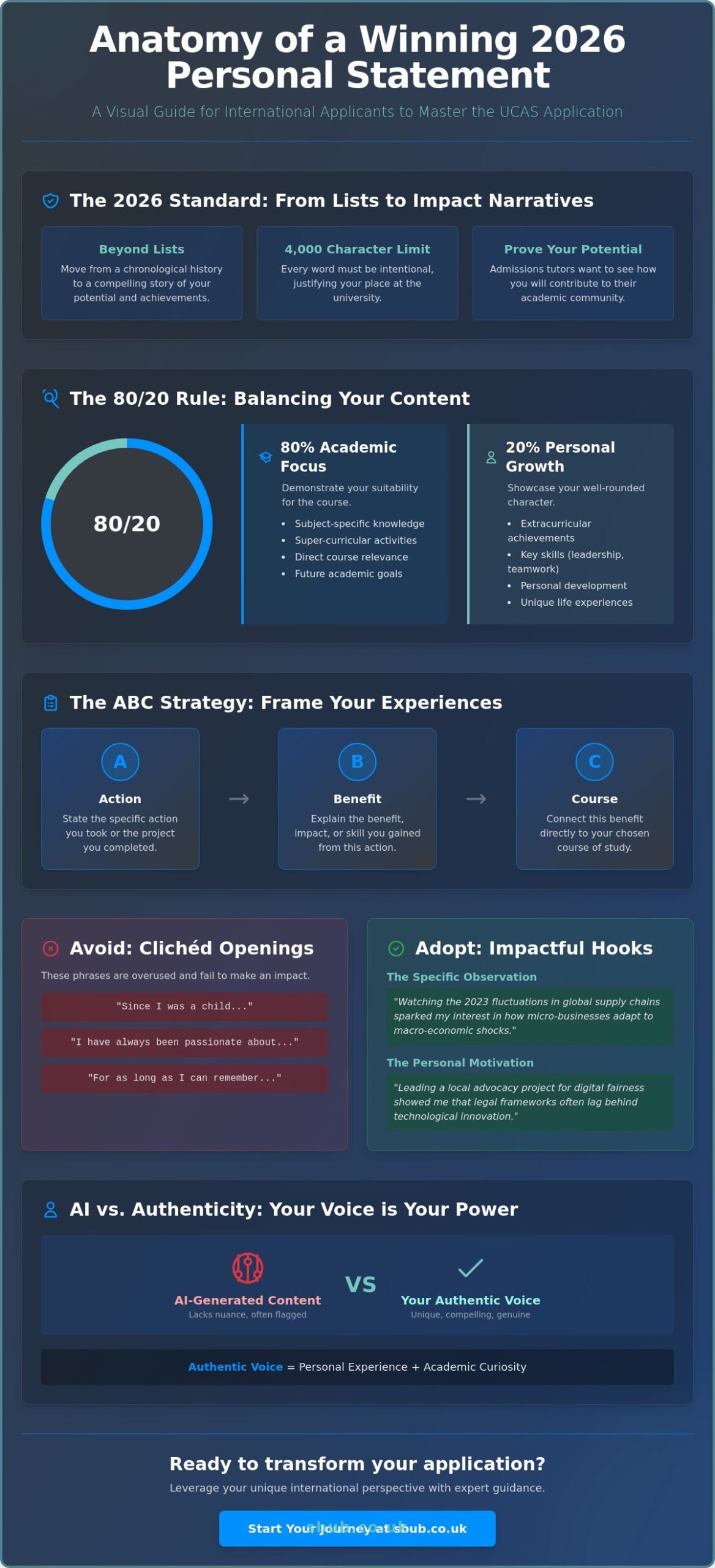
Your application is your voice in a crowded room. To make it heard, you must master a specific structure that balances academic rigor with personal character. We recommend following the 80/20 rule. This means 80% of your content focuses on your academic suitability and 20% highlights your extracurricular achievements and personal development. This ratio ensures admissions tutors see you as a dedicated scholar first and a well-rounded individual second.
When you describe your experiences, use the ABC rule to maintain focus. State the Action you took, explain the Benefit or skill you gained, and conclude with the Course relevance. This method prevents you from simply listing achievements; it forces you to analyze how those experiences prepared you for university life. You can find excellent that demonstrate exactly how this reflective writing distinguishes a top-tier candidate from the rest of the pool.
The Opening: Hooking the Admissions Tutor
The first paragraph needs to bridge the gap between your past experiences and your future goals. Avoid clichés like “Since I was a child” or “I have always been passionate about.” These phrases are overused and tell the tutor nothing about your actual suitability. Instead, use a specific observation or a personal motivation hook.
- The Specific Observation: “Watching the 2023 fluctuations in global supply chains sparked my interest in how micro-businesses adapt to macro-economic shocks.”
- The Personal Motivation: “Leading a local advocacy project for digital fairness showed me that legal frameworks often lag behind technological innovation.”
Link these openings directly to your subject. If you’re applying for Law, talk about a specific case that challenged your perspective. If it’s Engineering, mention a specific problem you tried to solve. This shows you’re already thinking like a professional in your field.
The Academic Core: Demonstrating Super-Curricular Interest
Admissions tutors look for super-curricular activities. These are academic pursuits that go beyond your school syllabus, such as reading specialized journals, listening to industry podcasts, or completing independent research projects. These activities prove you have the self-motivation required for the UK school system at the degree level.
Don’t just name-drop titles to look smart. Use the ABC method to show your engagement. For example, you might say: “Reading ‘The Lean Startup’ by Eric Ries allowed me to understand the importance of the ‘Pivot’ in business, which I then applied to my own freelance project to increase client retention by 15%.” Mentioning a specific influence should feel natural; for instance, citing a particular theory from a podcast helps ground your interest in real-world applications without sounding pretentious.
If you’re feeling overwhelmed by the drafting process, you can join our community to find more resources on navigating the 2026 application cycle. Your conclusion must reinforce your commitment to the UK academic environment and clearly state how you intend to contribute to the university community. Ending with a firm, declarative statement about your career goals leaves a lasting impression of purpose and clarity.
Subject-Specific Personal Statement Examples and Analysis
Your personal statement acts as your advocate in the admissions room. It bridges the gap between your grades and your potential impact on the campus community. Different disciplines require different weights of evidence. While a STEM applicant focuses on technical precision, a Humanities student must demonstrate a sharp critical lens. Institutions like Loughborough University look for candidates who don’t just understand theory but can apply it to solve real-world problems. They want to see that you’re ready to contribute to a level playing field in your chosen industry.
STEM Example: The Problem-Solver Approach
Success in STEM subjects relies on logical progression. When you examine a personal statement for uk university examples, look for specific technical challenges. A strong applicant doesn’t just say they enjoy physics; they describe a 4-week research project investigating fluid dynamics. Use evidence-based language to show your work. Mathematical fluency is vital here. Even if you’re applying for Biology or Computer Science, mention how you used statistical models or discrete mathematics to reach a conclusion. This shows you have the analytical tools required for a rigorous degree. Admissions tutors want to see that you’ve moved beyond the curriculum to test your skills in practical environments.
Business & Humanities: The Critical Thinker
For Business, Law, or Humanities, your voice must reflect social awareness and academic theory. You’re building a case for your place in a global dialogue. International students can gain an advantage by showing cultural capital. This involves connecting global events, such as the 2024 shift in digital trade policies, to your chosen degree. If you’re applying for Law, focus on professional ethics. Don’t just list your work experience; analyze a specific legal dilemma you observed. This demonstrates that you can think critically about the structures that govern our society. It shifts the narrative from what you’ve studied to how you’ll influence the future of your field.
Creative Arts applicants face a unique challenge. You must balance your written statement with your portfolio. Your text shouldn’t just repeat what’s in your sketches or films. Instead, use it to explain your process and your influences. Admissions tutors want to see the “why” behind the “what.” They’re looking for students who are brave enough to challenge conventions and persistent enough to refine their craft over hundreds of hours. When reviewing a personal statement for uk university examples in the arts, notice how the best ones link personal identity to creative output. This creates an immediate sense of partnership between the student and the institution.
- STEM: Focus on 80% academic theory and 20% extracurricular application.
- Business/Law: Highlight professional awareness and the impact of regulatory changes.
- Creative Arts: Use the statement to provide context for your technical portfolio.
Adapting Examples for International Students: The SBUB Strategy
Applying from overseas requires more than just translating your grades; it involves translating your impact. When you review personal statement for uk university examples, you’ll notice that the most successful international applicants bridge the gap between their local curriculum and the UK Higher Education framework. Whether you’re presenting CBSE results from India, the STPM from Malaysia, or the International Baccalaureate, you must articulate the academic rigor of these paths. Admissions officers at the 160+ UK universities value the diversity you bring, but they need to understand how your specific background prepares you for their lecture halls. Your global perspective isn’t just a footnote; it’s your competitive edge.
We believe your international status is a position of strength. If you’ve faced schooling disruptions or language barriers, don’t hide them. Use these “extenuating circumstances” to demonstrate resilience. A student who maintained a 90% average during a period of national instability shows a level of grit that a standard applicant might not. You must also be explicit about why the UK is your chosen destination for 2026. Mentioning specific UK research standards or the unique structure of the British modular system proves you’ve done your homework and aren’t just sending a generic template to multiple countries.
The Value of Global Experience
Your local community service or internships are goldmines for transferable skills. If you managed a project in your home city, you’ve already practiced cross-cultural communication and resource management. For those coming from systems that use different metrics, understanding your SAT scores helps contextualize your academic standing against a global benchmark. To prove English proficiency, don’t just point to an IELTS score. Use your narrative to show fluency by describing how you’ve debated complex topics or authored research papers in English. This demonstrates that you’re ready to contribute to seminar discussions from day one.
Navigating the Logistics
The personal statement is a dual-purpose document. While it secures your university offer, it also acts as vital evidence for student visa assistance Birmingham teams to prove you’re a “genuine student” with clear academic intent. Managing the 18:00 GMT UCAS deadlines requires precision, especially when you’re working across different time zones. We recommend requesting references at least six weeks in advance. Many international teachers aren’t familiar with the specific UCAS format, so provide them with a bulleted list of your achievements to help them draft a reference that supports your narrative perfectly.
Your voice deserves to be heard in the UK’s top lecture halls. Join our community today to ensure your international application carries the weight it deserves.
Refining Your Draft: From Example to Offer
You’ve analyzed various personal statement for uk university examples and built a solid foundation. Now, you must transition from a functional draft to a compelling narrative that demands an offer. This final stage is where your individual voice becomes your greatest asset. We recommend the Read Aloud test. When you speak your words, you’ll immediately catch clunky phrasing or sentences that run too long. Your tone should mirror that of an Empathetic Champion; you’re advocating for your place in the 2026 cohort with professional confidence and clarity.
The peer-review process requires a strategic approach. Don’t share your draft with a crowd. Too many opinions dilute your unique perspective. Instead, choose two reviewers. One should be a subject specialist who understands the academic rigour of your chosen field. The second should be someone who knows your personal journey. They’ll ensure your draft sounds like you, not a generic template. For international students, final proofreading is a non-negotiable step. UCAS systems favor British English. You must catch spelling traps like “programme” versus “program” or “centre” versus “center” before you hit submit.
Our UK university admission consultants provide the final expert polish that shifts a statement from “good” to “exceptional.” We understand that your statement isn’t just a document; it’s your voice in a room full of decision-makers.
The Editing Checklist
- Step 1: Remove the “dead wood.” UCAS limits you to 4,000 characters. Cut qualifiers like “very,” “really,” or “in order to.” Every character must earn its place.
- Step 2: Create a narrative loop. Ensure your first and last sentences connect. If you opened with a specific challenge you faced in 2024, your conclusion should reflect how that experience prepares you for the 2026 academic year.
- Step 3: Evidence every claim. Don’t just state you have leadership skills. Mention the specific 10-person project you managed or the 15% increase in efficiency you achieved during a work placement.
Partnering for Success
At SBUB, we act as your advocate during the most critical moments of the application cycle. This advocacy is vital during the “near miss” or Clearing stages in August 2026. If your results don’t quite match your offer, a powerful personal statement gives us the leverage to negotiate with admissions tutors on your behalf. In high-demand courses where 12 applicants compete for every single spot, your written voice often becomes the deciding factor for placement commissions.
Don’t leave your future to chance. Your story deserves to be heard by the right people at the right time. Submit your draft for a professional review by our Birmingham-based team today. We’ll help you refine your personal statement for uk university examples into a bespoke document that reflects your true potential and secures your seat at the table.
Secure Your Place in the 2026 Academic Intake
Navigating the 2026 admissions cycle requires more than just a list of achievements; it demands a narrative that resonates with UK admissions tutors. You’ve explored how personal statement for uk university examples can serve as a blueprint for your own success, helping you bridge the gap between your current qualifications and your future academic goals. By applying the SBUB strategy, you ensure your international perspective becomes a competitive advantage rather than a barrier. The right structure helps you articulate your voice with the clarity and impact needed to stand out in a crowded field of applicants.
You don’t have to navigate this journey alone. We provide direct support from our Birmingham-based head office to ensure your application is polished and persuasive. As official partners with 100+ UK universities, we understand exactly what faculty boards are looking for in a candidate. Our team maintains a 98% student visa success rate, proving that we know how to turn potential into placement. Let’s work together to make your academic ambitions a reality.
Get a Professional Review of Your Personal Statement from SBUB Experts
Your unique story deserves to be heard by the right people. Take the next step today and start shaping the future you’ve envisioned at a world-class institution.
Frequently Asked Questions
How long should a UCAS personal statement be for 2026?
Your UCAS personal statement for 2026 must not exceed 4,000 characters or 47 lines of text. This limit includes every space and blank line, so you need to make every word count toward your goal. UCAS confirmed these technical constraints remain the standard for the 2026 application cycle. We recommend drafting your content in a plain text editor to ensure your formatting doesn’t push you over the limit. Focus on your impact rather than just listing activities.
Can I use the same personal statement for all five UCAS choices?
You must use the same personal statement for all five of your UCAS choices. Admissions tutors from different universities won’t see where else you’ve applied; therefore, your narrative needs to be broad enough to cover your chosen subject area across various institutions. While you’re applying to different places, your core passion for the subject remains the same. When looking at personal statement for uk university examples, you’ll see how successful applicants balance specific interests with a general appeal to their chosen field.
How do I mention my international qualifications in the statement?
You should focus on the skills gained from international qualifications rather than listing specific grades, which belong in the dedicated UCAS education section. If you hold the International Baccalaureate or a national diploma from your home country, highlight how these curricula prepared you for the rigours of UK higher education. According to UCAS, over 140,000 international students apply annually. Mentioning your unique academic background helps you stand out as a global candidate. This perspective brings a big impact to small seminar discussions.
Is it okay to use quotes from famous people in my opening?
You should avoid using quotes from famous people in your opening paragraph. Admissions tutors want to hear your voice, not the words of a historical figure who isn’t applying for the course. Data from university admissions surveys suggests that 5% of applicants use the same handful of overused quotes, which can make your application feel unoriginal. Start with a direct observation about your subject instead. Your personal insight is what creates a level playing field for your application.
What should I do if I have a gap year or extenuating circumstances?
You should use your statement to explain how a gap year has enhanced your readiness for university or briefly mention circumstances that affected your grades. If you took a year out in 2024 or 2025, describe the professional skills or maturity you gained during that time. For health or personal issues, ask your referee to include those details in their section to save your character count. This ensures your voice remains focused on your academic potential and future impact.
How does SBUB help with the personal statement process?
SBUB provides you with the tools to amplify your voice through expert-led workshops and comprehensive personal statement for uk university examples. We believe that every applicant, regardless of their background, deserves a seat at the table. Our resources bridge the gap between individual potential and university requirements. By providing structured guidance, we help you turn your small business experience or local volunteering into a powerful narrative of leadership and academic commitment.
Do UK universities check for AI-written personal statements?
UK universities and UCAS use sophisticated software like Copycatch to identify AI-generated content and plagiarism. In the 2024 cycle, UCAS updated their systems to flag patterns typical of large language models. If your statement is flagged, it can lead to your application being cancelled or delayed. We encourage you to write authentically. Your unique perspective is your biggest asset; AI cannot replicate the genuine human experience you bring to your chosen field.
Can I mention specific universities by name in my statement?
You should never mention a specific university by name in your personal statement. Since all five of your choices receive the same document, naming one institution will likely alienate the other four. This is a common mistake that can lead to an immediate rejection from the institutions you didn’t name. Focus on the subject itself rather than the location. This approach ensures you maintain a professional and diplomatic tone across your entire application.