
Recommended SAT Score 2026: A Strategic Guide for International Students
What if the most powerful tool in your application isn’t your GPA, but a single number that levels the global playing field? While many universities maintain test-optional policies into 2026, a strong recommended sat score often acts as a vital translator for international students. You aren’t just a number, but numbers still carry weight. You understand that competing with 2.1 million global test-takers requires more than just good grades; it requires a way to make your individual story feel significant to admissions officers. We’re here to bridge the gap between your local success and your global ambitions, ensuring your small, independent voice has a big impact in a crowded market.
It’s natural to feel a sense of urgency when the rules of the game change. You want clarity on whether to submit your results or keep them private to protect your application impact. We’ve analyzed the data from the 2024 admissions cycle to show you exactly how to position your 2026 application for maximum fairness. You’ll discover specific score ranges for top-tier institutions and a clear strategy for when your results serve your advocacy. Let’s move from uncertainty to confidence as you claim your seat at the table.
Key Takeaways
- Identify the specific recommended sat score for your 2026 applications and why 1350+ has become the new global benchmark for competitiveness.
- Understand how the Digital SAT’s adaptive modules dictate your scoring ceiling and what 99th-percentile performance means for your academic representation.
- Navigate the evolving test-optional landscape and learn why elite institutions like Yale and Dartmouth are returning to mandatory testing requirements.
- Master the “25th Percentile Rule” to strategically decide when submitting your score will maximize your impact on global admissions officers.
- Discover how bespoke consultancy support in Birmingham, Hyderabad, and Subang Jaya bridges the gap between your results and a successful university placement.
Determining Your Recommended SAT Score: The 2026 Benchmark
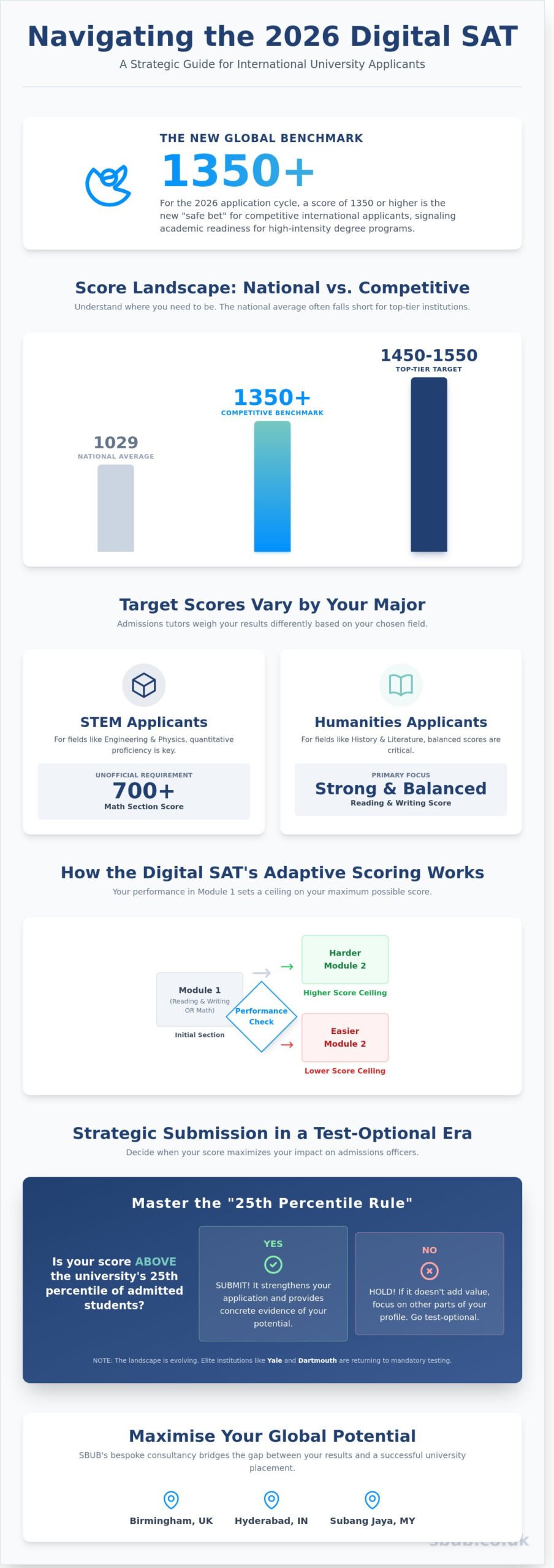
Your application is your voice in a crowded global room. When we discuss a recommended sat score, we’re defining a benchmark that meets or exceeds the 50th percentile of the previous year’s admitted class at your target UK university. For the 2026 cycle, a score of 1350 or higher has emerged as the “safe bet” for competitive international applicants. This number isn’t arbitrary; it signals to admissions committees that you possess the academic stamina required for high-intensity degree programs. Understanding the SAT structure and scoring is the first step in ensuring your voice is heard clearly by those who shape university cohorts.
We view your score as more than a metric. It’s a representation of your academic readiness. It bridges the gap between different global grading systems, providing a level playing field for students from every corner of the world. By hitting the recommended sat score for your specific institution, you’re not just ticking a box. You’re demanding a seat at the table by proving you can handle the rigors of a UK undergraduate curriculum.
The 2026 National vs. Competitive Average
The data from October 2025 is clear. The national average sits at 1029. While this represents a solid baseline for many, it often falls short for those aiming for the UK’s most prestigious institutions. If you’re applying from competitive hubs like Hyderabad or Subang Jaya, you’re part of a talent pool that consistently delivers high marks. You’ll likely need to exceed the 1029 average to truly stand out among your peers. A good score is one that aligns with the 75th percentile of your most ambitious target school.
Why “Recommended” Varies by Field of Study
Your choice of degree dictates how admissions tutors weigh your results. STEM candidates face a different reality than those in the humanities. If you’re pursuing Engineering or Physics, a Math section score of 700 or higher is often the unofficial requirement. For history or literature, your Evidence-Based Reading and Writing score carries more weight. This distinction ensures a sense of fairness where your specific strengths match your chosen path. Before you commit to a testing path, you should evaluate SAT vs ACT: Key Differences and How to Choose in 2026 to see which format best highlights your academic impact.
- STEM Applicants: Prioritize a 700+ Math score to demonstrate quantitative proficiency.
- Humanities Applicants: Aim for a balanced score with a strong showing in Reading and Writing.
- Top-Tier Universities: Often look for scores in the 1450-1550 range regardless of the subject.
Don’t view these numbers as barriers. View them as tools for advocacy. When you submit a strong score, you’re providing concrete evidence of your potential. It’s a way to make your individual profile feel significant and heard in a sea of thousands of digital applications.
The 2026 SAT Scoring Landscape: Percentiles and Adaptive Testing
The 2026 testing environment represents a total shift from the traditional paper-and-pencil era. For international students aiming for UK higher education, the Digital SAT is now the universal standard. We believe every student deserves a clear view of how these scores are calculated so you can advocate for your own academic future. Understanding the mechanics behind the numbers is the first step toward a successful application.
Digital SAT: The Adaptive Scoring Mechanism
The Digital SAT uses a multistage adaptive design that changes based on your input. Your performance on the first module of each section directly dictates the difficulty of the second module. If you don’t perform well in Module 1, the system provides a “lower-weight” second module. This effectively places a ceiling on your maximum possible score. It’s a system that rewards consistency from the very first question. You should consult the SAT Test Dates 2026 to plan your preparation cycles around this module-based format.
SAT Percentile Breakdown for 2026
Percentiles show how you compare to the global pool of test-takers. In 2026, a 1500+ score places you in the 99th percentile, which is the gold standard for elite institutions. A 1400+ score typically lands you in the 95th percentile. This is often the recommended sat score for competitive Russell Group universities that use standardized tests to filter high volumes of international applications.
- 1500+: Top 1% (Essential for ultra-competitive courses)
- 1400+: Top 5% (Target for most Russell Group universities)
- 1200+: Top 25% (A solid baseline for many regional UK institutions)
While the 50th percentile sits around 1050, this level is rarely the recommended sat score for international students seeking placement in top-tier programs. If you find the SAT’s adaptive format doesn’t reflect your true potential, you might explore What is a Good ACT Score in 2026? to see if a linear test better suits your testing style.
We strongly suggest a “super-scoring” strategy for 2026. This involves taking the test at least twice to capitalize on your best performance in individual sections. Many UK admissions offices allow you to combine your highest Math and Evidence-Based Reading and Writing scores from different dates. This approach reduces the impact of a single bad day and lets you build a profile that truly represents your capabilities. We invite you to join the conversation regarding fair access to these testing resources to ensure your voice remains central to your educational journey.
Target Scores for Elite, Mid-Tier, and International Institutions
Your test score represents more than just academic ability; it is your voice in a competitive global arena. We believe every student deserves a seat at the table, and understanding the recommended sat score for your specific goals is the first step toward claiming that seat. For the 2026 admission cycle, the landscape is shifting back toward standardized testing as a vital metric for fairness and comparison across different school systems.
If you are aiming for Ivy League or “M7” institutions, a score of 1520 or higher is now the baseline. This elite bracket uses high scores to filter thousands of qualified applicants. You should view your score as a gateway. For elite schools, the SAT is a threshold rather than a guarantee of admission. Once you clear that bar, your personal story and impact become the deciding factors in the room.
Mid-tier US public universities often offer the best return on investment through merit-based scholarships. In the 1250 to 1380 range, you often move from being a standard applicant to a priority candidate. We recommend a “Safety School” strategy where your score places you in the top 10% of the previous year’s admitted class. This positioning gives you maximum leverage for financial aid and honors program placements, ensuring your voice carries more weight during the selection process.
Recommended Scores for Top 20 US Universities
For the 2026 cycle, MIT, Harvard, and Stanford maintain incredibly high standards. MIT typically sees middle-50% scores between 1520 and 1580; meanwhile, Harvard and Stanford applicants usually fall within the 1500 to 1570 range. If your score sits slightly below these figures, the “holistic review” process becomes your advocate. Admissions officers look at your leadership, community service, and unique background to see if you fit their mission, even if your math score is ten points below their median.
SAT Scores in the UK Admissions Process
UK universities view US standardized tests through a different lens, often treating them as equivalents to A-Levels or IB points. Institutions like the University of Chester or Loughborough University use these scores to verify academic readiness for specific degree courses. While the UK system prioritizes subject-specific knowledge, a strong SAT score helps satisfy general entry requirements and proves you can handle rigorous academic pressure.
Many UK universities convert SAT results into UCAS tariff points to streamline the evaluation of international qualifications. A score of 1290 or higher is often the recommended sat score for competitive Russell Group courses. To ensure your application reflects your full potential, you can work with UK University Admission Consultants who specialize in navigating these transatlantic requirements. They help you translate your US achievements into a language that British admissions officers value, making your transition as seamless as possible.
Strategic Application: When to Submit Your Score in a Test-Optional Era
We are entering a new phase of academic advocacy where the “test-optional” label requires a more nuanced strategy. For the 2026-2027 cycle, the landscape is shifting back toward measurable benchmarks. Yale University and Dartmouth College led this movement in February 2024, reinstating mandatory testing after concluding that scores help identify high-potential students from diverse backgrounds. For you, this means a recommended sat score isn’t just a number; it’s a tool for representation. It levels the playing field when your local grading system might not be familiar to a UK or US admissions officer.
The Return to Standardised Testing
Top-tier institutions are reinstating requirements because they’ve found that high school GPAs alone don’t always predict university success. When you apply from an international pool, your score acts as a universal translator. It proves your academic readiness in a language every admissions committee understands. Even at schools that remain test-optional, having a strong score provides a competitive edge. It fills the gaps if your school didn’t offer specific AP or IB courses. We believe that your voice is amplified when you back your passion with objective data. The SAT remains relevant because it offers a standardised platform for fairness. Pairing your SAT preparation with dedicated IELTS and PTE training ensures that every component of your UK application meets the language proficiency standards that admissions officers require.
Score Submission Decision Framework
Deciding whether to submit requires a look at the data. Most universities publish a Common Data Set that lists the middle 50% range of SAT scores for their latest freshman class. If your score sits at or above the 25th percentile, you should generally submit it. Withholding a score that falls within the school’s typical range can sometimes signal a lower result than you actually achieved. However, if your score is significantly below that 25th percentile, “hiding” it is the professional move to keep the focus on your personal narrative and portfolio. SBUB’s career counselling helps you build a balanced profile that highlights your individual impact regardless of a single test result.
- Compensating for GPA: A high score can offset a 10% dip in your expected grades by proving your foundational skills are sharp.
- Limited Extracurriculars: If your local environment offered few clubs or leadership roles, a recommended sat score demonstrates your potential to handle rigorous work.
- Advocacy: Use your score to demand a seat at the table. It shows you’ve met a global standard of excellence.
Your application is a statement of your intent and your capability. By strategically choosing when to lead with your SAT results, you take control of your narrative. You transition from being one of many applicants to being a candidate with a verified academic impact. We are here to ensure your voice is heard in the corridors of higher education.
Maximising Your Global Potential with SBUB Consultancy
Achieving a recommended sat score is a significant milestone, but your potential isn’t defined by a single number. At SBUB Group Ltd, we believe every student deserves a seat at the table, regardless of where they start. We act as your bridge, turning raw test results into a compelling case for admission. With physical offices in Birmingham, Hyderabad, and Subang Jaya, we combine local expertise with a global reach. We ensure that your individual voice is heard by admissions officers in the UK and beyond. Our team works to level the playing field, making sure that students from every background have the advocacy they need to succeed. Your journey is personal, and our support is bespoke, focusing on the human element of your application.
Empowering International Student Journeys
We don’t just process applications; we craft narratives. Your academic journey is unique, and our role is to translate your scores into an impactful story of potential. SBUB Group Ltd maintains strong partnerships with universities, securing placements and recruitment commissions that benefit our students directly. This relationship allows us to advocate for you with authority. We handle the heavy lifting of complex documentation and visa requirements. Navigating Home Office regulations in 2025 requires precision and expert knowledge. We provide premium support to ensure your documentation is flawless, removing the barriers that often silence international voices. This advocacy ensures that even if you feel like a small voice in a massive system, your impact remains significant and visible.
Take the Next Step Toward Your Global Impact
Your ambition shouldn’t be limited by geography or complex regulations. Whether you’re aiming for a top-tier UK institution or exploring global options, we provide the platform for your success. We help with everything from personal statements to finding safe, reliable accommodation, ensuring a seamless transition to university life. We understand that moving countries is a big step, so we act as your local peer and expert guide. Our goal is to make the transition as smooth as possible, allowing you to focus on your studies rather than paperwork. A complete application strategy also means addressing your English proficiency requirements early; our guidance on IELTS and PTE training in 2026 will help you align your language scores with your chosen university tier and visa requirements.
Join the conversation today and take control of your academic future. You can book a consultation with our Birmingham team or visit our international branches to start your journey. For a deeper look at what the future holds, read our guide on SAT Scores in 2026: A Global Student’s Guide. Don’t let a recommended sat score be the end of your story; let it be the beginning of your global impact. We’re here to ensure your voice is heard in the corridors of academic power, helping you shape a future that reflects your true potential and drive.
Take Command of Your International Future
Navigating the 2026 admissions cycle demands a clear vision of your personal impact. Success isn’t just about a number; it’s about how that number amplifies your voice in a competitive global market. We’ve seen that a 1500+ score positions you in the top 1% of test-takers, while mid-tier institutions often look for a balance around the 1250 mark. Your recommended sat score acts as a bridge between your local achievements and international aspirations. Whether you’re targeting elite universities or specialized programs, your data must tell a story of readiness and resilience.
We understand the weight of these decisions. Our expert consultants in Birmingham, Hyderabad, and Malaysia provide the specialized support needed for both undergraduate and postgraduate admissions. We leverage a global network of partner institutions to ensure your application isn’t just seen, but heard. You don’t have to navigate these complex academic shifts alone. We’re here to help you turn individual effort into systemic opportunity.
Start your global journey with expert SAT and admission guidance from SBUB Group today.
You have the talent to shape the future. Let’s make sure the world sees it.
Frequently Asked Questions
What is considered a “good” SAT score for Ivy League schools in 2026?
A score between 1520 and 1580 is generally considered a competitive result for Ivy League admissions in 2026. While universities like Yale and Brown have reinstated testing requirements for the 2025-2026 cycle, your score remains a vital tool to demonstrate academic readiness. We believe every student deserves a seat at the table, and reaching the 99th percentile ensures your voice is heard in these selective corridors.
Do UK universities require an SAT score for international applicants?
UK universities don’t require the SAT for all international students, but they often mandate it for those following a US high school curriculum. For 2026 entry, top-tier institutions like Oxford or Cambridge typically expect a recommended sat score of 1470 or higher to supplement your AP exams. We advocate for clear pathways to global education, ensuring your international application carries the impact it deserves.
Is a 1200 SAT score good enough for scholarship opportunities in 2026?
A 1200 SAT score qualifies you for merit-based scholarships at many mid-tier public universities and smaller private colleges. Data from the College Board shows this score is higher than 74% of test-takers, giving you leverage in financial aid negotiations. It’s a solid foundation that allows you to shape your future without the burden of excessive debt, proving that small steps lead to big impact.
How does the Digital SAT adaptive format change the recommended score targets?
The Digital SAT adaptive format doesn’t change the numerical value of your target, as the 1600-point scale remains consistent with previous years. However, the 2024 shift to a shorter, more focused exam means you must maintain high accuracy on fewer questions to reach your recommended sat score. We view this digital evolution as an opportunity for students to showcase their agility in a modern, tech-driven academic market.
Should I submit my SAT score if it is below the school’s average but above the national average?
You should submit your score if it strengthens your overall narrative or if the school is test-optional and your score is above their 25th percentile. If a university’s average is 1400 and you have a 1320, your 1320 still places you well above the 2023 national average of 1028. We encourage you to join the conversation with admissions officers to ensure your unique background and potential are fully recognized.
Can a high SAT score help with my UK student visa application?
A high SAT score doesn’t directly influence the UK Home Office’s decision on your Student Visa application. Visa eligibility depends on your Confirmation of Acceptance for Studies (CAS) and meeting financial requirements set by UK Visas and Immigration. However, your score is the key that opens the door to the university offer itself. We’re here to help you navigate these regulatory hurdles with confidence and clarity.
What is the 75th percentile and why does it matter for my target score?
The 75th percentile represents the score that 75% of admitted students scored at or below, marking the top quarter of the class. Reaching this level, such as a 1560 at MIT, significantly increases your chances of admission compared to the median. It’s about securing a position of influence within the applicant pool. We believe in aiming high to ensure your academic voice carries the maximum possible weight.
How many times is it recommended to take the SAT before applying in 2026?
We recommend taking the SAT two or three times to maximize your results through superscoring. Statistics indicate that 55% of students improve their scores on the second attempt by familiarizing themselves with the digital interface. Taking the test more than three times often yields diminishing returns. It’s a strategic process of identifying a challenge, gathering your resources, and demanding the best possible outcome for your future.