
What is a Good ACT Score in 2026? A Guide for Global Students
What if a shorter test actually demands a higher level of precision to maintain your competitive edge? With the major ACT overhaul arriving in September 2025, many global students feel the weight of a shifting environment where the Science section is now optional and the core battery is reduced to just 125 minutes. You likely realize that the old benchmarks are evolving, and you need to know exactly what is a good act score to ensure your individual voice isn’t lost among thousands of applicants. We believe that your personal effort should have a massive impact regardless of the test’s length, and we’re here to help you advocate for your future with confidence.
You deserve a seat at the table at the world’s most prestigious universities, whether they’re in London or Boston. This guide provides the data you need to set a target score, such as the 34 or higher often required by the top 5% of global institutions, while explaining how the 2026 scoring structure affects your strategy. We’ll break down the specific expectations for the upcoming admissions cycle and show you how to turn these new testing standards into a platform for your long-term success.
Key Takeaways
- Define your target by aligning your performance with specific university benchmarks and your unique career path.
- Discover how percentile data shifts the narrative on what is a good act score, placing you in the top 25% of global candidates with a 23 or higher.
- Contrast the holistic US admissions process with the UK’s requirement-driven approach to ensure your score meets international standards.
- Prepare for the 2026 format transition, featuring a shorter 125-minute test designed to give you more time per question for a fair evaluation.
- Join the conversation on academic advocacy and learn how to leverage our expert strategy to turn your test results into a powerful tool for university admission.
What is a Good ACT Score in 2026? The Modern Benchmark
You aren’t just a data point on an admissions spreadsheet. The ACT acts as a vital tool for academic readiness, but we see it as a platform for your personal advocacy. It’s your chance to demonstrate to UK universities that your potential is as vast as your ambition. Understanding what is a good act score starts with recognizing that 2026 brings a new era for testing, where your voice matters more than your ability to memorize formulas.
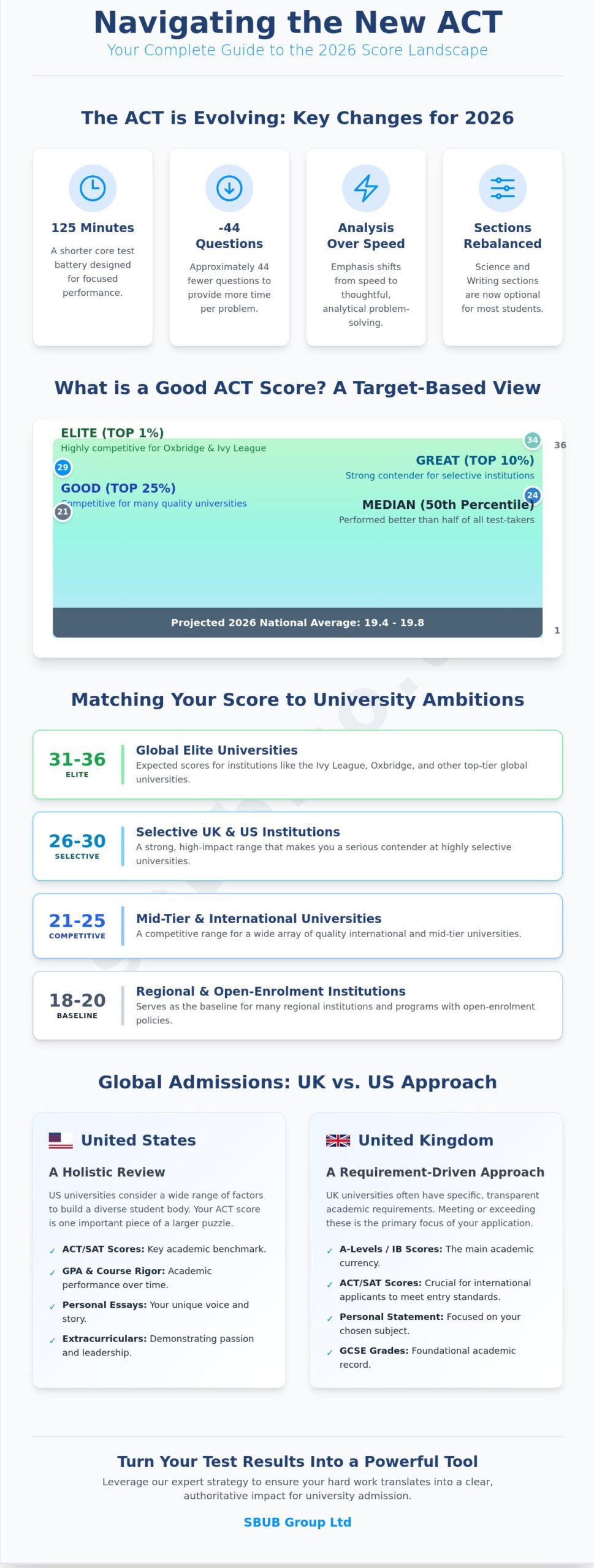
The 2026 testing cycle introduces significant shifts in how we measure merit. National averages for 2026 are projected to land between 19.4 and 19.8, reflecting a stabilizing trend in global education standards. You’ll face a shorter test format this year. The 2026 update removes approximately 44 questions, providing you with more time to focus on each answer. This change moves the goalposts from pure speed to thoughtful analysis, ensuring a fairer representation of your skills.
The 1-36 Scale: How the Composite Score Works
Your composite score is the simple average of three mandatory sections: English, Mathematics, and Reading. While the history and format of the ACT once required Science for everyone, the 2026 standards make both Science and Writing optional for most students. We believe your score represents your current potential rather than your ultimate limits. It’s a tool for representation, allowing you to speak the same academic language as students from every corner of the globe. This 1-36 scale provides a level playing field where your hard work translates into a clear, authoritative impact.
Why “Good” is Subjective: Target-Based Scoring
Defining what is a good act score depends entirely on your destination. A “good” score is a relative benchmark tied directly to your specific university goals. In 2026, the following brackets define the competitive landscape:
- Good (Top 25%): A score of 24 or higher.
- Great (Top 10%): A score of 29 or higher.
- Elite (Top 1%): A score of 34 or higher.
We encourage you to build a personal target score based on your dream university list. This test isn’t a barrier; it’s a level playing field that gives you a seat at the table in the global education market. When you determine your target, you’re taking the first step toward shaping your future impact and ensuring your voice is heard by top-tier institutions.
National Averages and Percentiles: Understanding the Data
Your ACT result is more than a summary of a single Saturday morning; it’s a metric of your potential impact in a global academic market. To grasp what is a good act score, you must look beyond the composite number and analyze how you rank against your peers. A score of 21 aligns with the 50th percentile, meaning you performed better than half of all test-takers. However, a jump to 24 elevates you to the 74th percentile, while a 30 places you in the elite top 5% of students worldwide.
The 2024 ACT College Readiness Benchmarks provide a clear roadmap for your first-year university success. These benchmarks, such as a 22 in Mathematics or a 23 in Science, indicate a 75% probability of earning a grade of C or higher in credit-bearing college courses. We see these benchmarks as vital indicators that help you claim your seat at the table in competitive higher education. You can find more detailed breakdowns in the official ACT score data to see where your specific strengths lie.
Percentiles allow universities to compare students from different educational backgrounds fairly. By using these rankings, admissions officers create a level playing field, ensuring that a student’s voice is heard regardless of their local grading system. It’s about collective fairness in a digital and globalized application process.
ACT Score Ranges: From Average to Exceptional
- 18-20: This range serves as the baseline for many regional and open-enrolment institutions across the globe.
- 21-25: These scores represent a competitive range for mid-tier and many international universities looking for consistent performers.
- 26-30: This is a strong, high-impact range that makes you a serious contender for selective UK and US institutions.
- 31-36: These scores are highly competitive and are typically expected by global elite universities like Oxbridge or the Ivy League.
The Role of Percentiles in Admissions
Admissions officers use national ranks to filter massive application pools efficiently. When you ask what is a good act score, remember that a 28 in 2026 might carry more weight than a 28 five years ago if the global average shifts. This dynamic nature of testing ensures that your application is judged against current standards rather than outdated metrics. A percentile is a measure of your standing relative to the global testing population.
If you’re ready to take the next step in shaping your future, you can join our community to gain more insights into navigating complex application systems. We believe in empowering every student to turn their individual effort into collective success.
Global Admissions: ACT Scores for UK vs. US Universities
We often hear that the ACT is a purely American endeavor. This is a misconception that limits your potential. While US admissions officers use a holistic lens to view your application, UK universities treat the ACT as a concrete entry requirement. In the UK, your score acts as a direct substitute for A-Levels, providing a standardized metric that levels the playing field for international applicants. You aren’t just a number; you’re using a globally recognized tool to prove your academic readiness and secure your seat at the table.
The US approach looks at your score alongside essays and extracurricular activities. In contrast, the UK system is more transactional. If you meet the threshold, you’re in the conversation. This clarity is empowering. It allows you to focus on achieving the specific results needed for your chosen path. When asking what is a good act score for international applications, the answer depends entirely on which side of the Atlantic you’re targeting. For the UK, a high score isn’t just a bonus; it’s your primary credential.
ACT Requirements for the UK Russell Group
Top-tier institutions like the University of Manchester and the University of Birmingham typically require a composite score between 28 and 32. These schools view the ACT as a rigorous alternative to the British curriculum. When you submit your UCAS application, your ACT results sit right next to your personal statement. This dual focus ensures your voice and your academic stats carry equal weight. For more details on this process, see our UK University Admissions: A Complete Guide for 2026. In 2024, approximately 15% of international applicants to the Russell Group used US standardized tests to secure their spots.
The Ivy League and US Elite Standard
For the Ivy League, the stakes are different. At schools like Harvard or Stanford, a 33 is often the floor rather than the ceiling. In these high-stakes environments, what is a good act score usually means sitting in the 98th percentile. US schools frequently offer “superscoring,” where they combine your best section scores from different test dates. This policy favors your growth over time. A high ACT can also offset a GPA that might be slightly lower than the 4.0 average. In 2023, Yale reported that 90% of their admitted class scored above a 31, proving that while the review is holistic, the numbers still drive the narrative.
The 2026 Format Changes: Navigating the New ACT
Starting in April 2026 for national testing, the ACT is undergoing its most significant evolution in decades. We understand that change can feel daunting for students aiming for top-tier UK universities. However, this shift aims to create a level playing field by reducing the “speededness” of the exam. You’ll move from a 175-minute marathon to a streamlined 125-minute format. By reducing the total question count from 215 to 175, the ACT provides you with more space to think. This extra time per question ensures your academic potential is measured by your depth of understanding rather than just your ability to beat the clock.
This transition represents a victory for representation and fairness. It acknowledges that a high-pressure environment doesn’t always reflect a student’s true voice or capability. When you’re determining what is a good act score in this new landscape, you must consider how the increased time per question might raise the average performance across the board. Your individual impact on the page will now depend on precision and critical thinking rather than frantic bubbling.
To Science or Not to Science?
The Science section will become optional in 2026; this is a pivot that puts the power of choice back in your hands. If you’re applying for Medicine, Engineering, or STEM-heavy programmes at Russell Group universities, taking the Science section remains vital. It directly contributes to your STEM score profile, which is a composite of your Math and Science results. Conversely, students focusing on Humanities or Social Sciences can now opt out. This allows you to channel your energy into the ELA score, which aggregates English, Reading, and Writing results to highlight your linguistic impact.
Preparing for the Shorter, Faster ACT
A shorter test doesn’t mean you can lower your guard. Stamina is still a core requirement. The shift in the Reading and English sections means you’ll have approximately 20% more time per passage for deeper analysis. You’ll need to move beyond surface-level scanning to find the nuanced evidence required by modern examiners. Despite the reduced question count and duration, the 2026 ACT will maintain the traditional 1-36 scale to ensure consistency for global admissions officers. We believe these changes empower you to present a more authentic version of your academic self. Your preparation should focus on this new rhythm to ensure your score reflects your true value.
Setting Your Strategy: Achieving Your Target with SBUB
Defining what is a good act score is not about chasing an arbitrary perfect 36; it’s about matching your performance to your specific ambition. If your goal is a 2024 entry at a top-tier institution like University College London, you’ll likely need a composite score of 33. For many other competitive UK programmes, a score of 28 provides a solid foundation for a successful application. We believe your academic potential shouldn’t be overlooked due to a lack of guidance. SBUB Group Ltd acts as your advocate, ensuring the small details of your application create a big impact on admissions officers.
Your score is more than a metric. It’s a statement of your readiness to contribute to a global academic community. To reach your target, you need a clear, actionable roadmap:
- Research: Confirm the specific score thresholds for 5 target UK universities to understand what is a good act score for your unique path.
- Practice: Complete at least 4 mock exams under the strict 2 hour and 55 minute time limit to build necessary stamina.
- Analyse: Use our data-driven feedback to identify the 3 specific sub-sections where you can gain the most points.
- Enrol: Join our structured coaching sessions to refine your strategy and bridge the gap between your current results and your target.
How SBUB Group Ltd Supports Your Global Journey
Choosing the right assessment is your first strategic decision. Our bespoke consultancy helps you determine if the ACT’s fast pace or the SAT’s focus on evidence-based reading aligns with your natural strengths. You can explore this further by reading our comparison guide, SAT vs. ACT: Which Test Should You Take?. We specialise in bridging the gap between your local results and world-class opportunities, ensuring that your voice is heard by international regulators and admissions boards alike. For international students planning their testing timeline, our comprehensive guide to SAT test dates 2026 provides essential scheduling information to coordinate both ACT and SAT preparation strategies effectively.
Take the Next Step Toward Your Future
Early preparation is the most effective way to eliminate the application anxiety that affects 45% of international students. Whether you join us in Birmingham or through our digital platforms, we provide the tools to make your transition seamless. Our integrated approach combines ACT coaching with IELTS and PTE training, ensuring your visa-ready profile is complete months before the January UCAS deadlines. This holistic strategy levels the playing field for every student. Join the conversation today and let us help you have your say in your educational future.
Shaping Your Global Academic Impact
The 2026 ACT transition marks a significant shift in how international admissions officers evaluate your potential. You’ve seen that a score of 31 or higher typically places you in the top 5 percent of test-takers globally, though UK universities often prioritize specific subject mastery within the new modular format. Understanding what is a good act score isn’t about chasing a single number; it’s about aligning your performance with the specific requirements of our 150 plus partner institutions. Your score is your voice in a competitive landscape.
Success requires more than just high percentiles. Since 2018, SBUB has empowered students to navigate these complex regulatory shifts to ensure their hard work results in a seat at the table. We provide expert student visa guidance directly from our Birmingham headquarters, bridging the gap between your local efforts and global opportunities. You don’t have to navigate these shifting digital markets alone. We’ve spent years building a network that advocates for your right to a world-class education. When planning your standardized testing strategy, coordinating your ACT preparation with the complete international student schedule for SAT test dates 2026 ensures you have multiple testing options to maximize your university application timeline. For students considering both standardized tests, our comprehensive guide to SAT scores in 2026 and their global impact provides essential insights into how the digital format changes affect your strategic approach to university admissions. Additionally, understanding the recommended SAT score 2026 benchmarks for international students can help you make informed decisions about which standardized test best aligns with your university goals and academic strengths.
Book a consultation with SBUB to map your path to a global university and start building your legacy. You’ve got the talent to succeed, and we’re ready to help you prove it.
Frequently Asked Questions
Is a 24 a good ACT score for UK universities in 2026?
A score of 24 is a solid result that meets the minimum entry requirements for several mid-tier UK institutions like the University of Aberdeen. This score puts you in the 74th percentile of test-takers globally. While it’s competitive for many programs, top-tier Russell Group schools often require a 28 or higher. Understanding what is a good act score depends entirely on your target university’s specific standards for 2026.
How do the 2026 ACT changes affect my composite score?
Starting in 2026, your composite score will be calculated using only the English, Reading, and Mathematics sections. The Science section becomes an optional component, though the maximum possible score remains 36. We advocate for this flexibility because it allows you to highlight your core academic strengths. You should verify if your chosen UK course requires the optional Science score before you sit the exam to ensure full representation.
Do UK universities accept the ACT instead of A-Levels?
UK universities accept the ACT as a direct equivalent to A-Levels for international students to ensure a level playing field. For instance, King’s College London typically requires a 27 or 28 alongside three AP scores of 4 or 5. This combination ensures your academic voice is heard during the competitive admissions process. It’s a proven path for students to demonstrate they possess the rigor required for a UK degree program.
What is the average ACT score for international students?
The average ACT score for international students was 20.8 in 2023, but successful UK applicants usually aim for higher benchmarks. To secure a place at a top 20 UK university, you should target a score between 28 and 32. Determining what is a good act score involves researching the 2026 entry profiles for your specific course. We’re here to help you navigate these numbers so your application has the greatest impact.
Should I take the optional ACT Science section in 2026?
You should take the optional Science section if you’re applying for STEM, Medicine, or Engineering courses at UK universities. Approximately 85% of competitive science programs in the UK look for specific evidence of your analytical skills. Even though it’s optional in 2026, skipping it might limit your options at specialized institutions like Imperial College London. We encourage you to take the section to keep your application robust, versatile, and fair.
Can I retake the ACT to improve my score for UK admissions?
You’re encouraged to retake the exam if your first result doesn’t reflect your true potential. Statistics show that 57% of students see a score increase on their second attempt. UK admissions tutors value the persistence and dedication shown by improving your results. Most institutions will accept your highest composite score from a single sitting. We believe in your ability to shape your future through preparation and a commitment to excellence.
How does the ACT compare to the SAT for UK university entry?
UK universities view the ACT and SAT as equal, with no preference given to either exam. A score of 29 on the ACT is roughly equivalent to a 1350 on the SAT according to official 2024 concordance tables. This parity ensures fairness for all international applicants during the review process. Whether you prefer the fast-paced nature of the ACT or the SAT’s structure, your choice won’t negatively impact your application’s standing.
What is a “perfect” ACT score and do I need one?
A perfect ACT score is 36, but it’s not a requirement for admission to even the most prestigious UK universities. Only 0.25% of test-takers achieve this mark. You don’t need a 36 to get into elite schools like Oxford or Cambridge, which typically set their requirements at 32 or 33. We advocate for a holistic view of your application where your personal statement and references carry weight. Focus on reaching your target score.