
Qualifications to Study Abroad: Complete Guide 2026
Studying abroad represents a transformative opportunity for personal growth, academic excellence, and career advancement. However, understanding the qualifications to study abroad can feel overwhelming, with different countries, universities, and programmes each having unique requirements. Whether you're planning to pursue undergraduate studies, postgraduate research, or specialised vocational training, knowing exactly what qualifications you need is the first critical step towards making your international education dream a reality. This comprehensive guide explores the essential criteria that students must meet, from academic credentials and language proficiency to financial documentation and health requirements.
Academic Qualifications Form the Foundation
Academic performance remains the cornerstone of any study abroad application. Universities worldwide assess your previous educational achievements to determine whether you possess the intellectual capability to succeed in their programmes.
Secondary School Requirements for Undergraduate Study
For undergraduate programmes, you'll need to have completed your secondary education with qualifications recognised by your chosen institution. In the UK, this typically means A-levels, whilst American universities accept SAT or ACT scores alongside your school leaving certificate. The International Baccalaureate (IB) diploma is widely accepted across most countries, offering a standardised qualification that universities globally understand.
Minimum grade requirements vary significantly:
- Top-tier universities often require AAA at A-level or equivalent
- Mid-ranking institutions may accept ABC or BBB grades
- Foundation programmes provide alternative pathways for students slightly below direct entry requirements
- Some countries require specific subject combinations relevant to your intended field of study
Grade point average (GPA) expectations differ between countries. American universities typically look for GPAs of 3.0 or above on a 4.0 scale, whilst European institutions may convert your grades to their local systems, such as the ECTS (European Credit Transfer System) framework.

Postgraduate Entry Requirements
Master's and doctoral programmes demand higher academic credentials. You'll generally need a bachelor's degree in a related field, often with specific classification requirements. UK universities typically require at least a 2:1 (upper second-class honours), whilst American graduate schools may expect GPAs of 3.5 or higher for competitive programmes.
Research-based postgraduate study requires additional qualifications beyond grades alone:
- A well-defined research proposal demonstrating clear objectives
- Academic writing samples or published papers
- References from academic supervisors familiar with your work
- Evidence of research methodology training or experience
- Relevant professional experience in your field
Language Proficiency Demonstrates Communication Ability
Language qualifications represent one of the most critical qualifications to study abroad, particularly if you're planning to study in a country where your native language isn't spoken. Universities need assurance that you can understand lectures, participate in seminars, complete assignments, and engage fully with campus life.
English Language Testing Requirements
For English-speaking destinations, you'll typically need to take one of several recognised tests:
| Test | Typical Minimum Score | Valid For |
|---|---|---|
| IELTS Academic | 6.0-7.5 overall | 2 years |
| TOEFL iBT | 80-100 | 2 years |
| PTE Academic | 58-68 | 2 years |
| Cambridge C1 Advanced | 176-185 | No expiry |
| Duolingo English Test | 105-120 | 2 years |
The University of Wisconsin–Madison provides detailed information on how these scores translate into programme eligibility. Higher scores are typically required for programmes in medicine, law, journalism, and teaching, where precise language use is essential.
Some students may be exempt from language testing if they've completed previous education in English or come from majority English-speaking countries. Always verify exemption criteria with your target universities.
Other Language Requirements
Students heading to non-English-speaking countries face different language qualifications. For France, you'll need DELF or DALF certifications; Germany requires TestDaF or DSH; Spain accepts DELE; whilst China recognises HSK levels. These tests assess reading, writing, listening, and speaking abilities at various proficiency levels.
Many European universities now offer English-taught programmes, even in countries where English isn't the primary language. This trend has expanded opportunities for international students who speak English but haven't yet mastered other languages.
Financial Documentation Proves Your Ability to Sustain Yourself
Financial qualifications to study abroad extend beyond simply having enough money. You must demonstrate this financial capacity through official documentation that satisfies both universities and immigration authorities.
Bank Statements and Sponsorship Letters
Immigration departments require proof that you can cover tuition fees and living expenses for the entire duration of your studies. The MEFA preparation guide emphasises the importance of comprehensive financial planning.
Required financial documentation typically includes:
- Bank statements covering the previous 3-6 months
- Proof of educational loans with official sanction letters
- Sponsorship affidavits from parents or guardians
- Scholarship award letters from institutions or external bodies
- Fixed deposit certificates or investment portfolios
Different countries specify minimum amounts students must demonstrate. The UK currently requires approximately £1,334 per month for living expenses outside London, whilst the USA, Canada, and Australia each have their own calculations based on programme duration and location.
Scholarship and Funding Evidence
Securing scholarships strengthens your application whilst reducing financial burden. Merit-based scholarships recognise academic excellence, whilst need-based support helps students from disadvantaged backgrounds. Research funding for postgraduate students often comes directly from universities or research councils.
The expert team at SBUB Group Ltd. specialises in identifying suitable scholarship opportunities and guiding students through complex application processes, significantly improving your chances of securing financial support for your international education journey.
Standardised Test Scores Supplement Academic Records
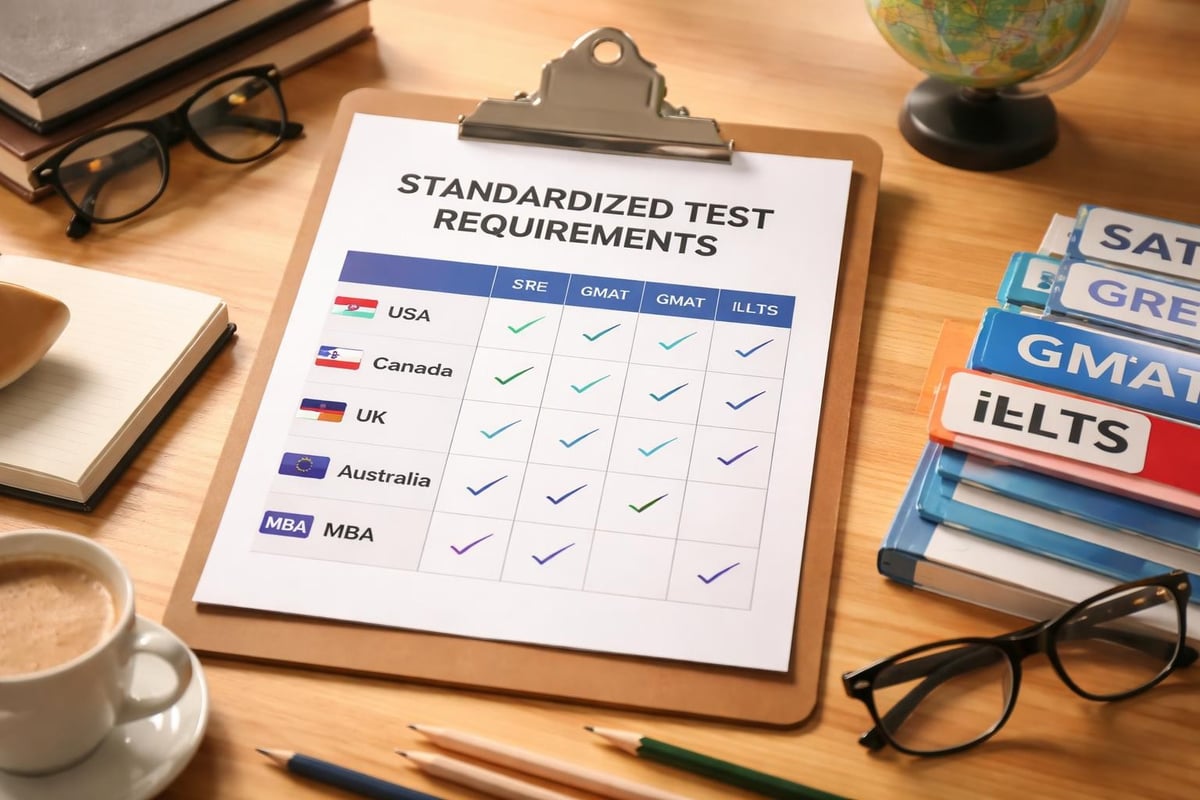
Beyond language proficiency, many destinations require additional standardised testing as part of the qualifications to study abroad. These assessments provide universities with comparable metrics across diverse educational systems.
Tests for Undergraduate Admissions
American universities heavily emphasise standardised testing for undergraduate admissions:
- SAT (Scholastic Assessment Test): Tests mathematics, evidence-based reading, and writing
- ACT (American College Testing): Covers English, mathematics, reading, and science reasoning
- SAT Subject Tests: Demonstrate knowledge in specific academic areas (though many universities have discontinued this requirement)
Top American universities typically expect combined SAT scores above 1400 (out of 1600) or ACT composite scores of 30 or higher. However, some institutions have adopted test-optional policies, particularly following disruptions during the pandemic period.
Graduate Programme Testing
Postgraduate applicants face different testing requirements depending on their intended field:
- GRE (Graduate Record Examination): Required for most graduate programmes, testing verbal reasoning, quantitative reasoning, and analytical writing
- GMAT (Graduate Management Admission Test): Specifically for business school and MBA applications
- LSAT (Law School Admission Test): Essential for law school applications in the USA and Canada
- MCAT (Medical College Admission Test): Required for medical school entry in North America
The step-by-step study abroad guide from MBA.com details how these scores factor into competitive programme selection.
Health and Medical Requirements Ensure Student Wellbeing
Health-related qualifications to study abroad protect both individual students and the broader university community. These requirements vary considerably between destinations but generally include vaccination records and medical certificates.
Mandatory Vaccinations and Health Screening
Most countries require proof of certain vaccinations before granting student visas. Tuberculosis (TB) testing is particularly common for students from countries with higher TB prevalence. The HSBC international student checklist outlines specific health requirements for various destinations.
Common vaccination requirements include:
- Measles, mumps, and rubella (MMR)
- Hepatitis A and B
- Meningococcal meningitis (especially for students living in university accommodation)
- COVID-19 vaccinations (requirements continue evolving in 2026)
- Country-specific vaccines based on your origin and destination
Some universities conduct additional health screenings during orientation, particularly for programmes involving laboratory work, healthcare placements, or close contact with vulnerable populations.
Health Insurance Coverage
Comprehensive health insurance represents a non-negotiable qualification in most study abroad destinations. Many countries make it a visa requirement, whilst universities themselves often mandate minimum coverage levels.
The USA requires all international students to have health insurance meeting specific criteria, often provided through university-sponsored plans. European countries with public healthcare systems may allow students to access services through the European Health Insurance Card (EHIC) or require private insurance depending on your citizenship and length of stay.
Visa and Immigration Documentation Requirements
Immigration qualifications to study abroad encompass the legal permissions and documentation needed to enter and remain in your host country for educational purposes. Visa requirements represent perhaps the most complex aspect of the qualifications landscape.
Student Visa Application Essentials
Each country operates distinct student visa categories with specific eligibility criteria. The University of New Mexico’s study abroad guide provides valuable insights into navigating these processes.
Core visa documentation typically includes:
- Valid passport with sufficient remaining validity (usually 6 months beyond your intended stay)
- Official university acceptance letter or Confirmation of Acceptance for Studies (CAS)
- Proof of financial capacity as discussed earlier
- Academic transcripts and certificates
- Language proficiency test results
- Biometric information and photographs
- Visa application fees and health surcharge payments where applicable
Processing times vary from a few weeks to several months, making early preparation essential. Some countries, including the USA, require in-person visa interviews at embassies or consulates, where you'll need to demonstrate genuine student intent and ties to your home country.
Post-Study Work Permissions
Understanding post-study work rights forms part of comprehensive planning. Many countries now offer graduate visas allowing qualified students to remain and work after completing their studies. The UK's Graduate Route permits two years of post-study work (three years for doctoral graduates), whilst Australia offers 2-4 years depending on qualification level and study location.
These opportunities increasingly influence destination choices, as students seek both quality education and career pathway options.
Age and Residency Criteria Affect Eligibility
Whilst less commonly discussed, age and residency requirements can impact the qualifications to study abroad, particularly for specific programme types or funding opportunities.
Age Restrictions for Various Programmes
Undergraduate programmes rarely impose upper age limits, welcoming mature students alongside school leavers. However, certain visa categories or scholarship schemes may specify age ranges. For instance, some government-funded scholarship programmes target students under 35, whilst high school study abroad programmes typically accept students aged 14-18.
Foundation and pathway programmes often provide flexible entry points for students of all ages who don't meet direct entry requirements. These programmes bridge qualification gaps whilst helping students adapt to new educational systems.
Residency and Citizenship Considerations
Residency status affects fee classification, with international students typically paying higher tuition than domestic or European Union students (where applicable). Some scholarships and financial aid packages are restricted to citizens or permanent residents of specific countries.
Gap year students should verify how time between qualifications affects their applications. Most universities accept gap years positively, particularly when used productively for work experience, volunteering, or developing relevant skills.
Character and Background Checks Maintain Campus Safety
Universities and immigration authorities increasingly require character assessments as part of the qualifications to study abroad. These safeguards protect institutional communities whilst ensuring student suitability for international study.
Police Clearance Certificates
Many countries require police clearance certificates or criminal background checks, particularly for visa applications. These documents verify that you have no serious criminal convictions that might pose risks to the host community.
Requirements vary by destination:
| Country | Certificate Name | Validity Period |
|---|---|---|
| UK | Disclosure and Barring Service (DBS) check | 6 months |
| USA | FBI background check | Varies by state |
| Australia | National Police Certificate | 12 months |
| Canada | Police Certificate | 6 months |
| New Zealand | Criminal Conviction Check | 6 months |
Processing times for these certificates can extend to several weeks, necessitating early application. Some countries require police clearances from every nation where you've resided for extended periods.
Academic Integrity Declarations
Universities take academic integrity seriously. Application forms typically include declarations confirming the accuracy of submitted information and acknowledgement of institutional policies regarding plagiarism and academic misconduct.
Submitting fraudulent documents or misrepresenting qualifications carries severe consequences, including offer withdrawal, visa cancellation, and potential bans from future applications. The Europass preparation guide emphasises the importance of authentic documentation throughout the application process.
Additional Programme-Specific Requirements
Beyond general qualifications to study abroad, specific programmes impose additional entry criteria reflecting their specialised nature and professional standards.
Portfolio and Audition Requirements
Creative and performing arts programmes require portfolios or auditions demonstrating artistic ability:
- Fine arts: Submit portfolios showcasing 15-20 original artworks across various media
- Architecture: Provide design portfolios with technical drawings and creative projects
- Music: Perform live auditions or submit recorded performances
- Drama: Attend audition days with prepared monologues or scenes
- Creative writing: Submit writing samples demonstrating style and technical competence
These assessments carry equal or greater weight than academic grades, as they directly evidence your practical capabilities and creative potential.
Work Experience and Professional Credentials
Professional programmes, particularly at postgraduate level, often require relevant work experience:
- MBA programmes: Typically require 2-5 years of professional work experience
- Executive education: May demand 10+ years in management roles
- Medical programmes: Require clinical observation hours or healthcare experience
- Teaching qualifications: Often need classroom assistant experience
- Social work: Demand volunteer or paid experience in social care settings
Applicants must document this experience through employer references, detailed CV descriptions, and sometimes portfolio evidence of projects completed.

Subject Prerequisites and Foundation Knowledge
Science, technology, engineering, and mathematics (STEM) programmes typically require specific A-level subjects or equivalent. Engineering degrees demand mathematics and physics; chemistry programmes need chemistry and often mathematics; whilst computing courses may specify mathematics or computing science.
Students lacking these prerequisites can often complete foundation years or bridging courses designed to build necessary subject knowledge before entering degree programmes proper.
Document Authentication and Recognition Processes
Having the right qualifications means little unless universities and immigration authorities recognise and accept your credentials. Document authentication ensures your certificates meet required standards.
Credential Evaluation Services
Educational systems vary globally, making credential evaluation essential. Specialised services assess your qualifications against host country standards, providing equivalency statements that universities and immigration departments accept.
Common evaluation services include:
- WES (World Education Services): North America's leading credential evaluator
- ENIC-NARIC: European network for credential recognition
- UK NARIC: Provides International Qualifications Comparisons for UK applications
- NOOSR: Australian service for overseas qualification recognition
These evaluations cost between £50-200 depending on service level and turnaround time. Some universities conduct internal evaluations, whilst others require independent third-party assessments.
Apostille and Notarisation Requirements
Many countries require document legalisation through apostille stamps or embassy attestation. The apostille process authenticates documents for use in foreign countries that are parties to the Hague Convention.
Documents commonly requiring apostille include:
- Degree certificates and academic transcripts
- Birth certificates
- Marriage certificates (for dependent visa applications)
- Police clearance certificates
- Medical reports
Processing involves multiple steps: notarisation by a solicitor, verification by your country's foreign affairs department, and sometimes additional embassy authentication. This process can take weeks, making early preparation vital.
Understanding Conditional Versus Unconditional Offers
Universities issue two types of offers based on whether you've completed all qualifications to study abroad at application time.
Conditional Offers and Meeting Requirements
Conditional offers state specific criteria you must fulfil before final admission. Current students awaiting examination results typically receive conditional offers specifying required grades.
Common conditions include:
- Achieving specified grades in pending examinations
- Completing language proficiency tests with minimum scores
- Submitting final transcripts and degree certificates
- Providing police clearance certificates
- Completing pre-sessional English courses
- Obtaining required vaccinations
You must satisfy all conditions by stated deadlines, usually several months before programme commencement. Failure to meet conditions results in offer withdrawal, though universities sometimes show flexibility if you narrowly miss requirements.
Unconditional Offers and Direct Entry
Unconditional offers confirm your place without further academic requirements. You receive these when you've already completed all necessary qualifications and submitted verified documentation.
However, unconditional offers may still include administrative conditions such as visa approval, deposit payment, or accommodation confirmation. These practical requirements ensure smooth programme commencement but don't relate to academic qualifications.
Preparing Alternative Pathways When Direct Entry Isn't Available
Not every student meets direct entry requirements immediately. Alternative pathways provide valuable routes to international education whilst developing necessary qualifications.
Foundation and Pathway Programmes
University foundation years bridge qualification gaps, particularly for students whose national qualifications don't directly align with host country requirements. These programmes typically last one academic year and cover:
- Subject-specific content in your intended field
- Academic English development
- Study skills and research methods
- Cultural orientation and adaptation support
Successful completion guarantees progression to degree programmes, making foundations attractive options for students with slightly lower grades or non-standard qualifications.
Pre-sessional English Courses
Students narrowly missing language requirements can attend pre-sessional English courses before their main programme starts. These intensive courses, typically lasting 4-12 weeks, focus specifically on academic English skills.
Pre-sessional programmes offer several advantages:
- Eliminating the need to retake IELTS or TOEFL tests
- Early arrival allowing campus familiarisation
- Building friendships before main programme pressure begins
- Developing discipline-specific vocabulary and conventions
- Learning academic writing and presentation skills
Many universities guarantee main programme entry following successful pre-sessional completion, removing the stress of further testing.
Understanding the qualifications to study abroad empowers you to plan strategically and prepare thoroughly for your international education journey. From academic credentials and language proficiency to financial documentation and health requirements, each element plays a vital role in successful application outcomes. SBUB Group Ltd. provides expert guidance throughout this complex process, helping students navigate qualification requirements, strengthen applications, and secure places at top universities worldwide. Whether you're just beginning to explore study abroad possibilities or ready to submit applications, professional consultancy support transforms overwhelming challenges into achievable milestones on your path to international academic success.