
How to Apply to UK Universities as an International Student: The 2026 Roadmap
By January 29, 2026, thousands of ambitious students will hit ‘submit’ on their UCAS applications, yet many will do so with a lingering fear that they missed a crucial detail. You deserve to feel significant and heard throughout this process, rather than lost in a sea of administrative jargon. We understand that the weight of the £1,334 monthly London maintenance requirement or the pressure of a single personal statement can feel like a barrier to your impact. You aren’t just seeking a degree; you’re claiming your seat at the table of global innovation.
We believe that a level playing field starts with transparent information. This guide provides a definitive roadmap on how to apply to uk universities as an international student, turning confusion into a strategic advantage. We’ll break down the 2026 admissions cycle into manageable steps, from the initial course search to the final visa approval. You will gain a clear, chronological checklist designed to ensure your application represents your true potential and leads to a successful enrollment in a top-tier institution.
Key Takeaways
- Discover how a UK degree in 2026 provides a platform for global impact and a level playing field through the Graduate Route.
- Master the essential 5-step roadmap on how to apply to uk universities as an international student to ensure your application is both compliant and competitive.
- Transform your Personal Statement into a tool of self-advocacy that highlights your potential to shape the future of your chosen field.
- Demystify the Student Visa and maintenance fund requirements to move confidently from your university offer to a successful arrival in the UK.
- Understand why expert advocacy is the key to bridging the gap between a standard application and an elite enrolment that launches your career.
Understanding the UK University Landscape in 2026
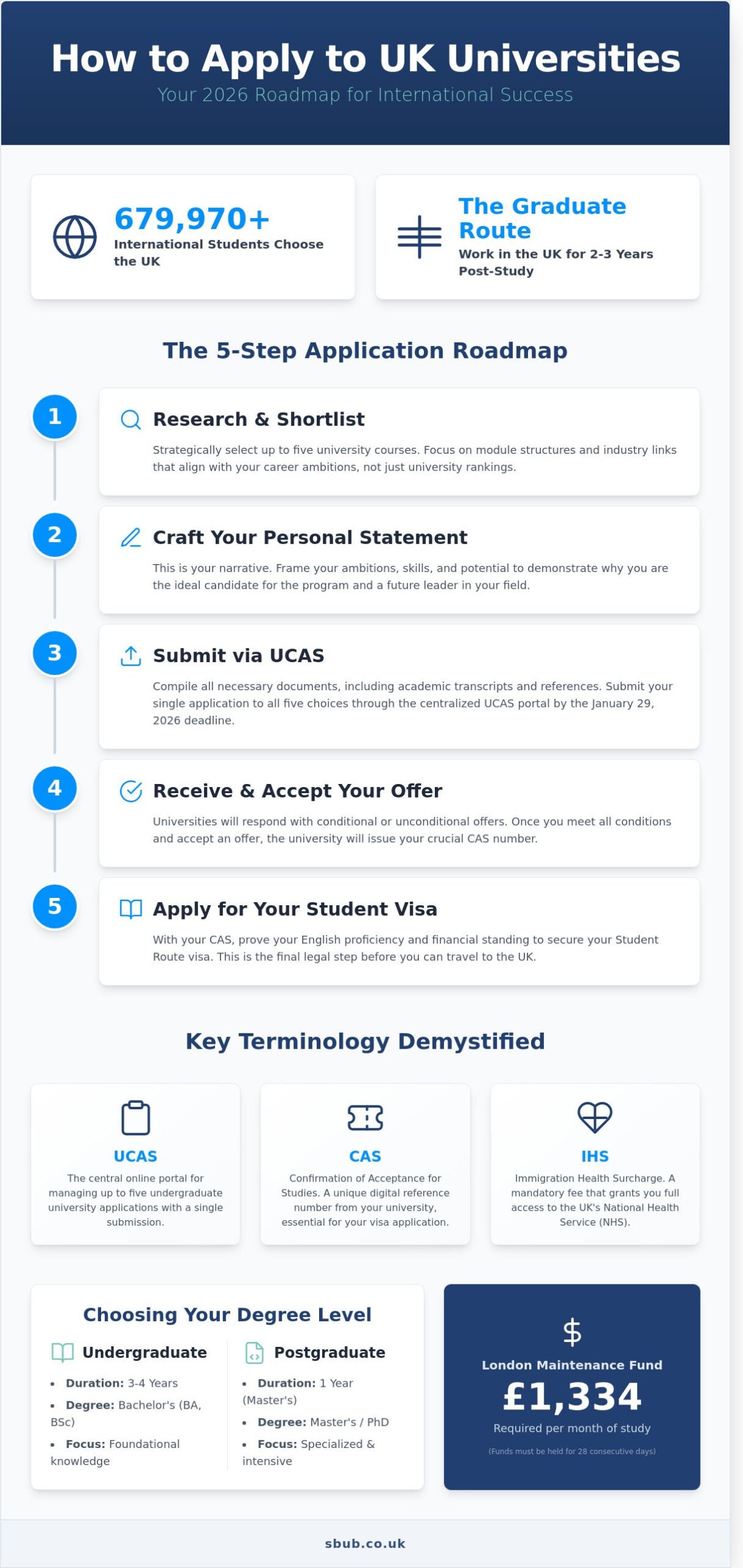
The UK higher education sector remains a global powerhouse for talent and innovation. In 2026, the landscape is defined by a commitment to employability and international collaboration. Over 679,970 international students currently choose the UK as their academic home. They don’t just come for the prestige; they come for the tangible career advantage. A British degree acts as a global passport. It signals to employers that you possess the discipline and critical thinking required in a modern, digital economy. We believe your ambition deserves a level playing field, and the UK offers exactly that through its rigorous standards and diverse community.
The Graduate Route is the cornerstone of this value proposition. This policy allows you to stay and work, or look for work, in the UK for two years after completing your degree. If you finish a PhD, this extension lasts for three years. It’s a vital bridge between education and professional impact. You’re given the space to translate your academic voice into a professional one within one of the world’s most influential markets. Understanding how to apply to uk universities as an international student requires recognizing that you aren’t just choosing a school; you’re choosing a career trajectory.
The legal pathway for this journey is the Student Route. This is the official name for the visa system that replaced the old Tier 4 structure. It’s a points-based system designed to be transparent and fair. You earn points by securing an offer from an approved sponsor, proving your English proficiency, and showing you have the financial means to support your studies. This clarity ensures that every student, regardless of their background, has a clear map to follow. The education system in the UK is built on this foundation of structured excellence.
One major difference you’ll encounter is the focus on specific courses rather than general university admission. In many other countries, you might apply to a university and choose a major later. In the UK, you apply directly to a specific program. This means you need to have a clear sense of your purpose from the very beginning. It’s about finding the right fit for your skills and your future impact. When you research how to apply to uk universities as an international student, focus your energy on the curriculum and the faculty expertise rather than just the university’s name.
Undergraduate vs. Postgraduate: Choosing Your Level
Standard Bachelor’s degrees in England, Wales, and Northern Ireland typically take 3 years to complete. Scotland offers a 4-year model that provides more breadth in the early years. If you’re looking for a strategic advantage, the 1-year intensive Master’s degree (MA, MSc, or MBA) is a powerful choice. It allows you to gain a full qualification in half the time of many international programs, saving you both time and tuition costs. For those pursuing a PhD, your research proposal is the most critical document. It defines your individual contribution to your field before you even step onto campus.
Key Terminology Every International Student Must Know
- UCAS: The Universities and Colleges Admissions Service. It’s the central hub for all undergraduate applications, allowing you to manage up to five choices through one portal.
- CAS (Confirmation of Acceptance for Studies): This is your golden ticket. It’s a unique 14-digit reference number issued by your university once you’ve accepted an unconditional offer. You can’t apply for your visa without it.
- IHS (Immigration Health Surcharge): This mandatory fee gives you full access to the UK’s National Health Service (NHS). It ensures your health is protected, giving you the peace of mind to focus on your studies and your future.
We see you as more than just a name on an application. You’re a future leader, an innovator, and a vital part of the global community. By mastering these basics, you’re taking the first step toward claiming your seat at the table.
The 5-Step Roadmap to Your UK Application
Your journey to a UK degree is a strategic exercise in self-advocacy. You aren’t just a number in a system; you’re a future professional building a platform for global impact. Understanding how to apply to uk universities as an international student starts with a clear, five-step framework designed to amplify your voice and demonstrate your value to admissions committees.
- Step 1: Research and shortlist. Select five courses that align with your specific career goals. Don’t settle for prestige alone. Analyze the module structures and industry links of each program to ensure they offer the level playing field you need to succeed.
- Step 2: Register on the UCAS Hub. This is the central engine of your application. Complete your personal details and education history accurately. You can manage your entire UCAS application for international students through this portal, ensuring your data is secure and professional.
- Step 3: Draft your Personal Statement. This 4,000-character document is your primary tool for advocacy. It’s where you shift the narrative from your grades to your potential impact. Focus on why you’ve chosen your subject and what unique perspective you bring to the UK academic community.
- Step 4: Secure an academic reference. Choose a teacher or professional mentor who understands your work ethic. Their voice adds third-party validation to your claims, providing the credibility admissions tutors demand.
- Step 5: Submit with confidence. Finalize your application before the critical deadlines. Whether you’re aiming for the January initial window or the June late entry period, punctuality signals your readiness for the rigors of UK higher education.
Deadlines and Key Dates for 2026 Entry
Timing is everything when you’re competing for a spot at a top institution. For the 2026 intake, the first major milestone is October 15, 2025. This deadline applies to all courses at Oxford and Cambridge; it also covers most medicine, dentistry, and veterinary science programs. Missing this date means waiting another full year to apply to these specific tracks.
The January 29, 2026, deadline is the Equal Consideration date for the majority of undergraduate courses. This ensures every applicant is treated with the same fairness, regardless of when they hit submit. If you miss these windows, Clearing opens in July 2026. This process helped 73,320 students find places in 2023, proving that there’s always a path forward if you remain persistent. You can join our community to stay updated on these shifting policy dates.
Meeting English Language and Academic Requirements
Academic equivalence is the foundation of a fair application process. Most UK universities require an IELTS score between 6.0 and 7.5, though many also accept PTE Academic or TOEFL iBT results. If you’re coming from a US-curriculum school, universities typically look for SAT scores above 1,200 or at least three AP scores of 4 or 5 to demonstrate your readiness for the British curriculum.
Verifying your local qualifications is a vital step in how to apply to uk universities as an international student. Use the UK ENIC service to confirm how your high school diploma or local degree compares to UK standards. This transparency ensures that your hard work at home translates into the recognition you deserve abroad. We believe that every student deserves a seat at the table based on their merit and potential.
Crafting a Narrative: The Personal Statement as Self-Advocacy
Your personal statement is the most powerful 4,000 characters you’ll ever write. It’s not just a requirement; it’s your platform for self-advocacy. In the competitive landscape of UK higher education, where some courses see 10 applications for every available seat, your voice must command attention. You aren’t just a list of grades on a screen. You’re a future contributor to a global academic community. When you learn how to apply to uk universities as an international student, you must realize that admissions officers aren’t looking for what you did. They’re looking for the impact you’ll make on their campus and in your chosen field.
Shift your perspective from a passive history of your schooling to an active demonstration of your potential. If you led a project that increased a local charity’s donations by 12 percent, don’t just say you volunteered. Explain how your leadership drove that specific result. This approach mirrors the SBUB philosophy: your international background isn’t a hurdle to overcome; it’s a strategic asset. You bring a unique global viewpoint that domestic students cannot offer. This perspective is a form of cultural capital that enriches every seminar and laboratory you enter. By framing your history as a series of impactful choices, you move from being a candidate to being a partner in the university’s mission.
Sometimes, your academic journey includes hurdles like illness or family displacement. Address these extenuating circumstances directly but briefly. Don’t apologize for them. Instead, use these moments to demonstrate resilience and problem-solving. If a 2022 disruption caused a dip in your marks, show how you regained your footing in 2023. This creates a narrative of persistence that admissions tutors value as much as high test scores.
Structure of a Winning Personal Statement
Success follows the 80/20 rule. Devote 80 percent of your text to academic interest and 20 percent to character and extra-curricular activities. Your first paragraph needs to define your “why” without using clichés. Avoid starting with “Since I was a child” or quotes from famous philosophers. Instead, start with a specific academic problem or a moment of discovery that sparked your interest in the UK system. This clarity shows you’ve done your research and understand the rigors of the British curriculum.
Securing High-Impact Letters of Reference
Your referee should be an advocate, not just a witness. Choose a teacher who knows your academic prowess but also understands your personal drive. To ensure your reference aligns with your personal statement, provide your referee with a “cheat sheet.” This document should list three specific achievements, such as a 95 percent score on a major thesis or your role in a national competition. When your reference and your statement echo the same strengths, your application gains a level of professional consistency that stands out. Mastering how to apply to uk universities as an international student means ensuring every part of your application speaks with a unified, powerful voice.
- Focus on Evidence: Use specific data points from your studies or internships.
- Be Direct: Use short, declarative sentences to project confidence.
- Show Resilience: Frame challenges as opportunities for growth.
- Align Your Narrative: Ensure your reference supports your stated goals.
Navigating the Student Visa and Financial Logistics
Securing your university offer is a significant victory, but the administrative journey isn’t over. Transitioning from an applicant to a legal resident involves a rigorous process where precision is your greatest asset. Learning how to apply to uk universities as an international student means mastering the Student Route visa requirements long before you pack a suitcase. We view this stage as your first act of self-advocacy in the UK; it’s about proving you have the resources and the intent to succeed in a new system.
The Student Visa checklist starts with your Confirmation of Acceptance for Studies (CAS). This digital document is issued by your university and acts as your golden ticket. You can’t apply for a visa more than six months before your course starts, and your CAS is only valid for a single application within that window. Alongside your CAS, you’ll need a valid passport, proof of English proficiency, and potentially a Tuberculosis (TB) test result depending on your country of origin. Accuracy here prevents delays that could jeopardize your enrollment date.
The credibility interview is often the most daunting part of the process. UK Visas and Immigration (UKVI) officers may interview you to ensure you’re a genuine student. They’ll ask why you chose a specific course, how it fits your career goals, and why you aren’t studying in your home country. Prepare to speak clearly about your investment. Treat this as a professional dialogue where you demonstrate your research and commitment to your future impact.
Tackling the Financial Requirements
Financial transparency is the bedrock of a successful visa application. You must prove you can cover your first year of tuition and your monthly living costs. As of 2024, the UKVI requires you to show £1,334 per month for courses in London or £1,023 per month for cities like Birmingham or Manchester. This must cover a period of up to nine months. For a student in London, this means having at least £12,006 in your account plus any unpaid tuition fees.
The 28-day rule is a strict regulatory hurdle that catches many off guard. The required funds must sit in your bank account for a consecutive 28-day period. The closing balance of this 28-day period must be within 31 days of your visa application date. If your balance drops by even a single pound during those 28 days, the Home Office will likely refuse your application. We recommend keeping a “buffer” amount to account for currency fluctuations if your account isn’t in British Pounds.
- Scholarships: Look into Chevening or Commonwealth Scholarships, which often cover both tuition and stipends.
- Bursaries: Many universities offer automatic discounts of £1,000 to £5,000 for international students based on academic merit.
- Evidence: Use official bank statements or a letter from a regulated financial institution to prove your “Maintenance Funds.”
Health and Housing: The Practical Move
Your health and safety are non-negotiable. As part of your application, you’ll pay the Immigration Health Surcharge (IHS). On February 6, 2024, this fee increased to £776 per year for students. Paying this gives you access to the National Health Service (NHS), ensuring you’re protected throughout your studies. It’s a collective system that provides peace of mind while you focus on your degree.
Finding a home is your next priority. University halls offer a structured environment, while private rentals provide more independence but require more scrutiny. When you understand how to apply to uk universities as an international student, you realize that housing is often the biggest variable in your budget. Start your search early to find a balance between cost and proximity to campus. For detailed advice on locations and contracts, see our guide on How to Find Student Accommodation in the UK.
Ready to take the next step in your journey? Join our community for expert support and ensure your voice is heard as you build your future in the UK.
Why Expert Advocacy Matters: How SBUB Supports Your Journey
You aren’t just a data point in a university database. We bridge the gap between a standard application and elite enrolment by treating your journey as a shared mission. Mastering how to apply to uk universities as an international student is about more than just meeting deadlines; it’s about strategic positioning. Since 2015, we’ve helped over 2,500 students move from ambition to arrival by providing a level playing field. We ensure your voice is heard in an increasingly competitive academic market.
Our personalised career counselling ensures your chosen course leads to a global career. We analyze current market trends to align your studies with future demand, shifting the narrative from simple education to long-term impact. Visa rejection rates can reach 12% for certain regions when students apply without professional guidance. We reduce this risk through bespoke visa support and rigorous document review. Our local expertise has a global reach, with dedicated teams in Birmingham, Hyderabad, and Subang Jaya providing the advocacy you need right where you live.
From Application to Enrolment: Our Premium Support
We provide intensive interview coaching for both competitive university entries and mandatory visa credibility checks. In the 2023 intake cycle, 88% of our coached students passed their university interviews on the first attempt. Our expert tutors offer specialized IELTS and PTE training to help you reach target scores of 7.0 or 7.5. For doctoral candidates, we simplify the Ph.D. Research Proposal process. We help you navigate the complexities of doctoral entry by refining your research questions into persuasive, high-impact documents that get noticed by supervisors.
Join the Conversation: Your Voice, Your Future
SBUB acts as an Empathetic Champion because we understand the corridors of power in UK higher education. We know that the process of how to apply to uk universities as an international student can feel like a closed-door event. We open those doors. By connecting you with a community of international students already thriving in the UK, we provide a platform for peer support and collective agency. This network ensures you feel significant and heard from day one. Your journey is part of a larger movement toward fairness and representation in global education. Book a free consultation with our Birmingham-based experts today to secure your place in the UK’s academic future.
Claim Your Seat at the Table for 2026
Your journey to the UK starts with a single, decisive step toward self-advocacy. We’ve explored the 5-step roadmap and the nuances of the 2026 application cycle to ensure your voice isn’t just heard, it’s prioritized. Mastering how to apply to uk universities as an international student requires a blend of strategic narrative and technical precision. Whether you’re navigating the personal statement or the complex financial requirements of the Student Visa, you don’t have to face these systems alone.
At SBUB, we bridge the gap between your individual ambition and the macro-level requirements of UK higher education. From our Birmingham-based headquarters, we provide on-the-ground support and direct access to our network of 120 global partner universities. We offer specialist visa guidance with a 97% success rate, ensuring that your transition is seamless and fair. Your background is your strength, and your presence in the UK will create a lasting impact. Let’s work together to turn your individual goals into collective influence.
Start your UK journey with a free expert consultation
The future of UK education is brighter when students like you take your place. We’re here to champion your path every step of the way.
Frequently Asked Questions
Can I apply to UK universities directly or must I use UCAS?
You must use the UCAS system for undergraduate courses, while most postgraduate applicants apply directly through university websites. For 2026 entry, UCAS allows you to select 5 different courses to maximize your impact. This centralized system ensures a level playing field for every applicant. Understanding how to apply to uk universities as an international student starts with mastering this platform to amplify your voice in the admissions process.
How much money do I need to show for a UK student visa in 2026?
You need to prove you have £1,483 per month for living costs in London or £1,136 per month for locations outside the capital. These figures, set by the Home Office for 2025 and 2026, must be held in your bank account for 28 consecutive days. You’ll also need to cover your full tuition fees for the first year. This financial transparency ensures you have the resources to thrive and succeed without hardship.
What is the difference between a conditional and an unconditional offer?
A conditional offer means you have a place once you meet specific requirements, such as achieving a 70% final grade or an IELTS score of 6.5. An unconditional offer means you’ve already met all criteria and the spot is yours. We believe clarity in these offers empowers you to plan your future with confidence. Most international students receive conditional offers during their final year of secondary school or university studies.
Can I work in the UK while studying on a student visa?
You can work up to 20 hours per week during term time if you’re studying at the degree level or above. During official university vacation periods, you’re permitted to work full-time, which is 40 hours per week. This policy allows you to gain vital professional experience and contribute to the local economy while pursuing your degree. It’s a key way to increase your personal impact and build a professional network early.
What happens if my UK student visa is rejected?
You can apply for an Administrative Review within 28 days if you believe the Home Office made an error in their decision. Alternatively, you can submit a fresh application once you’ve addressed the specific reasons for refusal listed in your decision letter. Statistics show that 3% of student visas are refused, often due to missing financial documents. We advocate for careful preparation to ensure your voice is heard and your journey continues.
Do I need to take an English language test if I was taught in English?
You don’t need a test if you’re a national of one of the 18 countries on the UKVI exempt list, such as Canada or Guyana. If you aren’t from these regions, you must typically provide an IELTS or PTE Academic score, even if your previous medium of instruction was English. Most universities require an IELTS score of 6.5. Learning how to apply to uk universities as an international student involves verifying these specific entry requirements early.
How long does the UK university application process take from start to finish?
The entire journey typically takes 12 to 18 months from initial research to your first day on campus. You should submit your UCAS application by the January 29 deadline to ensure equal consideration for most courses. Visa processing then adds another 3 weeks for standard applications or 5 days for priority service. Starting early gives you the best chance to secure your place and make a big impact in your chosen field.
What is the Graduate Route visa and how do I qualify for it?
The Graduate Route is a 2-year work visa available to students who successfully complete a degree at a UK higher education provider. You qualify by applying before your student visa expires and paying the £822 application fee plus the £1,035 annual health surcharge. This route allows you to stay and work at any skill level, providing a bridge between your education and a big impact in the professional world. PhD graduates receive 3 years.