
Average ACT Score 2026: What It Means for Your Global University Impact
What if your test result was more than just a metric, but a tool for representation on the global stage? As the ACT transitions to a shorter, 125-minute format starting in September 2025, many students worry that being average will leave them overlooked by elite institutions. You might feel that the average act score creates a ceiling for your ambitions, especially when navigating the nuances of UK admissions. We understand that this uncertainty is real, but we believe that every student deserves a seat at the table regardless of how the testing landscape shifts.
Our mission is to help you transform these benchmarks into a clear advantage. You’ll learn how to navigate the latest 2026 trends and use your results to secure a place at top-tier global universities. We’ll outline a specific roadmap to boost your score by 3 or 4 points and provide the confidence you need to lead your own application strategy. This guide moves you from individual concern to collective agency, ensuring your impact is felt far beyond the testing center. It’s time to stop feeling small in the face of big data and start shaping your own future.
Key Takeaways
- Understand how the 2026 ACT updates, including a shorter test format and optional science section, are redefining performance benchmarks for international applicants.
- Learn why the projected average act score of 19.4–19.8 is a shifting target and how to set a personalized goal that aligns with the requirements of your reach schools.
- Discover the specific criteria used by the Russell Group and other elite UK universities to evaluate your results within the context of the global admissions landscape.
- Identify early diagnostic strategies to address section-specific weaknesses, ensuring your final results reflect your true potential rather than just a national mean.
- Explore how a bespoke, advocacy-driven approach can elevate your application, moving the focus from a single number to your unique voice and global impact.
Understanding the Average ACT Score in 2026: The Global Benchmark
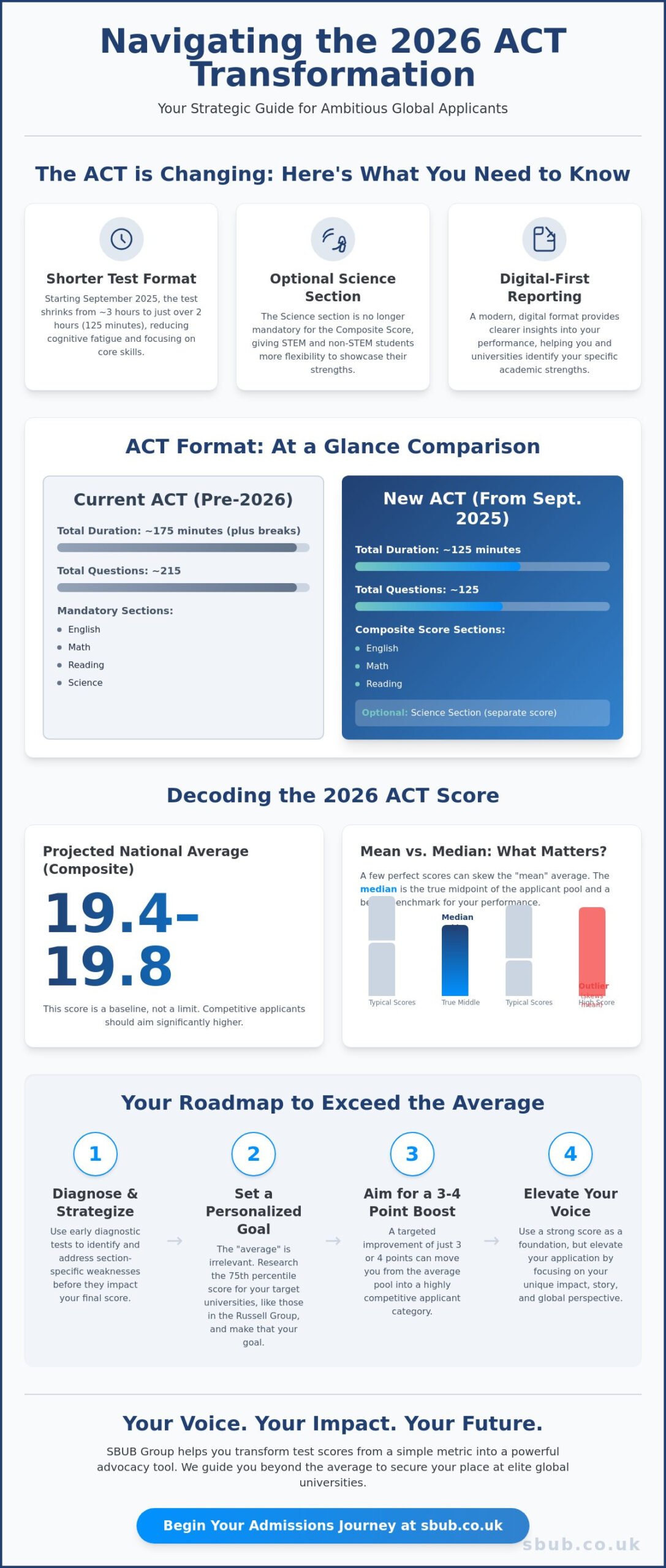
We believe your academic potential shouldn’t be defined by a single metric, yet we recognize that the average act score serves as a vital gateway in the global university market. For the 2026 testing cycle, data projections indicate a national composite average landing between 19.4 and 19.8. This narrow range represents a massive collective of students seeking to elevate their influence through higher education. You’re part of a movement where individual effort meets systemic opportunity. To understand the foundation of this assessment, you can review this ACT test overview which details the exam’s history and scoring mechanics.
The “average” is currently a shifting target. The 2026 format updates, including a shorter core test and a transition to digital-first delivery, are designed to modernize the experience. While the average act score provides a baseline, we know that being “above average” is what grants you a seat at the table in competitive programs. Universities often look at the 25th and 75th percentiles to gauge an applicant’s fit. If a school’s 75th percentile is a 28, scoring a 19.6 might leave you overlooked. We want to shift that narrative. Aiming for the top quartile ensures your voice is heard during the admissions process.
Mean vs. Median Scores: Why the Distinction Matters
A few high achievers scoring a perfect 36 can pull the mean upward, creating a skewed version of the “average” student. We advocate for looking at the median instead. The median represents the true middle of the applicant pool. It’s the point where half the students scored higher and half scored lower. When you research specific universities, the median score is the most reliable tool for benchmarking your impact. It creates a level playing field, allowing you to see exactly where you stand against the competition without the distortion of outliers.
The 2026 Standard: How Scores Have Evolved
Score trends have shown a steady pattern of change. In 2024, the national average hovered near 19.5. As we move into 2026, the shift toward a modular, digital format aims to improve fairness and representation. These digital-first reports provide a clearer picture of your strengths. A “good” score is no longer a fixed number; it’s a relative value that depends on your chosen program. Whether you’re targeting a local college or a global institution, your score is your advocacy tool. It’s how you prove that your small business mindset or local leadership has the power to scale on a global stage.
- Projected 2026 Average: 19.4 to 19.8
- Competitive Target: 75th percentile of your chosen university
- Format: Shorter, digital-first assessment
The 2026 ACT Scoring Shift: Shorter Tests and Optional Science
Starting in April 2026, the ACT undergoes its most significant transformation in decades. The testing window shrinks from three hours to two. This 20-30% reduction in duration directly addresses the cognitive fatigue that often drags down student performance during the final hour. By removing 90 questions, the total count drops from 215 to roughly 125. This shift creates a level playing field where your stamina doesn’t dictate your score. We see this as a vital step toward fairness, ensuring that the average act score reflects your actual knowledge rather than your ability to survive an endurance test.
The core of this change lies in the new flexibility. Science is no longer a mandatory component of the Composite score. While the test remains rigorous, the shorter format allows for more time per question, which typically benefits students who prioritize accuracy over speed. Data from the Average ACT scores by state show that performance often fluctuates based on regional access to prep materials; however, this streamlined version aims to minimize those barriers by focusing on essential core competencies.
Decoding the New 2026 Sectional Averages
Projected averages for the revised English, Reading, and Maths sections suggest a potential uptick in performance. By removing complex, time-consuming question types that previously cluttered the exam, the ACT is streamlining the path to success. The New ACT Composite is the average of the three core mandatory sections. This refined focus means your voice and academic strengths in literacy and numeracy carry more weight. You’ll find that the removal of “filler” content allows your specific skills to shine with greater clarity during the admissions process.
The Impact of the Optional Science and Writing Sections
Choosing to include the optional Science or Writing sections is a strategic decision for your future impact. For students pursuing STEM careers, the Science section remains a powerful advocacy tool. It demonstrates your readiness for technical rigor to elite global universities. Skipping Science won’t necessarily hurt your general admissions chances, but it might limit your representation in specialized programs. We recommend taking the Science section if you’re targeting engineering or medical tracks to provide a complete picture of your capabilities.
The Writing section continues to serve as an optional measure of your persuasive voice. If your career goals involve policy, law, or communication, this section is your chance to stand out. To ensure your voice is heard in the competitive admissions landscape, you can join our community of advocates for fair education access. Ultimately, your choice should align with the specific requirements of your target institutions and your personal professional trajectory.
ACT Scores vs. UK University Entry: A Competitive Comparison
Your journey to a UK degree starts with understanding how your US-based metrics translate across the Atlantic. For students targeting 2026 entry, the average act score serves as a baseline, but elite institutions demand much more. Oxford, Cambridge, and the wider Russell Group don’t just look for competence. They look for academic mastery that mirrors the depth of A-Levels. We see your test score as your seat at the table; it’s a way to ensure your voice is heard in competitive global admissions.
In the UK school system, students specialize early. This means your ACT results must demonstrate high proficiency in core areas to achieve parity with domestic applicants. While a score of 21 might be the national average act score in the US, UK recruiters often expect a 30 or higher to consider an application equivalent to top-tier domestic grades. Partnering with UK university admission consultants helps you frame these scores within a narrative of advocacy and impact, proving you’re ready for the intensity of a three-year honors degree.
ACT to UCAS Tariff: How it Works
UCAS doesn’t assign a fixed point value to the ACT, but admissions officers use it to verify your academic rigour. If you’re eyeing the University of Birmingham or University College London, a composite score of 29 to 33 is typically the standard for 2026 entry. This score complements your high school diploma, acting as a bridge to meet IB or A-Level equivalent requirements. It’s about leveling the playing field so your individual potential isn’t lost in translation. High scores in specific sections like Math or Science can also satisfy subject-specific prerequisites for competitive courses.
ACT vs. SAT: Which Average Should You Aim For?
Choosing between tests is about finding where your voice is clearest. By 2026, many international students may find the ACT’s shorter sections more accessible than the SAT scores benchmark. The ACT’s science section allows you to showcase data literacy, which is a trait highly valued in UK STEM programs. We encourage you to choose the test that highlights your individual strengths. Your choice should reflect your personal brand of excellence, ensuring your impact is felt by admissions committees from the very first page of your application.
Beyond the Mean: Strategic Steps to Exceed the Average ACT Score
While the national average act score often hovers around 19.5, your personal benchmark must reflect your specific global ambitions. We believe your voice deserves a seat at the most prestigious tables; therefore, you should set a target score based on the 75th percentile of your reach schools. If a university shows a middle 50% range of 32 to 35, your target is 35. This shift in perspective transforms the test from a hurdle into a platform for your future impact. It moves you from being one of many to being a candidate with a distinct, competitive edge.
Success requires moving away from passive learning. We advocate for the Empowered Study method, which prioritizes the quality of practice over the quantity of hours. Instead of completing dozens of random worksheets, spend your time on deep diagnostic testing to identify section-specific weaknesses. If you struggle with coordinate geometry or rhetorical transitions, focus 80% of your energy there. Many students fall into the trap of thinking they are simply not good test takers. We view this as a myth that limits your representation. Testing is a learnable system of logic; mastering its mechanics is a vital act of self-advocacy that proves you can navigate complex institutional frameworks.
Creating a 2026 Prep Timeline
The Spring 2026 ACT update introduces a shorter core test and makes the science section optional. To navigate these format adjustments, you should take your first diagnostic test by September 2025. This early start allows you to utilize superscoring effectively. Currently, over 70% of US four-year colleges accept superscores, which combine your highest section results from different test dates. You must balance this technical prep with your personal statements. A high score opens the door, but your story is what invites you in. We recommend finalizing your testing by December 2025 so you can focus entirely on your narrative impact during the final application cycle.
Leveraging Professional Support
Bridging the gap between a standard result and an exceptional one often requires targeted coaching. Professional guidance is a strategic investment in your future systemic impact. For students navigating global applications, IELTS and PTE training provides the foundational academic English necessary to decode the ACT’s complex reading and English prompts. When you master the linguistic nuances of these exams, you level the playing field. You ensure that your individual effort leads to a collective result that changes the trajectory of your career. Professional support doesn’t just improve a score; it equips you with the tools to be heard in a crowded digital market.
Ready to amplify your academic voice and reach your potential? Secure your target score today.
Your Voice, Your Impact: How SBUB Navigates Your Admissions Journey
We believe your potential shouldn’t be reduced to a single number on a transcript. While the average act score provides a useful benchmark for the 2026 admissions cycle, it doesn’t define your capacity for leadership or your ability to innovate. At SBUB, we act as your Empathetic Champion. We bridge the gap between your current academic standing and your ultimate global aspirations. Our bespoke approach ensures that we see the person, the dreamer, and the future professional behind the test results. We’re here to advocate for you in a system that often feels impersonal and rigid.
Our mission is to shift the narrative. You aren’t just an applicant; you’re a future contributor to the global economy. We understand the pressure of meeting specific metrics, but we also know that universities are looking for more than just a percentile. We help you present a narrative that highlights your resilience and your unique perspective, ensuring that your application carries the weight it deserves.
Comprehensive Support from Birmingham to the World
Our team provides a vital bridge for students from the West Midlands to the world’s most prestigious campuses. We offer student visa assistance in Birmingham to ensure the technicalities of your journey never stall your progress. We’ve built strong partnerships with global institutions that value diverse perspectives and unique life experiences. Our career counselling is designed to help you align your average act score with your long-term dreams. We focus on three key pillars of support:
- Strategic university matching based on your holistic profile and career goals.
- Detailed guidance on the 2026 regulatory changes for international students.
- Direct advocacy to help universities see your true value beyond standard data points.
By focusing on these areas, we ensure your test results serve as a foundation for your career rather than a ceiling on your potential. We handle the bureaucratic hurdles so you can focus on your studies and your future impact.
Start Your Journey with SBUB Group
Your future is a choice you make today. We invite you to join the conversation and shape your destiny with a team that understands the corridors of power. Booking a consultation with SBUB Group gives you access to personalised admission support that treats you like an individual, not a statistic. We’ve consistently seen that your size as an individual student doesn’t dictate your global impact. You have the power to influence your field, and we have the tools to help you get there.
Don’t let the complexity of the admissions process silence your voice. Whether you’re aiming for a specific school or exploring your options, we’re ready to stand by your side. Reach out to us today to secure your seat at the table and begin your international education journey with confidence.
Claim Your Seat in the Global Classroom
The 2026 ACT redesign transforms the testing experience with a 60-minute reduction in total time and the introduction of an optional science section. These structural shifts mean the average act score serves as a useful benchmark, but it shouldn’t be the ceiling of your ambition. High-ranking UK institutions often look for scores between 30 and 34 to align with the academic rigor of traditional A-levels. We understand that navigating these evolving standards feels daunting when you’re standing alone. That’s why we bridge the gap between your individual potential and systemic requirements. From our home base in Birmingham, we leverage a global network of partner universities to advocate for your unique profile. We don’t just look at data; we focus on your impact and representation in the wider academic world. Your voice matters, and your size shouldn’t limit your influence on the global stage. We’re ready to help you navigate this transition with clarity and firm intent. Your future is big, even if the journey starts with small, strategic steps.
Empower your application: Book a consultation with SBUB today
You’ve got the talent to succeed, and we’re honored to be the partner that helps you prove it to the world.
Frequently Asked Questions
What is a good ACT score for 2026?
A score of 30 or higher puts you in the top 10% of test-takers and is considered excellent for most selective universities. While a 24 is often the minimum benchmark for merit scholarships, elite institutions frequently expect a 33 or above. You should aim for a score that aligns with the middle 50% range of your target school’s most recent freshman class profile.
How does the new shorter ACT format affect the average score?
The 2025 redesign reduces the core test time by 60 minutes, which helps decrease student fatigue during the exam. While ACT Inc. uses concorded scaling to keep results consistent, the national average act score has remained steady between 19.0 and 20.0 over the last three years. This shorter format allows you to focus your energy on 44 fewer questions without losing scoring potential.
Do UK universities prefer the ACT or the SAT?
UK universities view the ACT and SAT as equal measures of academic readiness for the 2026 application cycle. Highly competitive schools like Oxford or Cambridge typically require an ACT composite score of 32 or 33 to consider an international application. We recommend choosing the test that best highlights your individual strengths, as admissions tutors focus on the final number rather than the specific exam type.
Is the Science section mandatory for the ACT in 2026?
The Science section is now an optional component of the ACT starting with the September 2025 test dates. You can choose to take only the core English, Reading, and Math sections if your target universities don’t require a Science score. This change gives you the power to tailor your testing experience to fit your specific academic goals and university requirements.
What is the national average ACT score for the class of 2026?
The projected national average act score for 2026 is 19.4 based on data trends from the 1.39 million students who tested in the previous cycle. This figure represents the mean performance across all 50 states. Understanding this baseline helps you gauge where you stand relative to the entire testing pool, but your individual impact depends on exceeding the specific requirements of your chosen institutions.
Can I get into a top UK university with an average ACT score?
Gaining admission to a Russell Group university with a score of 20 or 21 is statistically unlikely for international applicants. Most top-tier UK programs set their minimum entry threshold at 28 or higher for American curriculum students. If your score is lower, you’ll need to demonstrate exceptional achievement through your personal statement or AP exam results to remain a competitive candidate for these spots.
How many times should I take the ACT to improve my average?
You should plan to take the ACT 2 or 3 times to maximize your scoring potential. Statistics from ACT Inc. indicate that 57% of students see a score increase on their second attempt. We don’t recommend testing more than 4 times because score improvements typically plateau after that point. Focus your efforts on targeted practice between your first and second test dates instead.
How does SBUB Group help students with low ACT scores?
We advocate for your future by ensuring your application reflects your full potential beyond a single test result. Our team works to bridge the gap between your current metrics and university expectations through strategic storytelling and representation. We believe your voice matters more than a number, so we help you find a seat at the table by highlighting your unique contributions to the global academic community.