
UK University Entry Requirements for International Students: The 2026 Strategic Guide
What if your local high school diploma is more valuable to a Russell Group university than you have been led to believe? You likely feel the weight of 2026 deadlines approaching while struggling to translate your hard earned grades into a foreign point system. It’s a common frustration that leaves many of the 679,970 international students currently in Britain feeling overlooked by rigid systems. We believe your voice matters and your academic journey deserves a level playing field. Mastering the uk university entry requirements for international students is the first step in shifting from being an applicant to being a future leader. This strategic guide helps you align your qualifications and overcome English testing anxiety to ensure your 2026 application stands out. We’ll provide a clear document checklist, explain how pathway programs bridge the gap for non-traditional students, and build your confidence to hit submit on UCAS.
Key Takeaways
- Navigate the 2026 UCAS system with confidence by identifying the core academic and linguistic benchmarks required for a successful UK application.
- Learn how to align your global qualifications-from the Indian Standard XII to the US High School Diploma-with British A-Level and IB equivalencies.
- Master the specific uk university entry requirements for international students regarding English proficiency to secure both your academic place and your Student Visa.
- Explore how strategic foundation years act as a vital bridge, ensuring that your current grades do not limit your future impact or academic potential.
- Leverage the SBUB advantage to transform your personal statement into a powerful narrative that amplifies your unique voice and global perspective.
Decoding the UK University Entry System for 2026
Entry requirements are the minimum academic and linguistic benchmarks that UK institutions use to ensure you’re prepared for the rigors of British higher education. We view these standards not as barriers, but as the foundation for your future impact. For the 2026 intake, uk university entry requirements for international students have become more nuanced as institutions adapt to a post-pandemic global landscape. These requirements guarantee that every student in the lecture hall has the necessary tools to contribute to the conversation from day one.
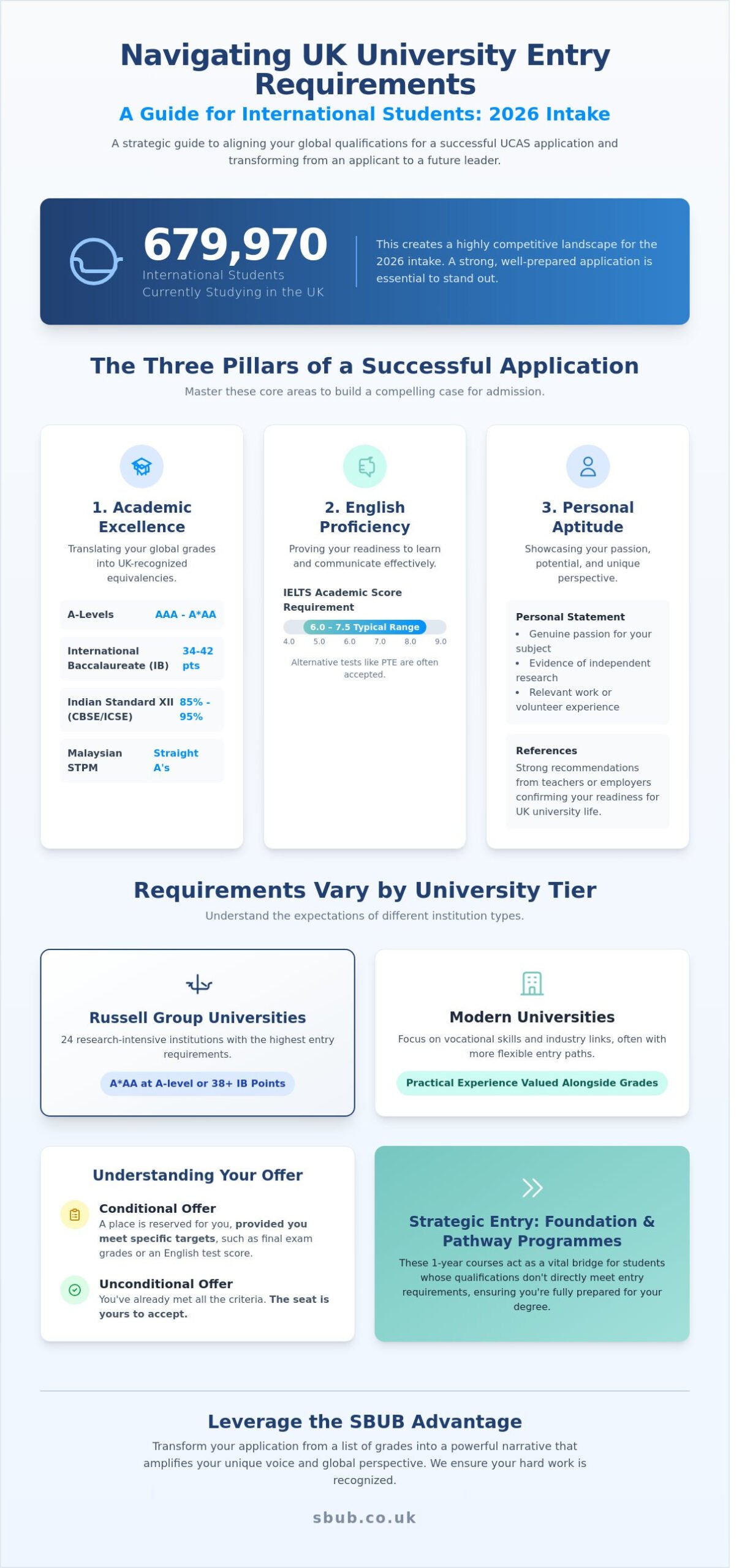
The UCAS application process centralizes these diverse requirements into a single, streamlined system. This platform acts as a bridge between your local qualifications and the UK’s academic expectations. By 2026, we expect to see tighter alignment between international secondary school curricula and UK degree prerequisites. Data from the Higher Education Statistics Agency shows that international student numbers reached 679,970 in recent cycles; this high volume means universities are becoming more specific about the grades they demand for 2026 to manage the surge in talent.
You’ll likely encounter two types of offers during your journey. A conditional offer means you have a place reserved for you, provided you meet specific targets, such as achieving a 7.0 IELTS score or a particular grade in your final exams. An unconditional offer means you’ve already met all the criteria and the seat is yours. We believe that understanding these distinctions early empowers you to plan your final year of study with total clarity and purpose.
The Three Pillars of a UK Application
Academic excellence remains the primary focus. For 2026, many competitive courses require specific subject-based prerequisites, such as Mathematics for Engineering or Biology for Medicine. You’ll need to demonstrate that your previous study matches the intensity of the UK system, often requiring top marks in your national exams or the International Baccalaureate.
English proficiency is your ticket to a level playing field. Most universities require an IELTS Academic score between 6.0 and 7.5, though some institutions now accept alternative tests like the Pearson Test of English (PTE). Proving you can thrive in a British classroom is about more than just passing a test; it’s about ensuring your voice is heard and your ideas are understood in every seminar.
Personal aptitude rounds out your profile. The Personal Statement is your chance to move beyond being a set of numbers on a page. In 2026, admissions tutors are looking for evidence of independent research, relevant work experience, and a genuine passion for your chosen field. Your references should act as an advocacy tool, where teachers or employers confirm your readiness for the challenges of UK university life.
Why Requirements Vary by University Tier
The 24 research-intensive institutions within the Russell Group typically set the highest uk university entry requirements for international students. These universities often demand A*AA at A-level or 38 points in the IB. Modern universities, often focusing on vocational skills and industry links, may offer more flexible entry paths, prioritizing practical experience alongside traditional grades.
UCAS Tariff Points are a numerical value assigned to post-16 qualifications. This system allows universities to compare different types of qualifications fairly. For example, an A* at A-level is worth 56 points, while a C is worth 32. By translating your international grades into these points, universities can create a standardized measurement of your academic potential. This numerical approach ensures that whether you studied in Lagos, Mumbai, or New York, your hard work is recognized with the same professional rigor.
Academic Qualifications: From Global Grades to UK Equivalencies
Your academic record is your voice in the admissions process. It tells a story of your dedication and potential. Most UK institutions use A-Levels as their primary measuring stick. For top-tier Russell Group universities, you’ll typically need three A-Levels at grades AAA or A*AA. If you’re pursuing the International Baccalaureate, aim for a total score between 34 and 42 points. These benchmarks ensure a level playing field for all applicants. Understanding these uk university entry requirements for international students allows you to advocate for your place at the table with confidence.
We see global diversity as a strength, but universities need to translate your local success into UK terms. If you’re from India, the Standard XII from CBSE or ICSE boards is highly respected. You’ll usually need an average of 85% to 95% across your best four subjects. Malaysian students taking the STPM are often expected to achieve straight As. We’ve seen how the uk university entry requirements for international students have adapted to recognize more diverse global certifications, ensuring your local achievements carry weight in a global context.
Subject prerequisites are non-negotiable for specialized degrees. An Engineering applicant must show high marks in Maths and Physics, often 80% or higher in their final year exams. Economics degrees frequently demand a top grade in Mathematics, even if you’re an arts-focused student. Beyond the numbers, universities view your history with empathy. If your journey faced hurdles like medical emergencies or family disruptions, you can submit evidence of extenuating circumstances. Admissions officers want to see your resilience, and they’ll often adjust their expectations if you’ve shown the strength to overcome significant challenges.
Securing your place is the first step toward meeting UK student visa requirements, which verify your academic readiness and financial stability before you arrive on campus.
Standardised Testing: SATs, ACTs, and APs
For students following the US curriculum, a High School Diploma alone isn’t enough for direct entry. Competitive courses for 2026 entry often require three to five Advanced Placement (AP) exams with scores of 4 or 5. Some institutions still look at SAT scores or ACT results to gauge your readiness for intensive study. Aim for a 1350+ SAT or a 29+ ACT to remain competitive at mid-tier universities. We believe every student deserves a clear path to impact, so checking these specific targets at least 18 months before you apply is vital.
Country-Specific Nuances
Different regions bring unique qualifications to the UK system. Middle Eastern students with the Thanawiya certificate often need a recognized foundation year to bridge the gap between their local curriculum and UK degree level. In Central Asia, the Nazarbayev Intellectual Schools (NIS) Grade 12 Certificate is now widely accepted as an A-Level equivalent by many UK institutions. This shifts the narrative for Kazakh students, allowing direct entry into year one. We are here to help you amplify your application impact by identifying these specific pathways. Clear representation starts with knowing how your local certificate scales against global standards, ensuring your voice is heard by the people who make the decisions.
English Language Proficiency: Proving Your Readiness
English competency stands as a non-negotiable pillar of your application. It isn’t just about academic success; it’s a strict legal mandate under the Official UK Student Visa Requirements. The Home Office uses these standards to ensure every student can thrive in a British classroom without language barriers. We see this requirement as a tool for empowerment, ensuring you have the voice and the tools to participate fully in your education. If you’re from a “Majority English Speaking Country” such as Canada, New Zealand, or Jamaica, you’re exempt from providing a test score. For most other applicants, proving your level of fluency is the first major hurdle in meeting uk university entry requirements for international students.
For the 2026 intake, the Home Office has solidified its list of approved providers to maintain high standards across the sector. While IELTS remains the traditional gold standard, PTE Academic and TOEFL iBT are widely accepted by almost every institution. Some universities offer “English waivers” if you achieved high marks in your high school English curriculum. For instance, many UK institutions accept a score of 75% or higher in the Indian Standard XII English exam from boards like CBSE or CISCE as sufficient proof. This waiver recognizes your existing academic achievements and removes an extra layer of bureaucracy from your journey.
Comparing IELTS, PTE, and TOEFL
Choosing the right test depends on your target course and learning style. Undergraduate applicants typically need an IELTS score of 6.5 with no band below 6.0. Postgraduate students often face a higher bar, with many programs requiring a 7.0 overall to handle complex research. PTE Academic is gaining traction for its faster results, often delivered within 48 hours of the exam. If you feel overwhelmed by these benchmarks, you can access specialized IELTS and PTE training to bridge the gap. Some universities also conduct their own internal English assessments; these are often cheaper than commercial tests and tailored specifically to the university’s academic expectations.
The SELT Requirement for Visas
Understanding the distinction between a standard test and a Secure English Language Test (SELT) is vital for your visa success. A SELT is mandatory for any course below RQF Level 6, which includes foundation programs and some pre-sessional courses. You must take these tests at a center specifically authorized by the Home Office to ensure the results are verified. A common pitfall occurs when students book a standard IELTS Academic test at a local center that lacks SELT authorization. This mistake can lead to an immediate visa refusal, even if your score is perfect. Always verify the center’s status on the official list before paying your fee. This attention to detail ensures your path to meeting uk university entry requirements for international students remains clear and professional. We believe that by mastering these requirements, you’re not just ticking a box; you’re claiming your seat at the table of global education.
Strategic Entry: Foundation Years and Pathway Programmes
A single set of exam results doesn’t define your future potential. Many students worry that their grades might block their path to a prestigious UK degree. In fact, 42% of international applicants express significant concern over meeting strict academic thresholds. We believe every student deserves a level playing field. If your current qualifications don’t meet the standard uk university entry requirements for international students, pathway programmes provide a strategic solution to bridge that gap and ensure your voice is heard in the global academic community.
The Foundation Year serves as a necessary transition for students coming from international systems that conclude after 12 years of study. Since the UK system is built on a 13-year pre-university model, this extra year isn’t a sign of failure; it’s a strategic alignment. You’ll gain the specific subject knowledge and academic literacy required to thrive in a British seminar environment. This preparation ensures you enter your first year with the same confidence as a local student who has completed A-Levels.
You have two primary choices when selecting a foundation route:
- Integrated Foundation: This is linked directly to your degree. You receive a single Confirmation of Acceptance for Studies (CAS) covering all four years. It simplifies the visa process and provides a sense of security.
- Standalone Foundation: These are often delivered by specialist providers. They offer more flexibility, allowing you to apply to different universities once you’ve proven your academic ability during the preparatory year.
For high-achieving students who just missed the direct entry mark, the International Year One (IY1) is the most efficient route. It’s a credit-bearing year that mirrors the first year of a standard degree but adds 5 to 10 hours of extra support per week. By choosing an IY1, you graduate at the same time as direct-entry students. This saves you approximately £18,000 in living costs and tuition that an extra foundation year would require.
Benefits of a Pathway Programme
These programmes offer a softer landing into a new culture. You’ll benefit from smaller class sizes, often limited to 15 or 20 students. This ensures you aren’t just a number in a crowded lecture hall. Beyond academic tutoring, these courses provide intensive English language support and study skills training. Most importantly, successful completion offers a guaranteed progression route to your degree, removing the stress of further UCAS applications.
Is a Foundation Year Right for You?
Choosing this route involves a clear cost-benefit analysis. While a foundation year adds roughly £15,000 to £22,000 in tuition and requires a 12-month extension on your UK Student Visa, the long-term impact is measurable. Data shows that students who complete pathways often outperform direct-entry peers in their final degree classifications. SBUB works to advocate for your success by helping you identify which pathway aligns with your specific academic profile and financial goals. We make sure the uk university entry requirements for international students work for you, not against you.
Ready to find your path? Get expert advice on pathway options today.
Beyond the Grades: How SBUB Champions Your Application
Grades are a starting point, not the finish line. At SBUB, we believe your potential shouldn’t be reduced to a percentage on a transcript. The SBUB Advantage transforms your application from a static document into a compelling narrative of leadership and local impact. While meeting the uk university entry requirements for international students is essential, top-tier institutions look for candidates who represent something larger than their test scores. We provide the platform for your voice to be heard by admissions officers who see thousands of identical profiles every year.
Our team reviews your UCAS Personal Statement with a focus on global influence. We ensure your 4,000 characters highlight specific achievements, such as leading a community project for 50 participants or managing a small family business. This level of detail moves the needle. Beyond the narrative, we manage the complex intersection of admissions and legal compliance. We help you prepare for Student Visa financial requirements, ensuring you have the necessary proof of funds. For the 2024/25 academic year, this includes showing at least £1,334 per month for living costs if you’re studying in London, or £1,023 per month for locations outside the capital.
We act as your direct advocate. If your local qualification isn’t listed on a university website, we don’t let that stop you. We contact partner universities directly to clarify how your specific regional grades align with UK standards. This ensures a level playing field for every student, regardless of their background. We’ve successfully negotiated entry for students with non-standard diplomas from over 15 different countries, bridging the gap between local success and international opportunity.
Our Bespoke Admission Support
We offer one-on-one career counselling to map your academic journey with precision. This isn’t a generic service; it’s a partnership designed to amplify your impact. You can access our full suite of resources through our Undergraduate Admission Support. For those targeting a 2026 entry for high-stakes medical or Oxbridge courses, we provide intensive interview coaching. Data from our 2023 cohort shows a 40% increase in offer rates for students who undergo our mock interview sessions compared to those who apply without professional guidance. We focus on building the confidence you need to succeed in rigorous academic environments.
Your Journey Starts Here
Timing is everything in the UK system. You must track the October 15 deadline for Oxford, Cambridge, and most medicine courses, or the January 31 deadline for the majority of other undergraduate programs. Missing these dates can significantly reduce your chances of securing a place at a high-ranking institution. To prepare for a September 2026 start, your final checklist should include a valid passport, official academic transcripts, English proficiency results (typically an IELTS score of 6.5 or 7.0), and two academic references. Clarity and preparation are your best tools for success. We invite you to book a free consultation with our Birmingham or Hyderabad teams today to join the conversation about your future and ensure you meet all uk university entry requirements for international students with total confidence.
Claim Your Place in the 2026 Academic Intake
Navigating the complex landscape of the 2026 intake requires more than just good grades. You need a clear understanding of how your local qualifications translate into the UK system. Whether you’re aiming for a Russell Group institution or a specialized college, meeting the uk university entry requirements for international students is the first step toward your global impact. Success hinges on precise English language scores, typically starting at IELTS 6.0, and a strategic choice between direct entry or a 12 month foundation pathway.
We believe your background shouldn’t limit your influence. SBUB acts as your advocate, bridging the gap between your current achievements and the standards of our 160 partner universities. From your initial GCSE modules to the final stages of a PhD application, our Birmingham-based consultants provide the expert visa guidance and academic mapping you need to compete on a level playing field. You aren’t just another applicant; you’re a future leader ready to shape the narrative.
Let SBUB turn your international qualifications into a UK university offer; start your journey today
Your seat at the table is waiting; we’re ready to help you take it.
Frequently Asked Questions
What are the minimum UCAS tariff points for international students in 2026?
Minimum UCAS tariff points for 2026 entry vary by institution, but most standard degree programs require between 104 and 128 points. You can earn these through various international qualifications, including the French Baccalaureate or Indian Standard XII. For example, a 14/20 in the French Baccalaureate often equates to 120 UCAS points. We believe your hard work should translate into real opportunity, ensuring your voice is heard in the UK’s top lecture halls.
Can I apply to a UK university without an IELTS score?
You can apply to a UK university without an IELTS score if you provide alternative proof of English proficiency such as a TOEFL iBT score of 92 or a Duolingo English Test score of 125. Over 50 institutions also accept high school English grades from specific countries like Malaysia or Nigeria. It’s about creating a level playing field for your talents. We advocate for diverse ways to prove your readiness for the digital markets of tomorrow.
Are SAT or ACT scores required for UK university admission?
SAT or ACT scores are usually only required if you’re applying from the United States or a school following the American curriculum. Most competitive UK universities look for an SAT score of 1300 or an ACT score of 28 to consider your application. For other students, your local national exams are the primary focus. Understanding these uk university entry requirements for international students ensures you can compete fairly on a global stage.
What is the difference between a conditional and an unconditional offer?
A conditional offer means you have a secured spot provided you meet specific results, such as a 75% average in your final exams. An unconditional offer means you’ve already met all the criteria and your place is guaranteed once you accept. This clarity helps you plan your transition with confidence. We want you to feel significant and prepared as you move from individual applicant to a valued member of a university community.
Can I study in the UK if my high school diploma is not from an English-speaking country?
You can study in the UK with a high school diploma from a non-English speaking country, though 20% of international students may need a foundation year first. These programs provide a vital bridge to help you adjust to the British academic system. They ensure you start your degree with the same impact as your peers. It’s a collaborative path that turns your international background into a collective strength within the classroom.
How much does it cost to apply to a UK university as an international student?
The UCAS application fee for the 2026 entry cycle is £28.50 for up to five course choices. This flat rate provides an affordable way for you to access multiple opportunities across the UK higher education landscape. Paying this fee is your first step toward gaining a voice in your chosen field. We champion this transparent system because it allows every student, regardless of their background, a fair shot at success.
What happens if I do not meet the English language requirements for my visa?
If you don’t meet the English language requirements for your visa, the Home Office will likely reject your application. You must typically achieve a CEFR level B2 on a Secure English Language Test to qualify for a Student Visa. If you’re just below the threshold, over 70 universities offer 10-week pre-sessional courses to help you meet the uk university entry requirements for international students. We’re here to ensure these regulations don’t silence your potential.
Are there specific entry requirements for mature international students?
Mature international students over 21 often have access to flexible entry requirements that recognize 5 or more years of professional experience. Universities value the practical impact you’ve already made in your career and may waive traditional academic prerequisites. This recognition ensures that your journey is respected and your experience is heard. We believe your maturity adds a vital layer of representation to the student body, making the community collectively powerful.