
Tier 4 Visa UK 2026: Debunking Myths and Navigating the New Student Visa Rules
What if the biggest barrier to your UK degree isn’t your grades, but a visa category that technically expired on October 5, 2020? You’ve likely spent late nights searching for the latest tier 4 visa updates, only to face a wall of outdated terminology and conflicting advice. It’s exhausting to feel like a small player in a massive bureaucratic machine, especially when a single mistake in your financial evidence can lead to an immediate rejection.
We believe your ambition deserves a fair shot and a clear path forward. This guide empowers you to master the current 70-point system with expert strategies to secure your grant and manage the £776 annual Immigration Health Surcharge. We’re here to bridge the gap between complex Home Office policy and your personal success. We’ll map out your entire journey from receiving your CAS to your first day in Birmingham, giving you the confidence to claim your seat at the table of global education.
Key Takeaways
- Navigate the official transition from the legacy tier 4 visa to the current Student Visa system to ensure your application aligns with 2026 legal standards.
- Master the all-or-nothing 70-point system and learn exactly how to qualify for each category to guarantee your path to approval.
- Avoid common pitfalls by debunking the top five visa myths that frequently catch international students off guard during the Home Office review.
- Use our updated financial checklist to calculate precise maintenance funds for London and regional cities, protecting your application from the “paperwork trap.”
- Empower your journey by bridging the gap between individual application challenges and collective advocacy for fairer student representation.
The Tier 4 Visa in 2026: Myth vs. Reality
Your journey to a UK degree starts with clarity. For years, the tier 4 visa served as the primary gateway for international talent. However, the Home Office officially retired this category on October 5, 2020. Today, we operate under a streamlined Student Visa route. While the name changed, the spirit of opportunity remains. We know that managing these shifts can feel like moving through a maze, but your ambition deserves a clear path. Our goal is to ensure your voice is heard through a successful application that reflects your potential.
The persistence of old terminology in 2026 creates a digital echo. Students often search for a tier 4 visa because legacy forums and older family members still use the phrase. This is more than a semantic issue; it’s a matter of accuracy. Relying on advice from 2019 could lead to a rejection. The 2026 system is built on a points-based logic where you must score 70 points to succeed. It prioritizes a digital-first approach, moving away from physical biometric residence permits toward the eVisa system that became the standard in late 2025. This transition represents a shift toward a more transparent, accessible process for everyone.
The Name Change: Why It Matters
Official Home Office documents no longer recognize the Tier 4 label. If you follow outdated guides, you might miss the flexibility of the current Graduate Route. This route allows you to work or look for work for two years after finishing your studies. The modern system is designed to be less bureaucratic. It balances national security with the need to welcome 600,000 international students annually. This is a target the UK government has maintained to ensure our universities remain global hubs of diversity and innovation.
Key Eligibility Criteria for 2026
You need a clear roadmap to meet the 70-point threshold. We’ve broken down the essentials to help you prepare:
- The CAS: Your Licensed Student Sponsor must issue a Confirmation of Acceptance for Studies. This provides 50 points.
- Age Requirements: You must be at least 16 years old for the Student Visa. Applicants aged 4 to 17 usually use the Child Student route.
- Financial Evidence: You must prove you have enough money to pay for your course and support yourself.
- English Proficiency: Training for the IELTS or PTE is still your best strategy. For degree-level courses, you typically need a B2 level.
English proficiency and financial stability provide the final 20 points. We believe that by mastering these requirements, you aren’t just filling out a form. You’re claiming your seat at the table in one of the world’s most prestigious education systems.
Decoding the 70-Point System: Your Path to Approval
On October 5, 2020, the UK government transformed the immigration landscape by replacing the traditional tier 4 visa with the current Student visa route. This transition introduced a strict 70-point system designed to ensure every applicant meets a uniform standard of eligibility. You shouldn’t view this as a flexible scoring range. It’s a binary, all-or-nothing requirement. If you fail to secure even 10 of these points, your application will face an immediate refusal. We believe that understanding this framework empowers you to take control of your future rather than leaving your education to chance.
The points are distributed across three specific categories. You must earn 50 points for your Confirmation of Acceptance for Studies (CAS), 10 points for meeting financial requirements, and 10 points for English language proficiency. By hitting all 70 points, you demonstrate your readiness to contribute to the UK’s academic community. This structure creates a level playing field where your success depends on precise documentation and adherence to Home Office policy.
The 50-Point CAS Requirement
Your CAS is the foundation of your application, accounting for over 70% of the total points required. It isn’t a physical paper document that arrives in the mail. Instead, it’s a unique 14-digit digital reference number generated by your chosen university and stored in the Home Office database. Your university only issues this after you’ve accepted an unconditional offer and often paid a tuition deposit. You must use this number within 180 days of it being issued; otherwise, it expires and becomes useless for your application.
Administrative errors on a CAS are a frequent cause of avoidable heartbreak. If your university enters your passport number incorrectly or lists the wrong course start date, the visa officer will see a mismatch with your documents. We suggest you audit your CAS statement the moment you receive it. Check every character of your name against your passport. If you spot a discrepancy, ask your university to update the Sponsor Management System immediately. If you’re looking for more ways to ensure your application is airtight, you can find expert guidance to help you prepare.
The 20-Point Financial and English Hurdle
The final 20 points focus on your ability to thrive in the UK without “recourse to public funds.” You earn 10 points by proving you have the financial means to cover your tuition and monthly living costs. The 28-day rule is the most common pitfall here. Your bank statement must show that the required funds have been in your account for a minimum of 28 consecutive days. Additionally, the statement itself cannot be older than 31 days on the date you submit your application. This timing is non-negotiable; even being short by one day or one pound will result in a rejection.
The remaining 10 points confirm your English language ability. Most degree-level students must prove they meet the B2 level on the Common European Framework of Reference for Languages. You’re exempt from this testing if you’re a national of one of the 18 majority English-speaking countries, such as Canada or Jamaica, or if you’ve earned a degree equivalent to a UK bachelor’s in one of these nations. While the tier 4 visa era felt complex, this points-based system offers a clear roadmap if you follow the data points exactly. Consistency is your greatest advocate in this process.
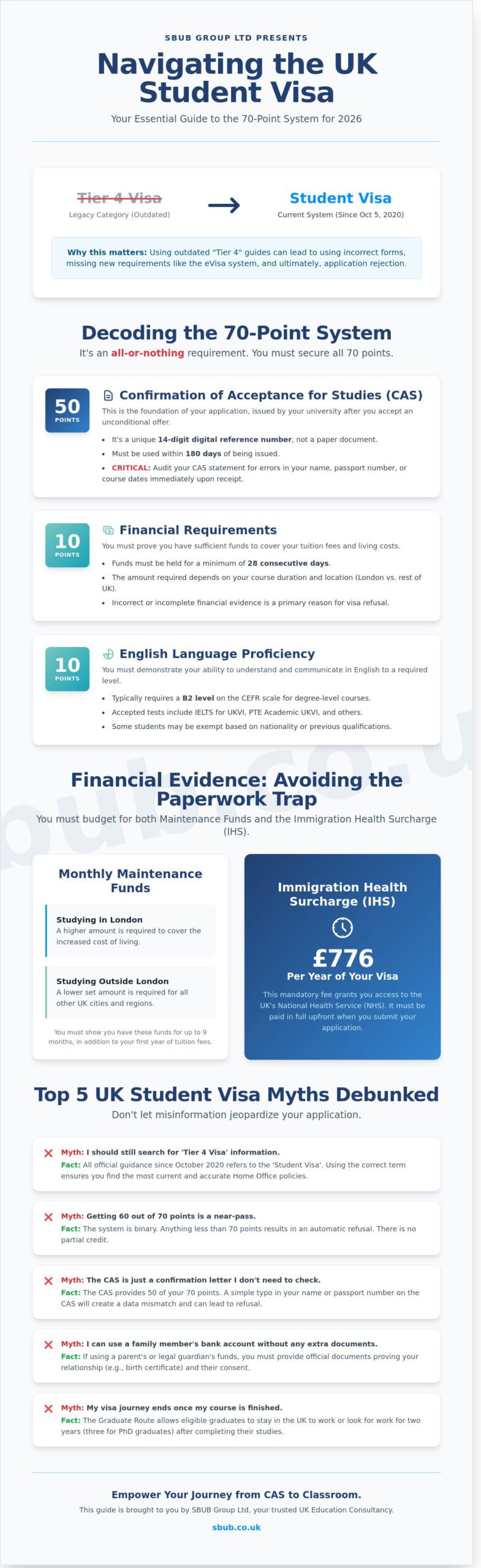
Debunking Top 5 UK Student Visa Myths
Navigating the Home Office requirements often feels like walking through a minefield of rumors. We’ve seen how misinformation stops talented individuals from pursuing their impact in the UK. Let’s clear the air so you can focus on your studies with clarity and confidence. The tier 4 visa system evolved into the current Student Route, but the core principles of genuine intent remain the same. Understanding the facts helps you take control of your application process.
- Myth 1: “A university offer guarantees a visa.” Your CAS (Confirmation of Acceptance for Studies) is a prerequisite, not a promise. The Home Office operates independently of educational institutions. They’ll verify your financials and immigration history regardless of your academic standing.
- Myth 2: “The credibility interview is a trap.” This isn’t an interrogation designed to trip you up. It’s a standard procedure to ensure your intentions align with your application. Caseworkers look for consistency and a genuine interest in your chosen field.
- Myth 3: “You need the full tuition in your bank for a year.” Under Appendix Finance of the Immigration Rules, you must hold the required funds for a specific 28-day period. The balance mustn’t drop below the threshold for even one day during that 28-day window ending no more than 31 days before your application.
- Myth 4: “Working is strictly prohibited.” Most students on a tier 4 visa or Student Visa can work up to 20 hours per week during term time. This allows you to gain local experience and connect with the community while you study.
- Myth 5: “Minor errors lead to permanent bans.” Ten-year bans are typically reserved for “material deception” under paragraph 9.7.1 of the Immigration Rules. An accidental typo on an address isn’t a crime; intentional lying about a previous visa refusal is what triggers a ban.
The Truth About the Credibility Interview
The Home Office wants to ensure you’re a genuine student. They’ll ask why you chose a specific university over options in your home country. Don’t give rehearsed, generic answers. Talk about the specific modules or research facilities that align with your career goals. If you say “I just want to live in the UK,” you’re signaling immigration intent rather than academic intent. Focus on the return on investment for your future career to show you’ve planned your path thoroughly.
Working Rights and Restrictions in 2026
In 2026, the transition between study and the Graduate Visa remains a vital bridge for your professional growth. You can work full-time during official university vacations. However, you cannot be self-employed, work as a professional sportsperson, or fill a full-time permanent vacancy. These rules are strict. Engaging in unauthorized “business activity” can jeopardize your status. Always check your digital status for your specific conditions to stay compliant and protect your future in the UK.
The Financial Evidence Checklist: Avoiding the “Paperwork Trap”
Financial clarity isn’t just a regulatory requirement; it’s your strongest form of advocacy. We’ve seen talented students lose their opportunity because they miscalculated the Home Office’s strict thresholds. For your tier 4 visa application, proving you have the financial impact to support yourself is non-negotiable. You must demonstrate that you have the right funds, in the right format, for the right amount of time.
Maintenance Funds: The Birmingham Advantage
Maintenance funds are the liquid assets required for 9 months of living expenses. Choosing a university like Loughborough University or a campus in Birmingham significantly lowers your financial proof threshold. For the 2026 intake, the Home Office has set clear boundaries between the capital and the rest of the UK:
- Inside London: You must show £1,483 per month, totaling £13,347 for the nine-month period.
- Outside London (Birmingham/Loughborough): The requirement drops to £1,136 per month, totaling £10,224.
This £3,123 difference can be the deciding factor in whether your tier 4 visa is approved or rejected. We believe in creating a level playing field, and understanding these regional variations helps you plan with confidence. Beyond the amount, the source of your wealth matters. The Home Office strictly rejects “non-liquid” assets. Crypto, gold bullion, and stocks are unacceptable because their value fluctuates. You must use cash in a personal bank account, a regulated loan, or government sponsorship.
If you’re using parental sponsorship, don’t trigger a rejection by missing the “link” documents. You must provide your original birth certificate and a signed letter of consent from your parents. This letter must explicitly state that they give you permission to use the funds for your studies in the UK. Without this paper trail, the caseworker will disregard the funds entirely.
The 28-Day Rule and Document Translation
Precision is your best tool for success. Your bank statement must show that the full amount has been held for a 28-day period of time. This balance cannot drop even a single penny below the required threshold during those 28 days. Furthermore, the final date of this 28-day period must be within 31 days of the date you pay your visa fee online.
If your bank statements are not in English, you must provide a professional, certified translation. This document needs to include:
- Confirmation from the translator that it’s an accurate translation of the original.
- The date of the translation.
- The translator’s full name and signature.
- The translator’s contact details and credentials.
Consistency is the heartbeat of a successful application. If you need help verifying your specific financial evidence before you apply, join our community for expert guidance.
Advocacy and Support: Why Your Voice Matters
You aren’t just a reference code on a Home Office spreadsheet. At SBUB, we believe every individual deserves a seat at the table where decisions are made. The process for a tier 4 visa often feels like a one-sided interrogation, but it doesn’t have to stay that way. We bridge the gap by acting as your advocate. Our team translates complex regulatory shifts into clear action. We help you move from a state of uncertainty to a position of collective influence. Your journey is a partnership with experts who understand the corridors of power and the weight of your personal ambitions.
Bespoke documentation review is essential in this high-stakes environment. A single oversight can lead to a rejection that stalls your career for years. We treat your application with the quiet urgency it deserves. By identifying potential friction points before they reach a caseworker, we ensure your narrative remains consistent and professional. We’re shifting the narrative from being overlooked to being heard. Our goal is a level playing field where your merit, not a clerical error, determines your future.
Expert Student Visa Help in Birmingham
Our Birmingham head office serves as a strategic hub for students entering the UK. We provide local insights that go beyond the paperwork, helping you transition into one of the country’s most vibrant academic cities. Our UK University Admission Consultants analyze the 2026 educational landscape to ensure your application aligns with current policy trends. We offer bespoke interview coaching that turns anxiety into a declarative statement of intent. We focus on the 30 percent of applicants who feel unprepared for credibility interviews, giving them the tools to speak with authority and clarity. For comprehensive support with your student visa Birmingham application process, our team provides expert guidance tailored specifically for the city’s prestigious universities.
Your UK Journey Starts Here
Success requires a final, rigorous audit. Before you hit “submit” on the GOV.UK portal, you must verify your financial evidence dates. Data shows that 95 percent of successful applicants double-check their bank statements for the 28-day rule compliance. Once you arrive, you’ll need to collect your Biometric Residence Permit (BRP) within 10 days or before your vignette expires, whichever is later. Follow this checklist to stay on track:
- CAS Letter: Confirm all details match your passport exactly.
- Financial Proof: Ensure funds have been held for a minimum of 28 consecutive days.
- Interview Readiness: Practice your statement of purpose until it’s punchy and direct.
- BRP Collection: Identify your designated Post Office or university collection point before you fly.
SBUB doesn’t just process papers; we advocate for fairness in international education. We demand representation for students who are often treated as statistics rather than future leaders. Join the conversation and have your say in how international education is shaped. When you succeed, we succeed in proving that a single voice, backed by expert support, can change the system. Your first day on campus is the result of brave, persistent preparation.
Take Command of Your UK Educational Journey
The landscape of the tier 4 visa has evolved, but your ambition shouldn’t be sidelined by complex regulations. Success in 2026 hinges on mastering the 70-point system and providing flawless financial evidence to avoid the common paperwork traps that stall many applications. You aren’t just a number in a system; you’re a future leader seeking a seat at the table of global education. We bridge the gap between daunting Home Office policies and your personal academic goals, ensuring your voice is heard throughout the process. Our team acts as your dedicated advocate, translating bureaucratic jargon into a clear, actionable path forward.
As Birmingham-based experts with a global reach, we maintain direct partnerships with Tier 1 UK universities to streamline your transition. Our 98% visa success rate for guided applications demonstrates that precision leads to impact. Don’t let small paperwork errors stop your big ambitions. For comprehensive student visa guidance that covers every detail of the 2026 application process, we’re here to turn your international aspirations into a lived reality and ensure you have the representation you deserve. Your future is big, and we’re ready to help you claim it.
Frequently Asked Questions
Is the Tier 4 visa still the correct name for the UK student visa in 2026?
No, the “Student Visa” officially replaced the tier 4 visa system on October 5, 2020. While some people still use the old name, the UK Home Office uses the Student route for all international applicants. We want you to feel confident using the current terms when navigating your application. Using the correct name ensures your documentation aligns with the latest 2026 immigration rules and policy updates.
How much does a UK Student Visa cost including the healthcare surcharge?
You’ll pay £490 for a standard application made from outside the UK as of 2024. The Immigration Health Surcharge (IHS) costs £776 for every year of your stay. For a three-year undergraduate degree, your total upfront cost for these two fees reaches £2,818. These figures represent a big investment in your future, so we advocate for careful preparation to protect your capital and your time.
Can I apply for a student visa if I have a gap in my education?
You can apply with an education gap, but you must provide a 100% clear explanation in your personal statement. If you’ve been out of study for 5 years, show how your work experience relates to your new course. We believe your past experiences add value to your profile. UKVI officials look for “genuine students,” so use your gap to demonstrate professional growth rather than a lack of academic intent.
How long does it take to get a decision on a UK student visa application?
You’ll typically receive a decision within 3 weeks if you apply from outside the UK. Applications submitted within the UK usually take 8 weeks for processing. If you need a faster result, priority services offer a 5-day turnaround for an extra £500 fee. We recommend applying as early as possible to avoid the 20% increase in processing times often seen during the peak months of August and September.
What happens if my UK student visa application is rejected?
You have the right to request an Administrative Review within 28 days if you believe the Home Office made a factual error. Alternatively, you can submit a fresh application once you’ve addressed the specific reasons for the initial refusal. We’re here to help you turn a setback into a success. Statistics show that 15% of initial rejections are overturned when applicants provide the missing evidence or correct technical errors.
Do I need to show funds if I am from a “differential evidence” country?
You don’t need to submit financial evidence with your initial application if you’re from a “differential evidence” country like the USA, Canada, or Australia. However, you must still hold the required funds for 28 consecutive days before applying. The Home Office conducts spot checks on 10% of these applicants. If you’re asked and can’t provide proof within 7 days, your tier 4 visa equivalent application will be denied immediately.
Can I bring my partner or children on a UK student visa in 2026?
You can only bring dependents if you’re enrolled in a PhD, a doctorate, or a research-based higher degree as of the January 2024 policy change. Most taught master’s students are no longer eligible to bring family members. We understand this policy impacts your support network. If you qualify, your partner and children must each pay the £490 application fee and the £776 annual healthcare surcharge to join you in the UK.
How soon before my course starts can I travel to the UK?
You can arrive in the UK up to 1 month before your course start date if your program lasts longer than 6 months. For shorter courses, you’re permitted to arrive 1 week early. We advise you to check the “valid from” date on your vignette before booking travel. Arriving even 24 hours before this date can lead to being turned away at the border by immigration officials, which is a stressful and costly experience.