
Average SAT Score in 2026: A Global Guide for International Students
Did you know that while the global average sat score hovered around 1028 in 2023, the full transition to the Digital SAT in 2024 has fundamentally changed how your performance is measured? You likely feel that this shift has added a layer of complexity to an already high stakes application season. It’s a common concern for international students who worry their results might be misunderstood by admissions teams outside the United States. We believe that your academic potential should never be lost in translation, especially when you’re aiming for a competitive spot in a UK university.
We are here to bridge that gap and ensure your hard work creates a significant impact on your future. In this guide, you’ll discover the latest 2026 score benchmarks and exactly how admissions officers at institutions like Oxford or King’s College London interpret your results. We’ll break down the confusing divide between percentiles and raw scores while providing a clear roadmap to elevate your standing. Whether your current score feels small or you’re already hitting top marks, we’ll help you use these numbers to claim your seat at the table.
Key Takeaways
- Gain clarity on the 2026 national data and understand how the average sat score serves as a vital indicator of your global academic standing.
- Learn to look beyond the mean by identifying the specific percentile range that makes your application competitive at elite institutions.
- Uncover the strategic value of the SAT as a recognized alternative to A-Levels or IB for international students entering the UK market.
- Identify actionable ways to close your “score gap” and build the confidence necessary to move from a standard result to an exceptional one.
- Discover how professional advocacy and career counseling help you interpret test data to ensure your unique potential is recognized by admissions officers.
Understanding the National Average SAT Score in 2026
We believe that every student deserves a clear path to higher education, and the Scholastic Aptitude Test (SAT) serves as a vital bridge to that future. It functions as a global benchmark, providing a standardized language that allows universities to evaluate your readiness on a level playing field. Whether you’re applying from a local high school or an international academy, this assessment ensures your voice is heard by admissions officers who manage thousands of diverse applications. In the upcoming 2026 cycle, the average sat score will remain a pivotal metric for students aiming to understand their standing in a competitive global market.
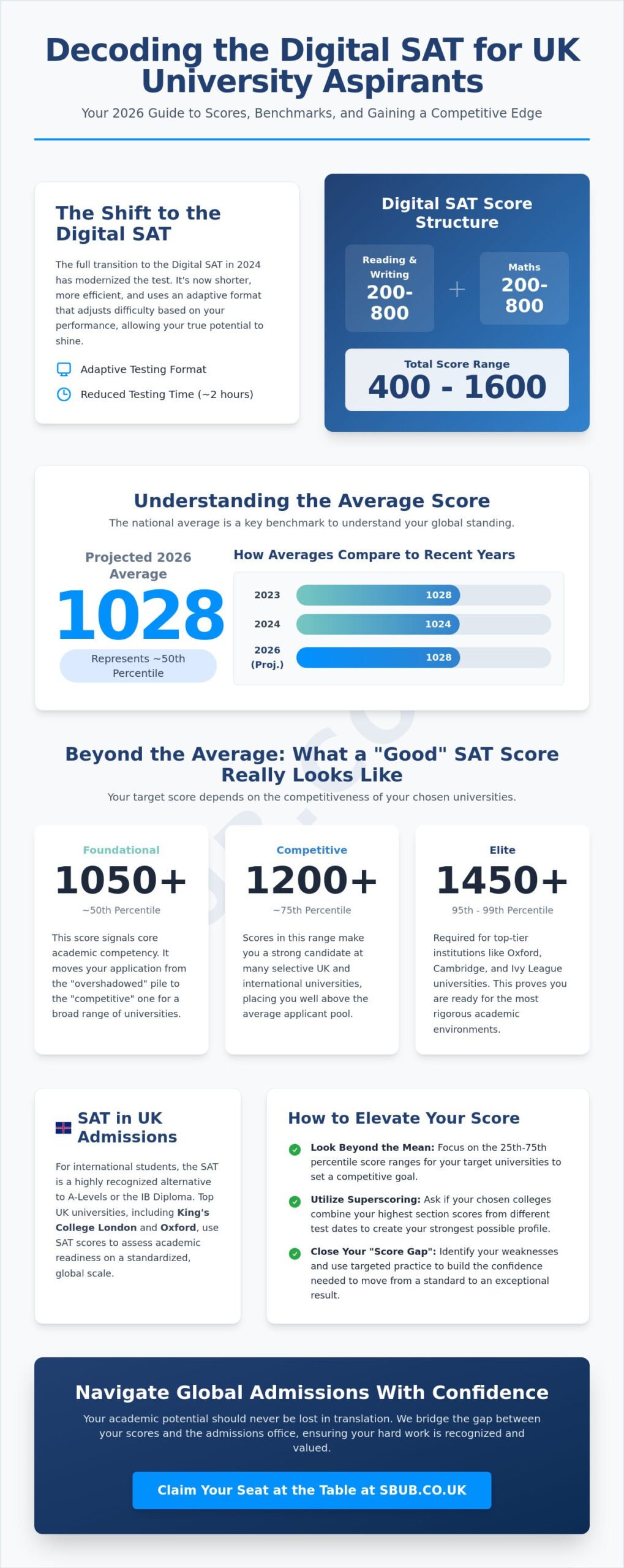
The 1050 benchmark is a significant milestone for many applicants, as it historically represents the 50th percentile. Reaching this score means you’ve performed better than half of the test-taking population. We see this as a foundational goal that signals your core competency in college-level skills. While a score is just one part of your story, hitting this national mean helps move your application from the “overshadowed” pile to the “competitive” one. It’s about building collective agency through individual achievement, proving that you have the tools to succeed in rigorous academic environments.
Digital SAT Score Scales: ERW and Maths
The Digital SAT maintains the traditional 400 to 1600 total scale, but the way you reach that number has changed. The test is split into two primary sections: Evidence-Based Reading and Writing (ERW) and Maths, each scored on a 200 to 800 scale. The adaptive nature of the digital format means the test adjusts its difficulty based on your performance in the first module. If you perform well early on, the second module becomes more challenging, which is necessary to reach the highest score tiers. This efficiency reduces testing fatigue and allows your true potential to shine without the weight of a three-hour paper marathon.
Historic Trends: How 2026 Averages Compare to Previous Years
Recent data indicates that national averages often fluctuate based on participation rates and changes in test accessibility. The Class of 2024 saw an average score of 1024, a slight decrease from previous years as more students from varied backgrounds entered the testing pool. This expansion of the “testing voice” is a positive trend for representation, even if it causes minor dips in the mean. As students and educators become more familiar with digital preparation tools, we expect to see a stabilization of these figures. For the 2026 testing year, we project the national mean score will reach 1028.
Understanding these trends helps you set realistic goals. We encourage you to look beyond the numbers and see them as a way to shape your future. By mastering the digital format, you aren’t just answering questions; you’re demanding a seat at the table in the global academic community. We’re here to ensure that the transition to the 2026 standards is a journey you take with confidence and clarity.
Percentiles and Benchmarks: What a “Good” SAT Score Really Looks Like
Your SAT score is more than a summary of your math and reading skills; it’s a tool for advocacy in your academic journey. While the College Board reports that the average sat score typically lands near 1050, this figure is just a baseline for the global student population. For an international student, “good” is a relative term defined by your target institution’s standards. We see this data as a way to create a level playing field where your performance gives you a seat at the table.
To compete effectively, you must analyze the 25th and 75th percentile scores of your chosen universities. If your score sits at the 25th percentile, you’re in the bottom quarter of admitted students. Reaching the 75th percentile means you’ve outperformed 75% of your peers, placing you in a position of strength. Top-tier institutions, such as MIT or Harvard, typically require scores between 1450 and 1600. These numbers aren’t just hurdles; they’re proof of your readiness to impact global research fields. You can also utilize “superscoring,” a policy where colleges combine your highest section scores from different test dates. This helps you shift from a standard average sat score to an elite profile by focusing on your individual growth over time.
Defining “Good” Based on Your Goals
Elite US institutions demand excellence, often setting benchmarks above 1500. Competitive international universities in the UK or Singapore frequently look for 1400 or higher to ensure academic parity. Beyond admission, these scores act as a primary filter for merit-based scholarships. Securing a high score can mean the difference between self-funding and receiving a full ride. You’re not just applying; you’re shaping your future through strategic preparation and clear intent.
The 90th Percentile: Entering the Top 10%
Achieving a 1350 or higher places you in the 90th percentile globally. This is a critical threshold. At this level, the admissions conversation shifts from “can you pass?” to “how will you contribute?” This score signals to officers that you possess the persistence required for rigorous study. For international applicants, hitting 1350+ is often the baseline for being considered competitive in a pool of thousands. It’s about making your voice heard in a crowded room. You’re moving from a state of individual concern to collective agency in the academic world.
The Role of SAT Scores in UK University Admissions
You might hear that British universities only value A-Levels or the IB. This is a common misunderstanding that limits your potential. In reality, the SAT serves as a powerful bridge for students coming from the US or other international systems. It translates your academic ability into a language that UK admissions officers understand. Your score acts as a vital data point in your UCAS application; it ensures you aren’t overlooked because of a different grading scale. The National Center for Education Statistics provides data showing that while the average sat score in the US often hovers around 1028, competitive UK applicants should aim significantly higher to secure their place.
Using the SAT creates a level playing field. It allows you to stand alongside students from London or Manchester with the same academic authority. By submitting your scores, you’re demanding a seat at the table; you’re proving that your education has prepared you for the intensity of a UK degree. This is about representation. It’s about making sure your hard work in a non-UK system carries the weight it deserves during the 2026 admissions cycle.
UK University Requirements for SAT Scores
Top-tier institutions within the 24-member Russell Group typically look for scores between 1350 and 1550. For instance, if you’re applying to a competitive law or engineering program, a score of 1480 or above is often the benchmark. While the average sat score for all global test-takers is a helpful baseline, your target should be defined by your specific course expectations. These results don’t exist in a vacuum. They complement your personal statement and your performance in GCSE-equivalent subjects. If you’re feeling overwhelmed by these requirements, working with UK University Admission Consultants can help you align your testing timeline with the 2026 UCAS deadlines.
SAT vs. ACT: Which is Preferred by UK Admissions Officers?
UK admissions teams don’t have a preference between the two tests. They treat them as equal measures of your verbal and mathematical reasoning. What matters most is your consistency. If you’ve taken the SAT multiple times, they want to see your growth and your highest achieved sections. You can explore the detailed SAT vs. ACT comparison to see which format fits your learning style best. Ultimately, the goal is to present a profile that highlights your individual impact and academic readiness. Choose the test that allows your voice to be heard most clearly.
How to Improve Your SAT Score: Moving Beyond the Average
Moving beyond the average sat score requires a strategic bridge between your current performance and your ultimate target. We call this the “score gap.” If your initial diagnostic test sits at 1050 but your target university requires a 1450, you have a 400-point mission. This journey isn’t just about a number; it’s about ensuring your academic voice carries the weight it deserves in a competitive global market. You aren’t just a statistic. You’re a candidate building a case for your future.
We recommend a 90-day study plan that prioritizes your weakest areas. Spend 65% of your preparation time on the sections where you consistently lose points. Use the official College Board Bluebook app to take at least five full-length practice exams. These sessions do more than teach content; they desensitize you to test anxiety. By the time test day arrives, the digital interface will feel familiar, and the pressure will feel manageable. You’ll move from a state of individual concern to a feeling of total agency over your results.
Mastering the Digital SAT Format
The Digital SAT is adaptive, meaning your performance in the first module determines the difficulty of the second. If you don’t perform well in the initial module, the system will not present the “hard” version of the second module, effectively capping your maximum possible score. You must treat the first module with absolute precision to keep the path to a high score open. Time management is your next priority. With only 71 seconds per Reading and Writing question, you don’t have time for hesitation. Use the “Mark for Review” tool to keep your momentum steady.
In the Maths section, your proficiency with the built-in Desmos calculator is a game-changer. Proficiency in this tool can save you 15 minutes of manual calculation, allowing you to focus on complex problem-solving rather than arithmetic. We believe that mastering these digital tools creates a level playing field for every student, regardless of their background.
When to Retake the SAT
While we advocate for persistence, you must recognize the law of diminishing returns. Data suggests that SAT scores typically plateau after three attempts. If your score hasn’t shifted by more than 20 points between your second and third try, your time is better spent strengthening other parts of your application, such as your personal statement or extracurricular impact. Representation matters, and a well-rounded profile often speaks louder than a fourth test attempt.
Timing is everything when planning your retakes. You must align your testing schedule with university deadlines to ensure your results arrive in time for consideration. To meet the January 31 UCAS deadline, you should aim for a second SAT attempt no later than the December test date of your final school year. This ensures you have a seat at the table when admissions decisions are made.
Your journey to a better score is about more than just beating the average sat score; it’s about proving your potential to the world. We are here to help you navigate these digital markets and find your voice. Join our community at SBUB to access more resources that help you shape your future and maximize your impact.
Navigating Global Admissions with SBUB Group
Your application is more than a collection of digital documents. It’s your story. At SBUB Group, we act as an empathetic champion for students who find the 2026 admissions cycle complex or intimidating. While the average sat score provides a vital benchmark for academic readiness, it doesn’t capture your full potential as a future leader. We believe every international student deserves a level playing field. Professional career counselling transforms your raw test data into a compelling narrative of ambition and impact.
We bridge the gap between a standardized result and a successful enrolment. Our team understands both the local Birmingham landscape and the shifting requirements of the global market. We don’t just help you apply; we advocate for your right to be heard by admissions officers. You’re moving from a state of individual concern to a position of collective agency. By interpreting your data through a lens of fairness, we ensure your application carries the weight it deserves.
Our Bespoke Support for International Students
We provide a clear path through the noise. From specific SAT prep guidance to visa assistance in Birmingham, our support is tailored to your unique journey. Understanding the UK school system is vital for students transitioning from international backgrounds. We simplify these structures to ensure you make informed choices. Our commitment is simple: we make sure your voice is heard in every office where decisions are made.
Take the Next Step in Your Educational Journey
Success in 2026 requires early action and a steady strategy. You can book a consultation today to receive personalised support that aligns with your specific goals. Starting early is especially important if you need accommodation assistance, as the Birmingham housing market moves quickly. We’re here to ensure you aren’t just another number in a database. We help you secure your home and your future simultaneously.
Your future shouldn’t be dictated by scale or status. Whether you’re aiming for the average sat score or striving for the top percentile, you need a partner who values your individual contribution. Join the conversation and let us help you shape your future. Partner with SBUB for your UK university journey and turn your academic dreams into a tangible reality. We’re ready to help you take your seat at the table.
Taking Command of Your Global Academic Journey
Your journey toward a global education in 2026 starts with a clear understanding of the data. While the average sat score reported by the College Board remains a baseline, reaching top-tier Russell Group institutions requires moving beyond the median. Success in the 2026 admissions cycle depends on your ability to translate these numbers into a narrative of potential. We believe every international student deserves a seat at the table. Whether you’re aiming for a 1300 or a perfect 1600, your score is a tool to amplify your voice in a competitive market.
Navigating complex visa regulations and university benchmarks shouldn’t feel like a solo mission. We’ve built a global network of partner universities to ensure your application carries the weight it deserves. We provide specialised support for international student visas alongside expert career counselling and test prep advice. You’re ready to make an impact; we’re ready to help you lead the way and shape your future.
Start your UK university application with expert guidance from SBUB Group and turn your academic goals into reality.
Frequently Asked Questions
What is the average SAT score for the Class of 2026?
The projected average sat score for the Class of 2026 is approximately 1050 based on current College Board performance data. This figure represents the midpoint for nearly 1.9 million students who take the exam each year. While this score serves as a global baseline, you should aim for the 75th percentile, typically above 1200, to ensure your application has a significant impact during the competitive admissions process.
Is a 1200 SAT score good for UK universities?
A 1200 SAT score is a solid entry point for many respected UK institutions like the University of Reading or the University of Surrey. It places you in the top 25 percent of test-takers globally, which demonstrates strong academic potential. However, highly selective programs often require scores between 1350 and 1500. We believe your score should reflect your unique voice and open doors to a level playing field in higher education.
Do UK universities require the SAT for international students?
UK universities don’t universally require the SAT, but they frequently accept it as a standardized measure for international applicants. Institutions like King’s College London often ask for a score of 1290 or higher if you aren’t providing A-level results. You should check the specific requirements on the UCAS portal for your chosen course. Providing a strong score helps you join the conversation with admissions officers at elite global institutions.
How many times should I take the SAT to reach the average?
You should plan to take the SAT two or three times to reach or exceed the average sat score. Statistics from the College Board show that 55 percent of students improve their results on their second attempt. Taking the exam multiple times allows you to use superscoring. This is where universities combine your highest section results from different dates to create a more powerful representation of your academic abilities.
What is the difference between an SAT percentile and a score?
Your SAT score is a specific number between 400 and 1600, while your percentile shows how you rank against other students. For example, a score of 1210 puts you in the 76th percentile, meaning you performed better than 76 percent of test-takers. Understanding this distinction helps you advocate for your academic standing. It shifts the narrative from just a number to a clear demonstration of your collective rank among global peers.
Can I get into a Russell Group university with an average SAT score?
Gaining admission to a Russell Group university with a score of 1050 is difficult because these 24 elite institutions usually require scores above 1300. Universities like Oxford or LSE often set their benchmarks at 1450 or higher. If your score is lower, you can still make an impact by highlighting exceptional grades in your local curriculum. We recommend focusing on a holistic application to show you’re a vital candidate despite a smaller test score.
Does the Digital SAT have a different average score than the paper version?
The Digital SAT uses the same 1600-point scale as the previous paper version, so average scores remain statistically consistent. The College Board uses a process called equating to ensure a 1200 on the digital test represents the same level of ability as a 1200 on paper. This consistency provides a fair environment for everyone. It ensures your digital performance is judged by the same rigorous standards as cohorts from previous years.
How does the SAT score impact my UK student visa application?
Your SAT score doesn’t directly affect your UK student visa application because the Home Office focuses on your Confirmation of Acceptance for Studies and financial evidence. However, a high score helps you secure an unconditional offer from a licensed sponsor university. Once you have that offer, you must still meet English language requirements, such as a 6.5 minimum score on the IELTS. Your academic success is the first step toward shaping your future abroad.