
The UK School System Explained: A Comprehensive 2026 Guide for International Students
What if the difference between a top-tier university offer and a rejected application isn’t your talent, but your understanding of a single acronym? The uk school system is a world-class engine of opportunity, yet for the 679,970 international students currently pursuing their goals in Britain, it often feels like a maze of A-Levels, T-Levels, and regional variations. You’ve likely felt the weight of choosing between a BTEC or a traditional academic route while worrying that one wrong turn might close the door to your dream career.
It’s frustrating to feel that your global ambitions are being held back by complex terminology and differing standards across England, Scotland, Wales, and Northern Ireland. We believe every student deserves a level playing field, which is why this 2026 guide breaks down the British education framework into manageable, actionable steps. You’ll master the academic timeline, identify which qualifications lead to elite universities, and gain the confidence to start your application with absolute clarity. We’re here to help you move from a state of individual concern to a position of collective agency in shaping your future.
Key Takeaways
- Understand the fundamental structure of the uk school system from ages 5 to 18 to ensure your child starts on a level playing field.
- Identify the critical milestones between primary and secondary education, including why Year 9 is the essential foundation for future academic success.
- Navigate the high-stakes choices at age 16 by comparing the specialized depth of A-Levels with the global breadth of the International Baccalaureate.
- Master the UCAS application process and degree structures to bridge the gap between secondary school and your ultimate career goals.
- Discover how an expert partner can amplify your voice and simplify the transition, turning complex educational policy into a clear path for your family’s impact.
The Architecture of Learning: Understanding the UK School Framework
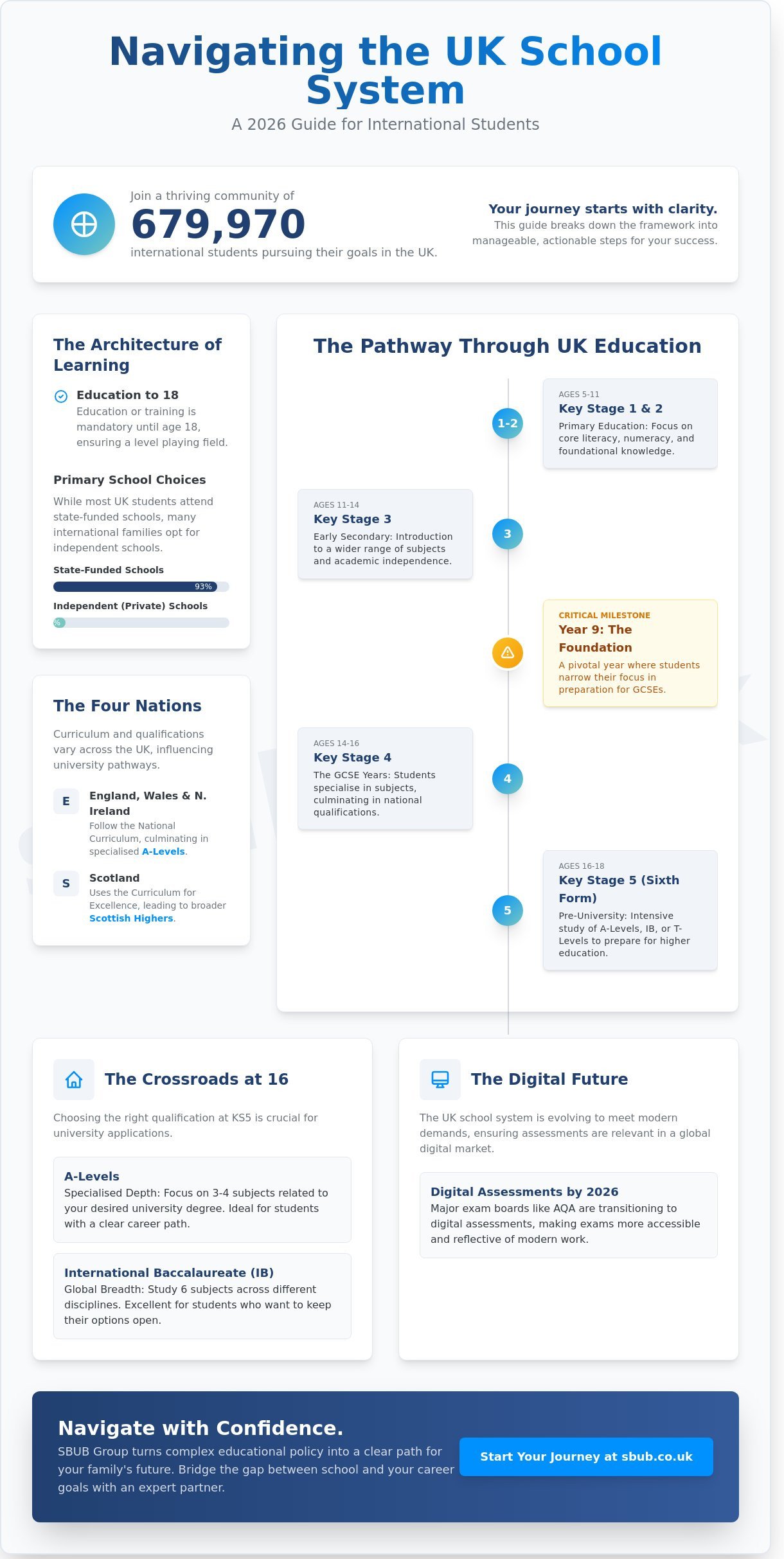
The uk school system provides a structured pathway designed to turn individual potential into tangible impact. We understand that for global students, this framework can seem complex, yet it’s built on a foundation of fairness and clear progression. In England, the Education and Skills Act 2008 mandates that young people remain in some form of education or training until they reach 18. This requirement ensures that every student has the tools to compete on a level playing field before entering the professional world.
You have three primary choices when selecting an institution: state-funded schools, independent (private) schools, and boarding schools. While approximately 93 percent of UK students attend state-funded schools, many international families choose independent boarding schools for their specialized pastoral care and high teacher-to-student ratios. For a broader UK education system overview, it’s helpful to see how these institutions align with national standards while maintaining their unique identities.
The system is currently evolving to meet modern digital demands. By 2026, major exam boards like AQA aim to transition at least one large-volume subject to digital assessment. This shift reflects a commitment to shaping the future of learning, ensuring that the uk school system remains relevant in an increasingly digital global market. We see this as a vital step in making assessments more accessible and reflective of how we work today.
The Four Nations: England, Scotland, Wales, and Northern Ireland
While the UK shares a commitment to excellence, the curriculum varies significantly across its borders. England, Wales, and Northern Ireland generally follow the National Curriculum, culminating in A-Levels. In contrast, Scotland operates under the Curriculum for Excellence, where students sit ‘Highers’ at age 16 or 17. These Highers are the standard entry requirement for Scottish universities and represent a broader range of subjects than the specialized English A-Level route.
Choosing the right region matters for your long-term residency and career goals. Different regions offer distinct economic strengths; for instance, Scotland’s growing green energy sector or the digital hubs in Northern England might influence where you want your child to build their network. Your choice is an invitation to join a specific community and local economy.
The Concept of ‘Key Stages’ (KS1-KS5)
The journey through the English system is divided into five distinct blocks known as Key Stages. These stages ensure that progress is measurable and that support is provided where it’s needed most. A Key Stage is a cumulative educational milestone that defines the specific knowledge and skills a student must master during a set period of their schooling.
- KS1 and KS2: Primary education for ages 5 to 11, focusing on core literacy and numeracy.
- KS3: The start of secondary school (ages 11 to 14), introducing a wider range of subjects.
- KS4: The GCSE years (ages 14 to 16), where students begin to specialize.
- KS5: Often called Sixth Form, this stage (ages 16 to 18) prepares students for university or higher-level apprenticeships.
Assessments at the end of each stage don’t just measure memory; they inform future academic placement and help teachers tailor their advocacy for each student. We believe this transparency allows you to track your child’s impact and ensures they aren’t overlooked in a large system.
From Primary to Secondary: Navigating Compulsory Education
The transition from primary (ages 5 to 11) to secondary school (ages 11 to 16) represents a significant shift in your child’s journey through the uk school system. In primary education, the focus stays on broad foundational skills. Once students enter Year 7, the environment becomes more specialized. You’ll notice a move toward academic independence and a wider variety of subject teachers. Year 9 is a pivotal foundation year. This is when students begin the pre-GCSE phase, narrowing their focus to prepare for the rigorous two-year qualification period ahead. It’s a time for students to find their voice and identify the subjects where they can make the most impact.
British schools balance academic pressure with personal development. Pastoral care is a hallmark of this experience. Every student has access to support through dedicated form tutors or house systems. This structure ensures that even in large secondary schools, your child feels seen and supported. The Department for Education 2023 standards emphasize that academic success and mental wellbeing are linked. We believe this holistic approach creates a level playing field where every student can achieve their potential. Schools often use these years to build confidence, leadership, and emotional intelligence alongside traditional subjects.
The GCSE Milestone: Your First Major Qualifications
General Certificates of Secondary Education (GCSEs) are the first major academic hurdles. Since the 2017 reforms, the UK uses a 9 to 1 grading scale. A grade 9 represents the top 3% to 5% of performers nationally. A grade 4 is a standard pass, while a 5 is a strong pass. Choosing “Options” in Year 9 is a strategic decision. These choices impact university eligibility. For example, top-tier science programs often require Triple Science at the GCSE level rather than Combined Science. You can join the conversation with education experts to better understand how these early choices shape your child’s future profile.
International GCSEs (IGCSEs) for Global Students
The IGCSE is a global variant of the domestic qualification, currently taught in over 120 countries. Many UK independent schools prefer this framework because it offers a more traditional, exam-based assessment without heavy coursework requirements. While domestic GCSEs often include UK-specific content, IGCSEs provide a broader international context. Top-tier university consultants and Russell Group admissions officers view IGCSEs and domestic GCSEs as exactly equal in value. They provide the same rigorous preparation for A-Levels while offering flexibility for students who may have started their education outside the UK school system.
- GCSEs: Taken at age 16; graded 9 (high) to 1 (low).
- Year 9: The critical year for choosing subjects that align with career goals.
- Pastoral Care: A system of emotional and social support unique to British education.
- IGCSE: An internationally recognized alternative used by many elite private schools.
The Crossroads at 16: Comparing A-Levels, IB, and T-Levels
At age 16, your journey through the uk school system reaches a pivotal moment of choice. You transition from the broad, mandatory curriculum of GCSEs into “Further Education,” a two-year period where you finally take control of your academic identity. This stage is about more than just passing exams. It’s about advocacy for your future and selecting the specific tools you need to make a significant impact in your chosen profession. Whether you prioritize deep specialization or a broader global perspective, your decision here shapes your path to university and beyond.
A-Levels: The Gold Standard for University Entry
Most international students select the three-subject A-Level path because it allows for intense focus. This specialization isn’t a limitation; it’s a strategic move to prove your expertise. If you want to study Medicine, you’ll likely choose Biology and Chemistry. If you’re aiming for Engineering, Physics and Maths are your essentials. By dedicating your time to just three or four subjects, you demonstrate the high-level analytical skills that top-tier UK universities demand. You’ll need to master the British education grading system, which uses an A* to E scale, to ensure your applications stand out in a competitive field. We see this path as your opportunity to move from a general learner to a focused specialist.
The International Baccalaureate (IB) and Vocational Paths
The IB Diploma offers a different kind of value. It’s designed for students who don’t want to narrow their focus too early. You’ll study six subjects across disciplines like languages, sciences, and the arts. This breadth is highly respected by global admissions officers who value well-rounded candidates. However, the landscape is shifting to include more practical options. By 2026, T-Levels will be a primary technical alternative in England. These qualifications are equivalent to three A-Levels but include a mandatory 45-day industry placement. They’re designed to bridge the gap between education and the digital markets, often leading directly into high-value degree apprenticeships.
- A-Levels: Best for those with a specific degree goal like Law or Medicine.
- IB Diploma: Ideal for students seeking a broad, international curriculum.
- T-Levels: A powerful 2026 initiative for those ready for technical, hands-on careers.
Your choice at 16 also dictates your wider testing strategy. If you’re eyeing universities in the US alongside the UK, your workload will influence your SAT scores strategy and preparation timeline. We believe every student deserves a level playing field, and choosing the right qualification is the first step in demanding your seat at the table. Your voice matters, and your education should reflect the impact you intend to make on the world.
Higher Education and Beyond: Mapping Your Path to a UK Degree
Transitioning from the uk school system to higher education requires a clear strategy and a firm understanding of the UCAS (Universities and Colleges Admissions Service) framework. You’ll typically apply to five universities through this centralized portal. Most undergraduate degrees in England, Wales, and Northern Ireland are completed in 3 years. However, many students now opt for 4-year “sandwich” courses. These include a one-year professional placement or study abroad period, which helps you build a professional network and gain a seat at the table in your chosen industry before graduation.
Your grades serve as your primary currency in this process. The UCAS Tariff system converts your A-Level, IB, or BTEC results into a numerical score. For example, an A* at A-Level provides 56 points, while a B grade provides 40 points. For the 2026 application cycle, the Personal Statement is undergoing a significant shift. Instead of a single long-form essay, you’ll respond to three specific prompts focusing on your course choice, preparation, and shared values. This change is designed to ensure fairness and give every student a clear voice, regardless of their background.
Decoding the Grading System for University Entry
Universities primarily make “conditional offers” based on your predicted grades. These are professional assessments provided by your teachers in Year 12. It’s vital to understand the British system grading to ensure your current performance aligns with your long-term ambitions. If you don’t meet your offer requirements on results day in August, you can enter the “Clearing” process. In 2023, over 67,000 students found university places through Clearing, proving that a setback doesn’t have to end your journey toward a degree.
Strategic School Selection for Top Universities
The school you attend can influence your path to elite institutions. While traditional “feeder schools” have historically dominated Oxbridge admissions, the landscape is changing. Modern rankings for institutions like Loughborough University highlight how specialized colleges can offer better pathways for specific careers like sports science or engineering. Admissions tutors now prioritize a holistic profile. They look for how you’ve maximized the opportunities within the uk school system, focusing on your individual impact and potential rather than just the prestige of your previous school’s name.
We’re here to help you navigate every step of your educational advocacy. Join our community to find the resources and support you need to succeed.
Navigating the Transition: How SBUB Empowers International Students
Entering the uk school system is a significant milestone that requires more than just academic preparation. It demands a dedicated advocate who understands the nuances of British policy and the personal challenges of relocation. At SBUB, we act as your Empathetic Champion. We believe that your international background is a strength, not a hurdle. Our role is to ensure that your voice is heard in admissions offices that often feel distant or bureaucratic. We bridge the gap between your home country’s curriculum and the UK framework, translating your past achievements into a narrative that resonates with top tier schools.
We take a proactive stance on advocacy. This means we don’t just submit forms; we fight for fairness and representation for every student we represent. By working closely with school registrars, we ensure they recognize the value of global perspectives. Our approach shifts the narrative from being an outsider to being a vital part of a diverse school community. We help you move from a state of uncertainty to a position of collective agency, ensuring you have a seat at the table during the selection process.
Bespoke Admission Support and Career Counselling
Our support starts with strategic subject selection for Key Stage 4 and Key Stage 5. We help you choose GCSE and A-Level subjects that align with your future impact, focusing on competitive fields like medicine, law, or digital markets. We handle the complex task of translating international transcripts into the UK equivalent, ensuring admissions officers see a clear, professional record of your success. According to 2024 Higher Education Statistics Agency (HESA) data, students who align their secondary subjects with their degree goals early have a higher success rate in university placements. We provide this long term mapping from age 14, guiding you through to postgraduate success and beyond.
Visa Guidance and Arrival Support
Securing a school place is only the beginning of your journey. We provide clear, declarative guidance on the Child Student and Student Visa (Tier 4) process. Based on 2024 Home Office guidelines, we help you gather the necessary financial evidence and CAS (Confirmation of Acceptance for Studies) documents to avoid delays. For families based in the West Midlands, our student visa assistance Birmingham service ensures you have a dedicated local expert navigating the 2026 requirements on your behalf. A safe transition is our priority, which is why our accommodation assistance is essential for securing a verified, high quality home for the 2026 academic year. We also invite you to join the conversation within our student community. By connecting with other global families, you find the peer support needed to thrive. We’re here to ensure your transition is smooth, professional, and empowering.
Take Command of Your Academic Journey
Navigating the uk school system doesn’t have to feel like an uphill battle. By 2026, the pathway from primary education to the specialized choices of A-Levels, IB, or T-Levels is more diverse than ever. Your understanding of the framework sets the stage for a degree that carries global weight. Whether you’re planning for 2026 or beyond, your voice deserves to be heard. Small steps in planning lead to a big impact on your future.
Our expert advisors in Birmingham, Hyderabad, and Subang Jaya provide the representation you need to bridge the gap between your current goals and a UK degree. We’ve built a proven track record of Tier 4 visa success by supporting students through every milestone from GCSEs to PhDs. Your ambition is the impact that drives us to level the playing field for every international applicant. We’re here to ensure you have a seat at the table.
Book a free consultation with our UK school experts
Your future in the UK is waiting, and we’re ready to help you claim it.
Frequently Asked Questions
At what age should an international student enter the UK school system?
Most international students enter at age 11 for Year 7 or age 16 for Year 12. These windows give you the best chance to integrate before major exams. Entering at 16 allows you to focus on the 2 year A-Level cycle, which is the gold standard for university entry. We believe your voice matters at every stage, so choosing the right entry point ensures you aren’t overlooked during critical transitions.
Is there a difference between the English and Scottish school systems?
Yes, Scotland operates an independent system using Highers and Advanced Highers instead of the English A-Levels. While the uk school system is often discussed as a single entity, the Scottish Curriculum for Excellence focuses on a broader range of subjects. In Scotland, students typically enter university at age 17, while English students wait until 18. This distinction is vital for your advocacy when choosing where to study.
What are the most important subjects to take at GCSE for university entry?
Mathematics, English Language, and Sciences are the non-negotiable subjects you need for a successful university application. Approximately 95 percent of UK universities demand a grade 4 or higher in these core areas. We encourage you to view these subjects as the foundation of your future impact. If you’re aiming for a STEM career, taking Triple Science provides a more robust platform than the Combined Science route.
Can I switch from my home country’s system directly into A-Levels?
You can transition into A-Levels if you’ve completed 10 or 11 years of schooling in your home country with equivalent results. Most institutions require an IELTS score of 5.5 or higher to ensure you can handle the academic load. This move levels the playing field for global students. It’s a strategic way to join the conversation in British higher education without repeating years of study.
What is the ‘Sixth Form’ and how does it differ from a College?
A Sixth Form is a specialized department within a secondary school, while a College is a larger, independent institution. Sixth Forms usually house 200 to 500 students and offer a familiar, structured environment. In contrast, Colleges can serve over 3,000 students and provide a wider variety of vocational qualifications. Both paths empower you to shape your future, but the choice depends on the level of independence you want.
Are UK state schools open to international students on a visa?
No, international students holding a Child Student visa are generally restricted from attending state-funded schools. You must enroll in an independent, fee-paying school that holds a valid sponsor license from the Home Office. This regulation, reinforced by 2020 immigration updates, ensures the uk school system remains sustainable. We’re here to help you navigate these corridors of power so your education remains uninterrupted and fair.
How do GCSE and A-Level grades affect my future UK job prospects?
Employers use these grades as a primary filter, with 80 percent of top graduate recruiters requiring specific A-Level results. A 2023 industry report highlights that grade 4 in English and Maths is a baseline requirement for most professional roles. Your grades don’t just represent numbers; they’re a testament to your persistence. They give you a seat at the table when you’re ready to enter the competitive UK workforce.
What happens if I fail my Key Stage assessments or GCSEs?
If you fail GCSE English or Maths, you’re required by law to resit these exams until you reach age 18 or achieve a grade 4. In 2022, nearly 30 percent of students took resits to improve their prospects. Key Stage assessments at ages 7 and 11 don’t have pass or fail marks but track your progress. Don’t let a single result silence your ambition; there are always pathways to recover and succeed.