
SAT vs ACT: Key Differences and How to Choose in 2026
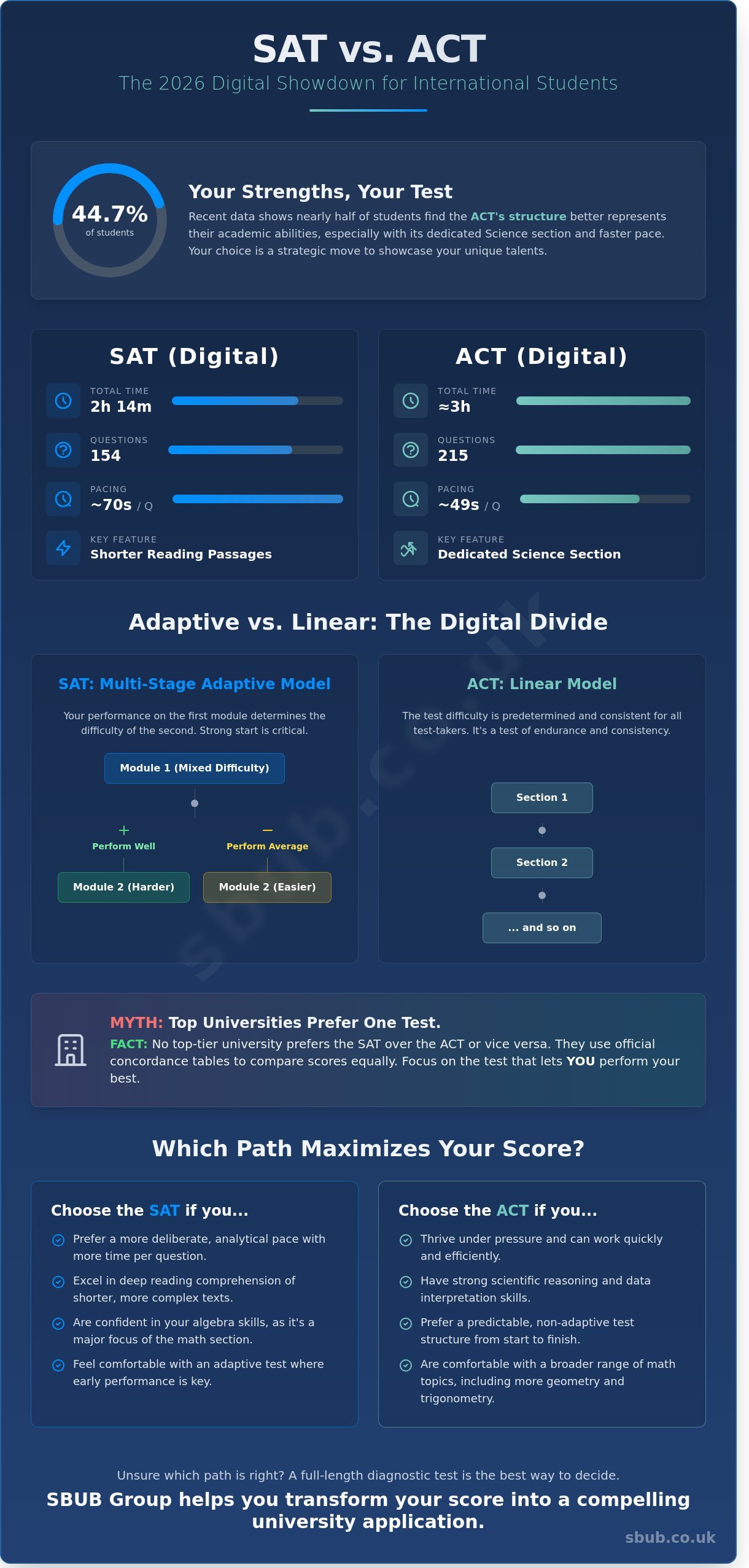
The test that feels most “traditional” might actually be the one that limits your final score. While many international students default to the SAT, data from a 2024 assessment cycle indicates that 44.7% of test-takers find their academic strengths are better represented by the ACT’s science section and specific pacing. Understanding the core difference between sat and act is no longer just about comparing math problems; it’s about how you interact with the new 2026 digital interfaces. Your choice is a vital part of your own advocacy, ensuring your academic voice isn’t lost in a format that doesn’t suit your natural rhythm.
We understand that the pressure to choose correctly creates a quiet urgency in your university preparation. You want to walk into that testing center with the confidence of an expert, knowing you’ve secured every possible advantage for your future. We’ve built this guide to transform your confusion into a clear, strategic framework. By examining the latest timing data and adaptive structures, you’ll gain the clarity needed to choose the path that maximizes your admission impact and levels the playing field for your application.
Key Takeaways
- Navigate the 2026 digital shift by comparing the SAT’s adaptive modules with the ACT’s longer format to see which pace best suits your testing style.
- Master the fundamental difference between sat and act by weighing the ACT’s dedicated science section against the SAT’s concentrated focus on algebra.
- Use full-length diagnostic tests and concordance tables to identify which assessment provides the level playing field you need to maximize your admission chances.
- Learn how SBUB Group helps you bridge the gap between a high score and a compelling application, ensuring your individual impact is recognized by international admissions boards.
Understanding the SAT and ACT in a Global Admissions Landscape
The SAT and ACT are globally recognized tools that give you a seat at the table in university admissions. By 2026, both tests are fully digital for every international student. This modern approach removes physical barriers and offers a faster, more responsive testing environment. We see these exams as a way for you to claim your space in the global academic community. Understanding the difference between sat and act is the first step in advocating for your own future and ensuring your hard work is reflected accurately.
The Role of Standardised Testing in 2026
A competitive score provides a vital edge in a crowded market. Application volumes at top 50 US universities increased by 15% between 2023 and 2025. In this high-pressure environment, your test result acts as a definitive signal of your readiness. These tests serve as a level playing field for students coming from different schooling systems. We’ve seen that a strong score can bridge the gap between varying international curricula.
- Scores provide a common language for admissions officers reviewing diverse educational backgrounds.
- High results often trigger automatic consideration for merit-based aid; 85% of international scholarships in 2026 still utilize these benchmarks.
- A strong score reinforces your GPA, proving your academic consistency to institutions that don’t know your local school’s grading rigour.
Universities and the Preference Myth
No top-tier university in the UK or US prefers one test over the other. Admissions teams use updated concordance tables to compare results with total precision. This ensures that a 34 on the ACT and a 1500 on the SAT are viewed with the same level of respect. When you’re analyzing the difference between sat and act, remember that schools only care about the final percentile you achieve. We want you to feel empowered to choose the path that highlights your unique skills. Your choice should be based on your performance, not university bias.
By focusing on your personal strengths rather than myths about institutional preference, you turn a stressful requirement into a strategic advantage. It’s about making your voice heard by the people who shape the future of these institutions.
Structural Breakdown: Timing, Modules, and the 2026 Digital Format
The SAT and ACT aren’t just different tests; they represent two distinct philosophies of assessment. By 2026, the digital divide between these exams has crystallized, offering you a choice between a streamlined, adaptive experience and a traditional, high-speed marathon. The SAT now clocks in at approximately 2 hours and 14 minutes, a significant reduction from its previous form. In contrast, the ACT remains a test of endurance, lasting nearly 3 hours. This 46-minute difference isn’t just about time spent in a chair; it’s about the intensity of the experience.
Understanding the difference between sat and act requires looking at how these minutes are utilized. One test rewards deep reflection, while the other prizes rapid-fire execution. Whether you’re a student in London or a small business owner supporting a family member through the process, recognizing these structural nuances ensures your voice and effort are directed where they’ll have the most impact.
Timing and Pace: The Seconds Per Question Factor
Pacing is the most visible barrier for many test-takers. On the SAT, you’re looking at a total of 154 questions, which grants you roughly 70 seconds per question. This allows for a more deliberate, analytical approach to problem-solving. The ACT, however, packs 215 questions into its three-hour window. This leaves you with approximately 49 seconds per question, creating a “race against the clock” that many international students find daunting.
The digital SAT, which transitioned to a fully digital format in March 2024, further eases reading fatigue. Instead of the long, 700-word passages found on the ACT, the SAT uses shorter text blocks followed by a single question. This structure helps you maintain focus and prevents the cognitive drain associated with traditional long-form testing. When you advocate for your academic future, choosing the pace that matches your natural rhythm is a vital first step.
Adaptive vs. Linear Testing Models
The SAT’s move to a multi-stage adaptive model is a game-changer for the 2026 testing cycle. Your performance in the first module of a subject directly influences the difficulty of the second module. While this makes the test feel more tailored to your specific skill level, it also means there’s less room for early errors. A few mistakes in the first 30 minutes can limit your access to the highest possible score bracket.
The ACT maintains a linear structure. The difficulty doesn’t shift based on your answers; it’s a predictable progression from start to finish. This format benefits students who prefer a steady, unchanging path. Handling the psychological pressure of the SAT’s adaptive transitions requires resilience, whereas the ACT requires a relentless, steady speed. Both paths lead to the same destination, but the terrain you’ll navigate is fundamentally different.
Subject Focus: The Science Section and Mathematical Complexity
The most visible difference between sat and act lies in how they categorize scientific knowledge. The ACT features a standalone Science section; the SAT integrates these skills into its Reading and Writing modules. By 2026, both tests have fully transitioned to digital formats. This means you can use a calculator for every math question on either exam. This policy change levels the playing field for students who rely on digital tools like the built-in Desmos graphing calculator to demonstrate their skills. While the SAT lacks a dedicated science section, it uses science-based reading passages to test your data literacy. You’ll analyze tables and graphs within the Reading and Writing section to prove you can interpret complex information under pressure.
The ACT Science Section: Myth vs. Reality
Many students fear this section because they haven’t mastered advanced physics or biology. This is a misconception. The ACT Science section is a test of logic and data interpretation. You have 35 minutes to answer 40 questions based on charts, graphs, and conflicting viewpoints. It measures your impact as a critical thinker. If you can identify trends in a 2025 climate study or compare two conflicting hypotheses, you’ll likely excel here. We see this as a test of scientific reasoning rather than rote memorization. If you haven’t studied a broad science curriculum recently, focus your preparation on reading scientific journals and practicing with complex data sets to build your stamina.
Math Comparison: Depth vs. Breadth
Choosing the right math path depends on your preferred problem-solving style. The difference between sat and act math is significant. The SAT focuses heavily on the “Heart of Algebra.” These questions account for roughly 35 percent of the math section. You’ll face multi-step problems that demand deep logical reasoning and the ability to manipulate complex equations. The ACT covers a wider territory. It includes more Geometry and Trigonometry, which often make up 15 to 20 percent of the section. You must be prepared for a higher volume of concepts delivered at a faster pace.
For the 2026 testing cycle, the SAT is about logic and depth; the ACT is about speed and variety.
You need to decide which approach showcases your strengths. If you prefer digging into complex algebraic functions, the SAT is your partner. If you have a broad grasp of various math concepts and can move through 60 questions in 60 minutes, the ACT offers the representation you need. We believe every student deserves a test that reflects their true potential. Selecting the right format is the first step in advocating for your academic future.
Strategic Selection: How to Decide Which Test Plays to Your Strengths
We believe your academic future shouldn’t be a matter of guesswork. Choosing the right path requires a professional, data-driven strategy that treats your time as a valuable resource. You need to create a level playing field for yourself by identifying which exam structure allows your voice to shine. This isn’t about which test is “easier” in a general sense; it’s about which one minimizes your specific obstacles and maximizes your individual impact.
The Diagnostic Test Approach
Don’t choose a format based on a friend’s recommendation or a generic social media post. Your first step is to sit for a full-length diagnostic of both exams under strict, timed conditions. Once you have your results, use the 2026 concordance table to compare your performance. A 1350 on the SAT might initially seem higher than a 29 on the ACT, but the data often reveals a different story. Look for “low-hanging fruit” in your section scores. If you missed 10 points on ACT Math due to the 60-question-in-60-minute pace, you might find the SAT’s slower tempo more manageable. Understanding this specific difference between sat and act allows you to focus your energy where it has the most impact.
Matching Your Personality to the Test
Your testing style is a reflection of how you process information. The SAT typically suits the “Deep Thinker” who can handle adaptive difficulty and complex logic. In contrast, the ACT rewards the “Quick Processor” who can maintain high accuracy under extreme time pressure. If you’re aiming for a STEM-heavy course, the ACT Science section provides a 35-minute window to prove your data literacy. This helps build a narrative of technical competence. For those who feel test anxiety, the SAT’s shorter passages can feel less punishing than the ACT’s dense reading blocks. Recognizing the difference between sat and act structures ensures you aren’t just working hard, but working smart. You can shape the future of your applications by selecting the exam that amplifies your natural strengths.
- Analyze the data: Use 2026 percentiles to see which score puts you in a higher bracket.
- Assess the clock: Decide if you prefer more time per question (SAT) or straightforward questions at high speed (ACT).
- Review the content: Determine if a dedicated Science section supports your intended university course narrative.
Beyond the Score: Building a Competitive International Application with SBUB
Securing a top-tier score is a vital milestone, but it doesn’t guarantee a seat at a world-class university. Admissions committees in 2026 look for more than just academic data; they seek individuals who demonstrate impact and purpose. While understanding the difference between sat and act helps you pick the right testing path, your application must also prove you can handle the rigors of a global campus. Data from 2024 admissions cycles shows that 75% of successful Ivy League and Russell Group applicants presented a profile where extracurricular leadership was as prominent as their test results.
We advocate for a balanced approach. You shouldn’t sacrifice your GPA for months of test prep. Instead, we help you manage your time effectively to maintain a high standing in your local curriculum. Our team works with you to ensure your application reflects your full potential. This involves:
- Integrating your test scores into a research proposal that shows deep subject interest.
- Developing a personal statement that highlights your unique voice and community contributions.
- Strategic planning for the 2026-2027 application deadlines to avoid last-minute stress.
- Expert guidance on navigating Tier 4 visa requirements and finding secure accommodation.
Holistic Application Support
We bridge the gap between your standardized test results and your ultimate career goals. Your score is a tool, not a destination. Our career counseling services analyze your specific score profile to identify universities where you’ll thrive, ensuring a level playing field regardless of your background. We believe every student deserves representation in the corridors of higher education. We don’t just look at numbers; we look at your trajectory. By focusing on the difference between sat and act, we help you choose the assessment that best showcases your natural strengths, making your application significantly more persuasive to admissions officers.
Your Partner in Global Education
From our offices in Birmingham to our hub in Hyderabad, SBUB Group provides a local perspective on a global journey. We’ve spent over 15 years helping students translate their local successes into international opportunities. Beyond the SAT and ACT, we offer specialized IELTS and PTE training to ensure your English proficiency meets the strict 2026 standards for UK and US institutions. We’re here to be your brave and persistent advocate throughout the entire process. Join the conversation and start your application journey with SBUB today.
Take Control of Your 2026 Admissions Journey
Choosing your testing path is the first step toward reclaiming your voice in the global admissions landscape. By 2026, the digital SAT will provide a 2 hour and 14 minute experience, while the ACT continues to test endurance with its 2 hour and 55 minute structure. Understanding the difference between sat and act helps you decide if you’ll thrive in the ACT’s 40-question Science section or the SAT’s adaptive math modules. Your scale as an individual student shouldn’t limit your global impact.
At SBUB, our Birmingham-based consultants provide a level playing field for every applicant through a network of partner universities across 15 countries. We manage the heavy lifting, from hitting your 7.5 IELTS target to securing your Student Visa. We’re here to ensure your application is heard in the corridors of the world’s elite institutions. Empower your future—book a consultation with our admission experts. You’ve got the drive to succeed, and we’re ready to help you claim your seat at the table.
Frequently Asked Questions
Is the SAT or ACT easier for international students in 2026?
Neither test is objectively easier, but the Digital SAT is often more accessible because it lasts 2 hours and 14 minutes, which is 41 minutes shorter than the ACT. We see students find success when they choose the format that highlights their individual voice. While the SAT focuses on logic within shorter passages, the ACT requires a faster pace across 215 total questions.
You should choose the test that makes you feel most powerful. The Digital SAT uses an adaptive model to adjust difficulty, while the ACT remains a linear, paper based or digital experience. We believe your choice should reflect your personal strengths rather than a perceived market standard.
Do UK universities prefer the SAT or the ACT for undergraduate admissions?
UK universities treat the SAT and ACT as equal qualifications and show no preference for one over the other. Institutions like the University of Oxford and LSE explicitly state they accept either test for 2026 entry. For example, LSE typically requires a minimum SAT score of 1470 or an ACT score of 32 to consider an application.
We advocate for you to submit the score that best represents your academic impact. Since 100 percent of Russell Group universities accept both, your decision should focus on where you can achieve the highest percentile. This ensures you enter the admissions process on a level playing field.
Can I take both the SAT and the ACT to see which one I score better on?
You can absolutely take both exams to determine which platform better amplifies your strengths. Understanding the difference between sat and act is the first step in shaping your future. Approximately 25 percent of competitive applicants sit for both tests to compare their results before committing to a final strategy.
However, we recommend focusing your energy on one specific test after an initial diagnostic. This approach ensures your preparation remains purposeful and your voice remains clear. Concentrating your efforts allows you to move from individual concern to a state of collective agency in your applications.
How many times can I retake the SAT or ACT in a single year?
You can take the SAT up to 7 times and the ACT up to 7 times within a single testing year. International testing calendars for 2025 and 2026 provide 7 specific windows for students to demonstrate their growth. Most students reach their peak performance on their second or third attempt.
We believe in your right to persist until your score reflects your true capability. Retaking the test is a brave and constructive way to ensure your representation in the global applicant pool. It allows you to refine your approach and demand a seat at the table of your top choice university.
Does the 2026 Digital SAT still have an optional essay section?
The 2026 Digital SAT does not include an optional essay section. The College Board officially removed the essay from all standard administrations in June 2021 to streamline the testing experience. This change allows you to focus your impact entirely on the Reading and Writing and Math modules.
While the ACT still offers an optional 40 minute writing test, 90 percent of top tier universities no longer require it for admissions. We encourage you to check specific college portals to ensure your voice is heard without wasting resources on unnecessary components. This clarity helps you navigate complex digital markets of education.
What is considered a good SAT or ACT score for top-tier universities?
A good score for top tier universities generally places you in the 99th percentile of all global test takers. For 2026 admissions at Ivy League institutions, this means aiming for a 1530 on the SAT or a 34 on the ACT. These numbers are vital tools that ensure your personal impact is recognized by admissions officers.
These benchmarks represent more than just data; they are a way to bridge the gap between your potential and your future. We view these scores as a means of advocacy for your academic journey. Achieving these targets helps shift the narrative from being one of many to being a significant candidate.
How much does it cost to register for the SAT and ACT internationally?
Registering for the SAT internationally costs $103, while the ACT costs $193.50 for the version without the writing section. The SAT fee includes a $60 base registration charge plus a $43 regional fee for international testing sites. These costs represent a financial commitment to your future representation.
Fairness in testing starts with transparent pricing, and we encourage you to join the conversation regarding fee waivers if these costs are a barrier. Many students qualify for support that covers 100 percent of these fees. Ensuring a level playing field is essential for the heart of entrepreneurship and academic success.
When should I start preparing for these tests if I want to apply for 2026 entry?
You should start your preparation at least 6 months before your first scheduled exam date. For a 2026 university entry, we recommend taking your first test by October 2025. This timeline gives you enough space to identify the difference between sat and act and refine your testing strategy before final deadlines. Planning your preparation around SAT test dates 2026 registration deadlines ensures you secure your preferred testing window without last-minute stress.
Starting early ensures you have a seat at the table when the most competitive application rounds open. It allows for a steady and logical progression in your learning journey. By gathering your voice early, you can lead the transition from preparation to a successful university placement.