
Master of Science in Nursing (MSN) in the UK: The Ultimate 2026 Guide for International Students
According to NHS workforce projections, the UK will require 40,000 additional specialist nurses by 2026, making your international expertise more vital than ever. You know that pursuing an msn in uk isn’t just about a degree; it’s about gaining a seat at the table where global healthcare policy is shaped. However, when you’re staring at a £20,000 tuition bill and the complex web of the Nursing and Midwifery Council (NMC) registration, that dream can feel out of reach. We believe your professional voice shouldn’t be silenced by bureaucratic hurdles or the confusion between pre-registration and post-registration pathways.
You’ve worked hard to build your clinical foundation, and you deserve a clear path to leadership. We’ve built this guide to turn that individual ambition into a collective impact for the 2026 intake. You’ll gain a step by step roadmap to university admission, a breakdown of high demand MSN specialisations, and strategies to handle international fees. We’ll also reveal how to leverage the Graduate Route visa to secure your future in the UK after graduation.
Key Takeaways
- You will learn to distinguish between pre-registration and post-registration pathways, ensuring your degree choice empowers your specific professional journey and registration status.
- Navigate the rigorous academic and English language standards required for NMC registration, giving you a clear voice and a competitive edge in the UK healthcare market.
- We break down the total investment for an msn in uk, including tuition fees and hidden costs, so you can plan your 2026 application with absolute financial clarity.
- Discover how to utilize the Graduate Visa and advanced clinical leadership modules to leap into senior NHS Pay Bands and shape the future of global nursing.
What is an MSN in the UK? Distinguishing Degrees from Registration
Pursuing an msn in uk universities is a strategic move to claim your seat at the healthcare leadership table. It’s more than a simple academic upgrade; it’s a career catalyst that transforms your clinical identity. We recognize that for many of you, this represents a bold step toward personal and professional advocacy. You’re moving from being a vital member of a team to becoming a primary architect of patient care and health policy.
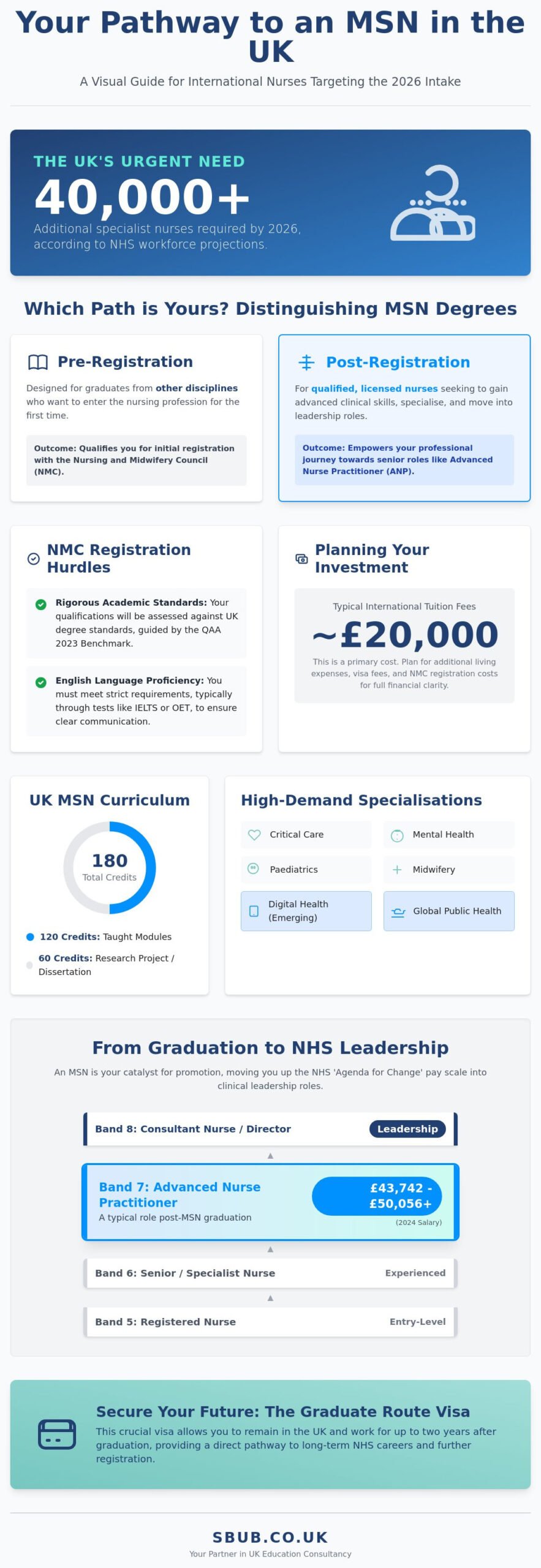
You must understand the fundamental divide between pre-registration and post-registration Master’s programmes. Pre-registration courses are designed for graduates from other disciplines who want to enter the nursing profession. Post-registration programmes are for qualified nurses who already hold a license and seek advanced clinical skills. This distinction is vital because it dictates your eligibility for the Nursing and Midwifery Council (NMC) register. For a foundational Overview of Nursing in the UK, understanding these regulatory structures is the first step toward a successful application.
The year 2026 stands as a pivotal milestone for the UK healthcare system. By this date, the NHS aims to have fully integrated the 2023 NMC standards for post-registration education. This shift ensures that every Advanced Nurse Practitioner (ANP) possesses the high-level decision-making skills required for modern, complex practice. Your MSN is the credential that bridges the gap between general nursing and the autonomy of an ANP. It gives you the authority to prescribe, diagnose, and lead clinical teams.
Academic Rigour vs. Clinical Competency
UK universities follow the Quality Assurance Agency (QAA) 2023 Subject Benchmark Statement for Nursing. This framework ensures a sophisticated balance between research-led theory and hands-on practice. Because of these rigorous standards, an msn in uk is highly portable across borders. Healthcare boards in Australia, Canada, and the US frequently recognize the depth of UK training. Most programmes require you to complete significant clinical hours, often ranging from 500 to over 1,000 hours depending on your chosen pathway. This ensures you’re not just a scholar, but a highly competent practitioner ready for the ward.
Specialisations: Finding Your Clinical Niche
Your choice of track determines your professional impact and your future voice within the NHS. Popular pathways include Critical Care, Mental Health, Paediatrics, and Midwifery. However, we are seeing a rise in emerging fields like Digital Health Nursing and Global Public Health. These specialisations directly influence your position on the NHS Agenda for Change pay scale. For instance, moving into an ANP role typically shifts you from Band 5 or 6 to Band 7. In 2024, a Band 7 salary starts at £43,742 and can rise to over £50,056. By choosing a niche, you’re not just specialising; you’re increasing your economic value and your ability to drive systemic change.
- Band 5: Entry-level registered nurse.
- Band 6: Senior staff nurse or specialist nurse.
- Band 7: Advanced Nurse Practitioner or Clinical Lead.
- Band 8: Consultant Nurse or Nurse Director.
Core Curriculum and Learning Outcomes of a British MSN
The journey toward an msn in uk is designed to transform your professional identity. It’s a rigorous 180-credit framework that balances advanced clinical expertise with the strategic influence needed to shape healthcare policy. We see this transition as a way for you to move from being an individual contributor to a collective force for better patient outcomes. Most programs divide these credits into taught modules worth 120 credits and a final 60-credit research project. This structure ensures you have the theoretical depth to back up your clinical decisions in high-pressure environments.
Clinical leadership is a cornerstone of the British curriculum. It’s about moving beyond the bedside and into the boardroom where systemic decisions are made. You’ll learn to analyze national healthcare strategies and interpret how policy affects your local ward. This level of insight is vital for those exploring career paths for nurses in the NHS, as it prepares you for Band 7 and Band 8 roles. By bridging the gap between frontline care and executive management, you ensure the nurse’s voice is heard at every level of the institutional hierarchy.
Evidence-based practice serves as the heart of the UK nursing dissertation. Rather than just collecting data, you’ll learn to challenge the status quo through critical inquiry. Whether you’re investigating a 12% reduction in patient readmission rates or evaluating new triage protocols, your research has real-world impact. This academic rigor is coupled with interprofessional learning. You’ll sit at the table with doctors, pharmacists, and social workers to solve complex cases. This collaboration isn’t just a classroom exercise; it’s a blueprint for the integrated care models currently being rolled out across the 42 Integrated Care Systems in England.
Mandatory Modules: The Foundation of Excellence
Research Methods in Healthcare provides the essential toolkit for your final project. You’ll master qualitative and quantitative analysis to ensure your findings are robust and credible. Advanced Physical Assessment and Clinical Decision Making sharpens your diagnostic skills, allowing you to manage caseloads with greater autonomy. Finally, Leadership and Management in Nursing focuses on navigating complex healthcare environments. You’ll study organizational culture and change management, gaining the confidence to lead teams of 25 or more staff through periods of clinical transition.
Elective Pathways: Tailoring Your Degree
Pharmacology and Independent Prescribing is a transformative elective for many pursuing an msn in uk. Obtaining your V300 qualification allows you to prescribe medications, significantly improving patient access to treatment. If you choose Chronic Disease Management, you’ll focus on the 15 million people in England currently living with long-term conditions. This pathway emphasizes community-based care and preventative strategies. For those drawn to teaching, the Education and Mentorship module prepares you to train the next generation of practitioners. You can join our professional network to discuss how these specialized skills can increase your individual impact on the wider healthcare sector.
Entry Requirements and the NMC Registration Hurdle
Securing a place on an msn in uk program requires more than just academic merit; it demands a clear understanding of the professional landscape. You need a 2:1 or 2:2 honours degree in nursing to qualify for most high-ranking institutions. This usually translates to a GPA of 3.0 or higher in international systems. Admissions tutors look for evidence that your previous education aligns with the UK’s rigorous clinical standards. Your degree is your foundation. It’s the platform from which you’ll build your advanced practice.
Most universities insist on specific English language scores to ensure patient safety. The Nursing and Midwifery Council (NMC) updated their standards in 2023, requiring an IELTS score of 7.0 in reading, listening, and speaking, and at least 6.5 in writing. If you prefer the Occupational English Test (OET), you must achieve at least a Grade B in all four sub-tests. These aren’t just hurdles; they’re essential tools for your advocacy as a nurse. Clear communication saves lives.
Clinical experience is non-negotiable for postgraduate success. You’ll typically need 12 to 24 months of post-qualification work experience before applying. Universities want to see that you’ve handled the pressures of a ward and developed a professional identity. This experience ensures you can contribute to seminar discussions and apply theoretical frameworks to real-world scenarios. It bridges the gap between being a student and becoming a leader.
We must address the biggest misconception in postgraduate nursing. Earning an msn in uk does not automatically grant you the right to practice as a registered nurse in Britain. The degree is an academic qualification, not a professional license. To work, you must separately join the NMC register. This distinction is vital. You’re pursuing two parallel paths: one for your mind and one for your legal right to work.
The NMC Registration Process for International Nurses
The registration journey involves the Test of Competence (ToC). Part 1 is the Computer Based Test (CBT), which assesses theoretical knowledge. Data from the NMC 2023 annual report shows an 88% pass rate for first-time CBT candidates. Part 2 is the OSCE, a practical clinical exam. Many universities now offer dedicated support sessions or “OSCE boot camps” to help international students bridge the gap between their home country’s practices and UK standards. You should start your NMC application at least six months before your course begins to align your graduation with your professional registration.
Portfolio and References: Building a Strong Case
Your application must reflect your commitment to the “6Cs”: Care, Compassion, Competence, Communication, Courage, and Commitment. These core values guide the NHS. When documenting clinical hours, provide verified logs from your employer. You’ll need two professional references; at least one must be from a clinical supervisor who can speak to your decision-making skills. Your personal statement is your voice. Use it to show how your local experience will make a global impact. We believe every nurse’s story deserves to be heard by admissions tutors. Make yours count.
Costs, Scholarships, and the 2026 Application Timeline
Your decision to pursue an msn in uk is a significant investment in your professional voice. It represents a move from individual care to systemic impact. Understanding the financial landscape is the first step toward securing your seat at the table. Tuition fees vary based on geography and institutional prestige. In London, elite institutions like King’s College London or City, University of London often set international fees between £28,000 and £31,500 for the 2025/26 academic year. Conversely, regional universities offer a more accessible entry point. For example, the University of Wolverhampton or the University of Hull may offer comparable programmes for £16,500 to £19,000. This price gap of nearly £12,000 allows you to choose a path that fits your personal economic reality without sacrificing the quality of your clinical education.
Direct tuition is only one part of the equation. You must also account for essential regulatory and living costs that ensure your legal standing. The UK Home Office requires a Student Visa, which currently costs £490. You’ll also pay the Immigration Health Surcharge (IHS) of £776 per year, providing you access to the National Health Service. For clinical placements, professional indemnity insurance is a non-negotiable requirement. While some universities include this, many students join the Royal College of Nursing (RCN), where postgraduate membership costs approximately £195 annually. These small, individual costs aggregate into a larger financial commitment that demands early planning and transparency.
The Home Office sets strict “Proof of Funds” requirements to ensure you can sustain yourself without public assistance. If your university is in London, you must demonstrate you have £1,334 for each month of your course, up to nine months. For regional institutions, this figure drops to £1,023 per month. For a standard one-year programme, this means having at least £9,207 in a bank account for 28 consecutive days before your visa application. We believe that financial clarity creates a level playing field, allowing nurses from all backgrounds to advocate for their place in UK healthcare.
Funding Your MSN: Scholarships for Global Nurses
Scholarships are vital tools for ensuring diverse representation in advanced nursing. The Chevening Scholarship remains the gold standard, covering full tuition, travel, and a monthly stipend for emerging leaders. Applications for the 2026 cycle typically close in early November 2025. Commonwealth Scholarships specifically support students from developing nations, focusing on sustainable development and health impact. Most UK universities also offer “International Excellence” awards, ranging from £2,000 to £5,000, which are often applied automatically upon admission. These funds ensure your voice is heard, regardless of your initial capital. You can explore funding advocacy resources to help bridge the gap between your current role and your future impact.
The Application Roadmap: Step-by-Step
Success in the 2026 application cycle requires a steady, logical rhythm. You don’t want to rush these foundational steps.
- Month 1-3 (October to December 2025): Research specific specialisations and sit your English language tests. Aim for an IELTS score of 7.0 or an OET Grade B to meet NMC and university standards.
- Month 4-6 (January to March 2026): Submit your formal applications. Once you receive a conditional offer, pay your deposit to secure your Confirmation of Acceptance for Studies (CAS). This document is essential for your visa.
- Month 7-9 (April to June 2026): Finalise your visa application and attend pre-departure clinical orientations. If you’re targeting the January 2026 intake, these deadlines shift forward by six months.
The journey to an msn in uk is a rhythmic progression toward a more powerful career. By identifying the costs and deadlines early, you gather the strength needed to demand a seat at the table of global health leadership.
Career Outcomes: From Graduation to NHS Leadership
Your journey doesn’t end when you submit your final thesis. The UK Graduate Visa, reintroduced in July 2021, gives you a clear two-year window to work and live in the country without needing a specific job offer first. This period acts as your professional bridge. It’s the time to translate your academic rigor into clinical impact while building a network within the world’s largest publicly funded healthcare system. You’ll have the space to find a role that aligns with your specialization rather than rushing into the first available vacancy.
An msn in uk serves as a financial and professional catalyst. Most international nurses enter the NHS at Band 5, with starting salaries around £28,407 as of 2024. However, holding a Master’s degree allows you to bypass years of slow progression. You can target Band 7 roles, such as Advanced Nurse Practitioners, where salaries range from £43,742 to £50,056. For those moving into Band 8a management or consultant roles, earnings often exceed £53,000. We believe your expertise deserves this level of recognition; it’s about closing the gap between your potential and your paycheck.
Transitioning from a temporary stay to permanent residency is a structured process. After your Graduate Visa, you’ll likely move to the Health and Care Worker Visa. This route offers a faster, cheaper path to Indefinite Leave to Remain (ILR) after five years of continuous residence. It bypasses the standard Immigration Health Surcharge, saving you thousands of pounds over the duration of your stay. We’re here to ensure you understand these policies so you can advocate for your future with confidence.
Your UK credentials travel well beyond the British Isles. A UK Master’s degree is highly regarded by the American Nurses Credentialing Center (ANCC) and regulatory bodies in Dubai and Qatar. Whether you aim to practice in North America or the Middle East, the clinical leadership skills you gain here make you a global asset. You aren’t just earning a degree; you’re gaining a seat at the table in any healthcare system worldwide.
Advanced Clinical Practice Roles
Advanced Nurse Practitioners (ANPs) in the UK operate with a high degree of autonomy; they diagnose, treat, and prescribe medication independently. In the private sector, Clinical Nurse Specialists (CNS) focus on complex conditions like oncology or cardiology, often seeing a 15% salary premium over public roles. Consultant Nurses represent the pinnacle of the profession. These leaders spend 50% of their time in clinical practice while shaping national healthcare policy and research.
How SBUB Group Ltd Empowers Your Nursing Journey
We don’t just provide information; we provide a platform for your success. Our bespoke consultancy matches your specific clinical background to the UK universities that offer the best msn in uk for your career goals. We handle the intricacies of both Student and Health and Care visas to ensure your transition is seamless. Based in Birmingham, our team offers local expertise to help you settle into one of the UK’s most diverse healthcare hubs. Your voice matters in this system, and we’re here to make sure it’s heard.
Your Path to NHS Leadership Starts Now
Securing your place for the September 2026 intake requires a strategic approach to the NMC registration hurdle and a clear plan for funding your postgraduate education. By choosing to pursue an msn in uk, you’re doing more than advancing your clinical skills; you’re positioning yourself to influence systemic change and lead within the world’s most recognized healthcare brand. We’ve spent over 5 years bridging the gap between international talent and British institutions. From our Birmingham HQ, we provide expert visa guidance and leverage our direct partnerships with top-tier UK nursing schools to ensure your application stands out. You don’t have to navigate these complex regulatory corridors alone. Our team acts as your professional advocate, turning your individual ambition into a powerful career trajectory. Take the first step toward your global nursing career today.
Book Your Free University Admission Consultation
The future of healthcare needs your expertise, and we’re ready to help you claim your seat at the table.
Frequently Asked Questions
Can I work as a nurse in the UK while studying for my MSN?
You can work up to 20 hours per week during term time if you hold a valid UK Student Visa. If you’ve already secured your NMC registration, you can use these hours to work as a registered nurse in clinical settings. This balance ensures you maintain your professional voice while advancing your education. We believe this practical experience strengthens your impact on the healthcare system.
Is the OET easier than the IELTS for international nursing students?
Many nurses find the OET easier because it uses healthcare-specific scenarios rather than general academic topics. The NMC requires a Grade B in all OET subtests or a minimum score of 7.0 in the IELTS. Choosing the right test is a vital step in your advocacy for a fair career path. It’s about finding the platform where your professional communication skills can truly shine.
What is the average salary for an MSN graduate in the UK?
Registered nurses with a Master’s degree often move into NHS Band 7 roles. As of April 2024, Band 7 salaries start at £43,742 and can rise to £50,056 with experience. This reflects the high level of responsibility you carry in senior clinical or management positions. We advocate for this financial recognition because your specialized skills deserve a level playing field in the professional market.
How long does a Master of Science in Nursing take in the UK?
A full-time msn in uk typically takes 12 months to complete, consisting of 180 credits of study. Some specialized clinical programs or part-time options extend this duration to 24 months to accommodate your work schedule. This timeframe is designed to move you quickly from a state of learning to a position of collective agency. Your journey toward leadership is a steady, logical progression.
Do I need to be registered with the NMC before applying for an MSN?
You don’t need NMC registration to apply for a theoretical or leadership-based Master’s degree. However, you must have an active NMC PIN if the program includes clinical placements or advanced practice modules. We encourage you to check specific university requirements to ensure your qualifications give you a seat at the table. It’s essential to align your current registration status with your long-term career impact.
Are there any fully funded nursing scholarships for international students in 2026?
The Chevening Scholarship and the Commonwealth Scholarship offer full funding for international nursing students in 2026. These awards cover 100% of your tuition fees and provide a monthly living stipend of approximately £1,300. We view these scholarships as a powerful tool for representation, allowing talented nurses from all backgrounds to lead. Securing this support ensures your voice is heard without the burden of financial barriers.
Can I bring my family with me on a UK Student Visa while studying an MSN?
You can only bring family members if your MSN is a research-based program or if you’re receiving a government scholarship. New Home Office regulations that took effect on January 1, 2024, ended the right for most taught Master’s students to bring dependents. This policy change impacts how you plan your future in the UK. We understand this creates challenges for international healthcare professionals seeking to build a life here.
What is the difference between an MSN and a Master’s in Public Health (MPH)?
An msn in uk focuses on clinical leadership and direct patient care, while a Master’s in Public Health centers on community-wide health strategies. Choosing an MSN prepares you for roles like Advanced Nurse Practitioner, where you’ll have a direct impact on individual recovery. An MPH involves analyzing data to shape national health policies. Both paths give you a powerful voice in shaping the future of global medicine.