
British System Grading: A Complete Guide for International Students in 2026
What if a 70% score wasn’t a mediocre result, but actually the highest mark achievable in your entire cohort? You’ve likely spent years aiming for 95% or higher back home, so seeing a 62% on your first UK assignment feels like a setback rather than a success. It’s a common grade shock that leaves many of the 679,970 international students currently studying in the UK feeling anxious about their Tier 4 visa requirements and their future impact. We understand that your marks are more than just numbers; they’re your voice in a competitive global market and a key part of your professional representation.
This guide empowers you to master the nuances of **british system grading** so you can explain your worth to any admissions officer or employer with clarity. We’ll break down the confusing shift between GCSE 9-1 scales and A-Level A*-E results, while providing a clear roadmap to achieving First-Class Honours. You’ll gain the confidence to turn these academic benchmarks into a platform for your long-term success. We’re here to help you improve your standing and ensure your academic journey is both fair and rewarding.
Key Takeaways
- Shift your perspective on academic success by understanding why the British system prioritizes the depth of your argument over simple completion.
- Navigate the transition from GCSE numerical scales to A-Level distinctions to ensure your application stands out to elite universities.
- Decode the university classification system to identify the specific marks required for your future graduate career or advanced study.
- Learn to translate your british system grading into global equivalents like the US GPA, ensuring your academic impact is clearly understood worldwide.
- Discover how to move beyond raw numbers by framing your unique academic background in a way that captures the attention of admissions officers.
The Philosophy of British System Grading: Why 70% is the New 100%
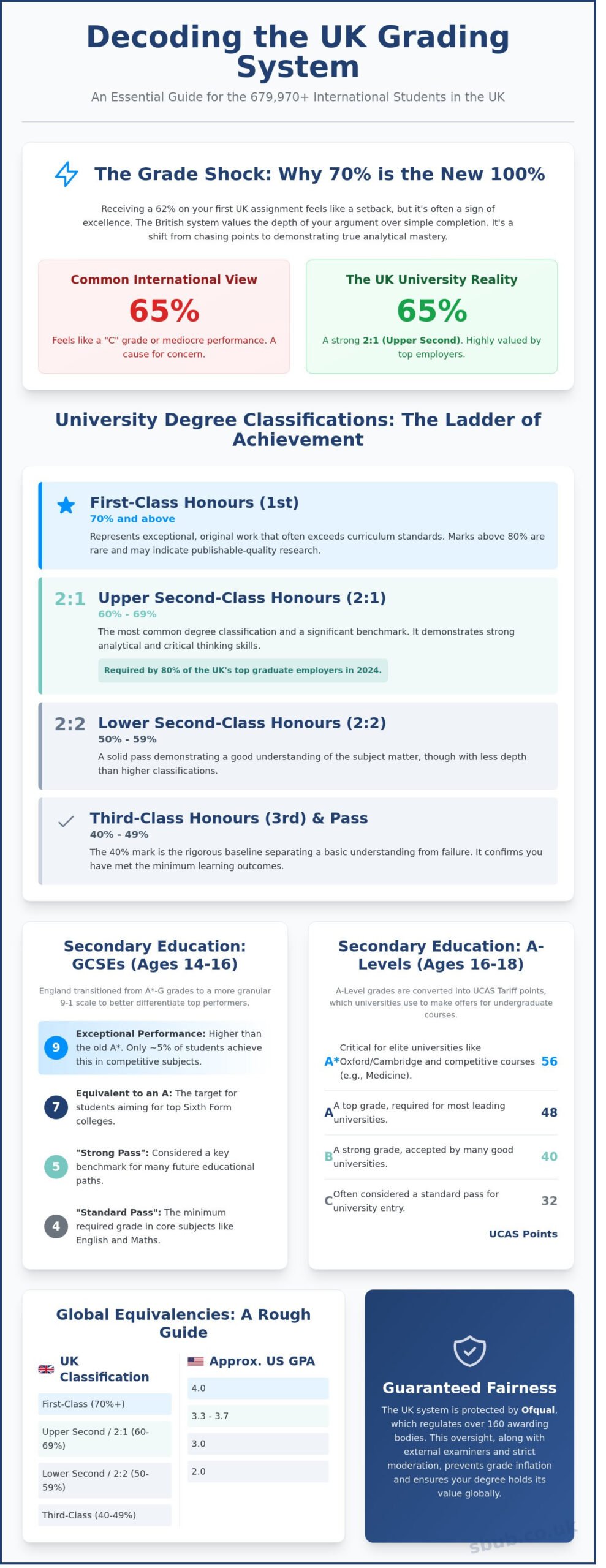
You might feel a sharp sense of alarm when you receive your first university assignment back with a 62% mark. In many international systems, that score signals a struggle. In the UK, you’re actually excelling. This psychological shift is the most vital part of mastering british system grading. We want you to see these numbers not as a loss of points, but as a ladder of achievement. UK examiners don’t just check for “correct” answers; they measure the impact of your voice and the depth of your independent thought.
In humanities and social sciences, marks above 80% are statistically rare. These scores are often reserved for work that shows publishable quality or professional-level insight. The system values mastery over simple completion. You aren’t rewarded for just reciting facts. You’re rewarded for how you use those facts to build a persuasive, original argument. This rigor ensures that your degree isn’t just a piece of paper, but a verified testament to your critical thinking skills.
The ‘Low Percentage, High Value’ Reality
- The 40% pass mark is a rigorous baseline that separates basic understanding from failure.
- A mark between 60% and 69% is known as a 2:1 (Upper Second-Class), which was the entry requirement for 80% of the UK’s top graduate employers in 2024.
- A First-Class degree, typically 70% or higher, represents an exceptional level of independent thought and analytical sophistication that exceeds the standard curriculum.
Understanding the nuances of Academic grading in the United Kingdom helps you bridge the gap between your home system and these new expectations. We believe that when you stop chasing a perfect 100% and start chasing deeper analysis, your academic impact grows. Your 65% is a badge of honor in a system designed to challenge the brightest minds.
National Standards and Ofqual Oversight
Fairness is the foundation of the British system. The Office of Qualifications and Examinations Regulation (Ofqual) regulates more than 160 awarding organizations to ensure that standards remain consistent across the country. This oversight is why a grade from a UK institution carries such significant weight with global employers. While other global systems have seen 90% averages become the norm, the UK uses external examiners and strict moderation to manage grade inflation. This process ensures a level playing field for every student. It means your hard work is protected by a national framework that refuses to devalue your achievements.
Secondary Education: Navigating GCSE and A-Level Grade Scales
Your journey through the UK education system reaches a critical junction during secondary school. This is where your academic voice starts to carry real weight. The british system grading structure at this level is designed to highlight your specific strengths to future employers and admissions officers. We believe every student deserves a level playing field, and that starts with clear, actionable information about how your work is measured.
Understanding the GCSE 9-1 Numerical Scale
In 2017, England completed a transition from the old A*-G system to a more granular 9-1 numerical scale. A grade 4 is currently defined as a “standard pass,” while a grade 5 is a “strong pass.” If you’re aiming for entry into elite Sixth Form colleges, you’ll typically need at least six subjects at grade 7 or higher. Grade 7 aligns with the old grade A, but the elusive grade 9 is now the benchmark for exceptional performance. In 2024, only about 5% of students achieved this top mark in competitive subjects like Mathematics. This granularity ensures your individual impact is recognized with precision by the british system grading standards.
A-Level Boundaries and University Entry
Transitioning to A-Levels introduces the A*-E scale. The A* grade, introduced in 2010, remains the critical differentiator for elite university admissions. Most top-tier UK universities require at least one A* for competitive courses like Medicine or Engineering. These grades don’t just exist in a vacuum; they translate into UCAS Tariff points. For example, an A* earns you 56 points, while a C earns 32. Your performance here sets the foundation for your next chapter, where Understanding university grades and degree classifications will become your new focus.
Predicted grades are perhaps the most vital part of your Year 13 experience. These are the marks your teachers expect you to achieve, and they form the basis of your university offers. It’s a high-pressure environment, but you don’t have to face it alone. We help students bridge the gap between their current marks and the requirements of their dream university. Whether you choose A-Levels, the International Baccalaureate (IB) 45-point scale, or a vocational BTEC route, your path should reflect your personal goals. A BTEC National Extended Diploma at Distinction* level carries the same 56 UCAS points as an A*, proving that practical learners can exert just as much influence in the academic market.
University Degree Classifications: From First-Class to Third
Understanding the british system grading is about more than just numbers; it’s about your future professional impact. Your final degree classification acts as a shorthand for your expertise and dedication. We want you to feel empowered by these benchmarks rather than intimidated by them. Each tier represents a specific level of mastery that tells employers exactly what you’re capable of achieving.
- First-Class Honours (1st): This is the pinnacle of undergraduate achievement. Representing the top 28% of graduates according to 2024 Higher Education Statistics Agency data, a 1st requires a consistent score of 70% or higher.
- Upper Second-Class Honours (2:1): Scoring between 60% and 69% puts you in the most common bracket for successful graduates. Currently, 82% of top-tier UK graduate recruiters set a 2:1 as their minimum entry requirement.
- Lower Second-Class Honours (2:2): Often referred to as a “Desmond,” this 50-59% range is a solid pass. While it may limit access to some elite corporate schemes, it remains a respected qualification for thousands of specialist roles and SMEs.
- Third-Class Honours (3rd): This is the minimum honours pass, covering the 40-49% range. It proves you’ve met the academic standards of your institution, though you might need to highlight relevant work experience when starting your career.
How Degree Marks are Calculated
Your final grade isn’t a simple average of every assignment. Most universities use a weighted system where your first year often counts for 0% of the final classification. This allows you to find your footing without risking your final outcome. Typically, your second year contributes 33% and your final year 67% to the total. You’ll aggregate 120 credits per year through various modules. If your final average is 69.5%, universities apply “borderline” rules. They may look at your “exit velocity,” giving you the higher grade if your final year marks were consistently in the 1st class range. You can find a deep dive into these historical structures by reviewing Academic Grading in the UK to see how standards evolved.
Postgraduate Grading: Pass, Merit, and Distinction
Master’s degrees simplify the british system grading into three categories: Pass (50%), Merit (60%), and Distinction (70%). Don’t let the lower percentages fool you. Postgraduate marking is significantly more rigorous than undergraduate study. A Merit at the Master’s level is widely viewed by industry leaders as equivalent to a 2:1 at the Bachelor’s level. We see this as a vital stage where you shift from being a student to a specialist. It’s your opportunity to command a seat at the table in your chosen field.
International Equivalencies: How UK Grades Compare Globally
Understanding how your hard work translates into the british system grading is essential for your global mobility. You’ve put in the hours, and we want to ensure your impact is recognized. A common shock for US students is seeing a 70% on a paper. While this looks like a mediocre grade in a GPA-based system, it actually represents a First Class mark. UK ENIC, the national agency for international qualifications, frequently equates this 70% threshold to a 4.0 GPA. We believe every student deserves a level playing field when their results cross borders.
For students from India, particularly those under CBSE or ICSE boards, the shift is equally dramatic. You might be used to chasing 95% for top-tier Indian colleges. In the UK, achieving a 65% consistently puts you in the Upper Second Class (2:1) bracket. This is the benchmark for 80% of graduate jobs in the UK. Europe uses the ECTS to keep things fair and portable. Usually, 2 UK credits equal 1 ECTS credit. This means your 120-credit academic year carries 60 ECTS credits, facilitating movement across 48 different countries.
- The ‘C’ Grade Trap: In the US, a ‘C’ is often an average passing grade. In the UK, a ‘C’ at the undergraduate level often maps to a Lower Second Class (2:2), which can limit access to certain competitive Master’s programs.
- The 40% Floor: Most UK universities set the pass mark at 40%. In many other systems, anything below 50% or 60% is a total failure.
- Volume vs. Depth: The UK system rewards deep analytical voice over the high-volume testing common in other regions.
The SBUB Conversion Framework
For our peers in Malaysia or Saudi Arabia, the conversion process requires a steady hand. If you’re applying with a CGPA from a Saudi university, a 3.75 out of 5.0 often aligns with a 2:1 in the british system grading. We know life isn’t always a straight line. If your grades dipped because of personal hurdles, use your personal statement to voice those extenuating circumstances. Equivalence is often at the discretion of the specific university admissions team.
Meeting Visa Requirements with Your Grades
Your grades aren’t just academic markers; they’re legal requirements. To maintain your Student Visa under current Home Office academic progression rules, you must successfully complete your previous course to move to a higher level. Failing a core module (typically anything under 40%) can stop your progression entirely. You must maintain a ‘Pass’ profile as the bare minimum to ensure your right to stay remains secure. We advocate for your success because your presence strengthens the UK’s academic diversity.
Ready to see how your specific qualifications match up? Access our grade advocacy resources to ensure your voice is heard by admissions officers.
Navigating Admissions with Your Grades: How SBUB Supports You
Your grades are a starting point, not the final word on your potential. At SBUB, we ensure UK admissions officers see the full picture of your academic journey. We frame your unique background to highlight your strengths, ensuring your voice is heard in a crowded field of applicants. Our team acts as a bridge between your current school and your future university, advocating for your place in the 2026 intake. We translate your local achievements into the language of the british system grading so that no detail of your hard work is overlooked.
We help you craft Personal Statements that provide essential context. If your grades were impacted by specific regional curriculum shifts or local economic factors, we make sure the university understands that reality. This level of advocacy turns a standard application into a powerful narrative of resilience. We believe fairness in representation starts with a clear explanation of where you’ve come from and what you’ve achieved against the odds.
Personalised Career Counselling
Success requires a clear roadmap. We match your current grade profile to the right tier of UK universities, whether you’re aiming for the Russell Group or specialized modern institutions. For students who achieve between 45% and 55% in their home country exams, we identify high-quality foundation year opportunities that lead to direct degree entry. Our counsellors build a strategy that aligns your current academic standing with a long-term career path in the UK. We focus on your future impact, ensuring your individual voice translates into collective success.
Take the Next Step Toward Your UK Degree
Join a community of international students who have already secured their futures through dedicated advocacy. With physical offices in Birmingham, Hyderabad, and Subang Jaya, we provide local expertise with a global reach. We understand that the british system grading can feel like a barrier, but we’re here to turn it into your greatest opportunity. You deserve a seat at the table, and we have the tools to help you claim it. Small steps in preparation lead to big impacts in your professional life.
Ready to begin your journey? Book your free academic assessment with SBUB today and let’s start shaping your future together.
Secure Your Academic Future in the UK
Navigating the british system grading standards doesn’t have to feel like a barrier to your global ambitions. You’ve now seen that a 70% score represents the elite First-Class threshold, a mark of true academic mastery in the UK. Whether you’re decoding the numerical 9 to 1 GCSE scales or aligning your home country’s GPA for the 2026 academic cycle, your potential deserves to be translated with absolute precision. At SBUB, we act as your dedicated advocates in a competitive landscape. Our Birmingham-based experts utilize strategic partnerships with over 130 top-tier UK universities to ensure your application carries the weight it should. We’ve built our reputation on solving the most complex visa and admission cases, ensuring that administrative hurdles don’t silence your voice. Your background is an asset, not a complication. We provide the professional bridge between your current achievements and your future degree. You have the talent; we provide the platform to make it count.
Start your UK university journey with expert guidance from SBUB
The future of your education is within reach; let’s build it together.
Frequently Asked Questions
Is a 2:2 degree good enough to get a job in the UK?
Yes, a 2:2 degree is a valid qualification for many UK career paths. While roughly 15% of top tier graduate schemes specifically require a 2:1 or above, many employers across the SME sector and public services prioritize your skills over a specific grade. You can still access competitive roles by highlighting your work experience and professional certifications. Your potential isn’t limited by a single classification; it’s about the impact you bring to the workplace.
What is the equivalent of a UK First-Class degree in the US GPA system?
A UK First-Class degree generally equates to a US GPA of 3.7 to 4.0. This top tier classification reflects academic excellence and is the highest achievement in the british system grading framework. Most US graduate programs, including those at Ivy League institutions, recognize a First-Class mark as equivalent to an ‘A’ grade average. Understanding these benchmarks helps you navigate global opportunities with confidence and clarity.
Do UK universities accept the Indian 10th and 12th standard board marks?
Yes, UK universities widely accept Indian 10th and 12th standard board marks for undergraduate admission. Most institutions require a minimum of 70% to 85% from recognized boards like CBSE or ICSE to meet entry standards. If you’re coming from a State Board, the requirement might increase to 90% or higher depending on the specific course. We recognize your hard work in these rigorous systems as a vital step toward your international education.
What happens if I fail a module in my first year at a British university?
You’ll typically be offered a resit opportunity if you fail a module during your first year. Most universities allow one attempt to retake the exam or resubmit the assignment, usually capped at a 40% pass mark. If you fail the resit, you might need to repeat the entire year or switch to an Ordinary degree track. It’s important to act quickly and use the academic support services available to ensure your progress stays on track.
Is 70% hard to get in a British university?
Achieving a 70% mark is challenging because it represents the threshold for a First-Class degree. In the 2022/23 academic year, approximately 32% of students in the UK achieved this top classification. Unlike other systems where 70% might be considered average, here it indicates exceptional work that shows original thought and deep understanding. You must demonstrate a high level of critical analysis to reach this benchmark within the british system grading structure.
What is the difference between an ‘Honours’ degree and an ‘Ordinary’ degree?
An Honours degree requires 360 credits of study, while an Ordinary degree is typically awarded at 300 credits. Most students aim for the Honours route because it includes an independent dissertation or final project in the third year. If you don’t meet the full credit requirements for Honours, you might receive an Ordinary degree instead. This distinction ensures that your academic record accurately reflects the depth and volume of the work you’ve completed.
Can I apply for a Master’s in the UK with a Third-Class degree?
You can apply for a Master’s with a Third-Class degree, though your options will be more limited. While many programs require a 2:1 or 2:2, institutions like the University of Portsmouth or Birkbeck often consider applicants with lower grades if they have 3 to 5 years of relevant professional experience. We advocate for a holistic view of your profile, where your career achievements and personal growth carry weight alongside your undergraduate marks.
How does the GCSE 9-1 system compare to the old A*-G system?
The 9 to 1 system replaced the old A* to G grades in 2017 to provide more differentiation at the top end. A grade 9 is higher than the old A*, while a grade 4 is considered a standard pass, equivalent to a traditional C grade. Currently, roughly 20% of entries receive a grade 7 or above, which aligns with the old A and A* benchmarks. This structure helps you and your future employers understand your specific academic strengths with greater precision.