
Extenuating Circumstances: A Student’s Guide to Academic Fairness in 2026
What if the difference between a First Class degree and a fail isn’t your effort, but your willingness to speak up when life hits hard? You’ve worked for years to build your academic profile, yet a single month of illness or a family crisis can make that progress feel incredibly fragile. Data from the 2024 Student Academic Experience Survey shows that 37% of students feel their personal situation has negatively impacted their results. In 2026, university systems are more complex than ever, and many students fear that reporting extenuating circumstances will lead to judgment rather than support. We believe your voice matters and that your potential shouldn’t be defined by a temporary setback beyond your control.
We agree that the pressure to remain perfect while facing personal challenges is overwhelming and often unfair. You deserve a level playing field where your grades reflect your true ability, not your most difficult days. This guide promises to strip away the complex jargon and provide you with a clear roadmap to secure the extensions or mitigation you need. We’ll walk you through the evidence requirements, the application process, and the specific ways you can advocate for your academic future without compromising your privacy.
Key Takeaways
- Define what qualifies as extenuating circumstances to ensure your personal challenges are recognized and managed fairly by your university.
- Navigate the application process with confidence by mastering the critical timeline and documentation steps required to protect your academic standing.
- Secure the “Gold Standard” of professional evidence to transform your individual hardship into a powerful, policy-backed case for support.
- Understand your rights to uncapped resits and deferred exams, ensuring that unforeseen events have a minimal impact on your long-term success.
- Shift the narrative from feeling overwhelmed to being empowered by using university policies as a platform for your academic advocacy.
What are Extenuating Circumstances in UK Higher Education?
In the UK higher education sector, extenuating circumstances refer to specific, unforeseen events that are outside of your control and negatively impact your academic performance. These aren’t excuses for poor time management or a lack of preparation. Instead, they represent a vital safety net designed to ensure that your final grade reflects your true ability rather than your proximity to a sudden crisis. We believe that your academic record should be a testament to your hard work, not a reflection of a temporary hardship.
Universities implement these policies to maintain a level playing field for every student. According to 2024 sector data from the Office for Students (OfS), approximately 12% of students will submit at least one claim during their degree. By the 2026 academic year, digital learning standards have evolved significantly. These updated standards now recognize “digital infrastructure failure” and specific forms of digital poverty as valid grounds, provided the student can prove the event was unpreventable. This shift acknowledges that the modern classroom is as much about your internet connection as it is about your library access.
It’s vital to distinguish between a sudden event and an ongoing condition. If you live with a long-term disability or a chronic mental health diagnosis, you shouldn’t rely on extenuating circumstances for every deadline. Universities expect you to use “Reasonable Adjustments” or a “Learning Support Plan” for these cases. This specific policy is reserved for the “unforeseen,” such as a sudden hospitalisation, a significant family bereavement, or being a victim of a crime within 14 days of an assessment date.
Extenuating vs. Mitigating Circumstances
UK universities often use the terms “extenuating” and “mitigating” interchangeably, though their application can vary by level of study. While undergraduate programs frequently use the former, PhD and research-led departments often prefer “mitigating circumstances” when discussing viva delays or extensions of registration. You must check your specific 2026 student handbook for local terminology. Whether you are at a Russell Group institution or a modern post-92 university, the core requirement for independent, third-party evidence remains the standard for success.
The Role of Academic Advocacy
You should view this process as a collaborative partnership with your faculty. It isn’t a confrontation; it’s a request for fairness and representation. Professional uk university admission consultants act as your voice during this process, helping you translate personal hardship into the formal language of university policy. This shifts your mindset from being a victim of circumstance to a proactive student who values their academic integrity. We want you to feel empowered to have your say and ensure that your voice is heard in the corridors of academic power.
What Counts? Valid Reasons for a Claim in 2026
Fairness isn’t about gaining an unfair advantage. It’s about ensuring your hard work isn’t erased by events beyond your control. In 2026, the criteria for extenuating circumstances are designed to protect the integrity of your degree while acknowledging your humanity. We believe your voice matters most when life becomes unpredictable. Valid claims generally center on four specific areas of impact where life interrupts your ability to demonstrate your true potential.
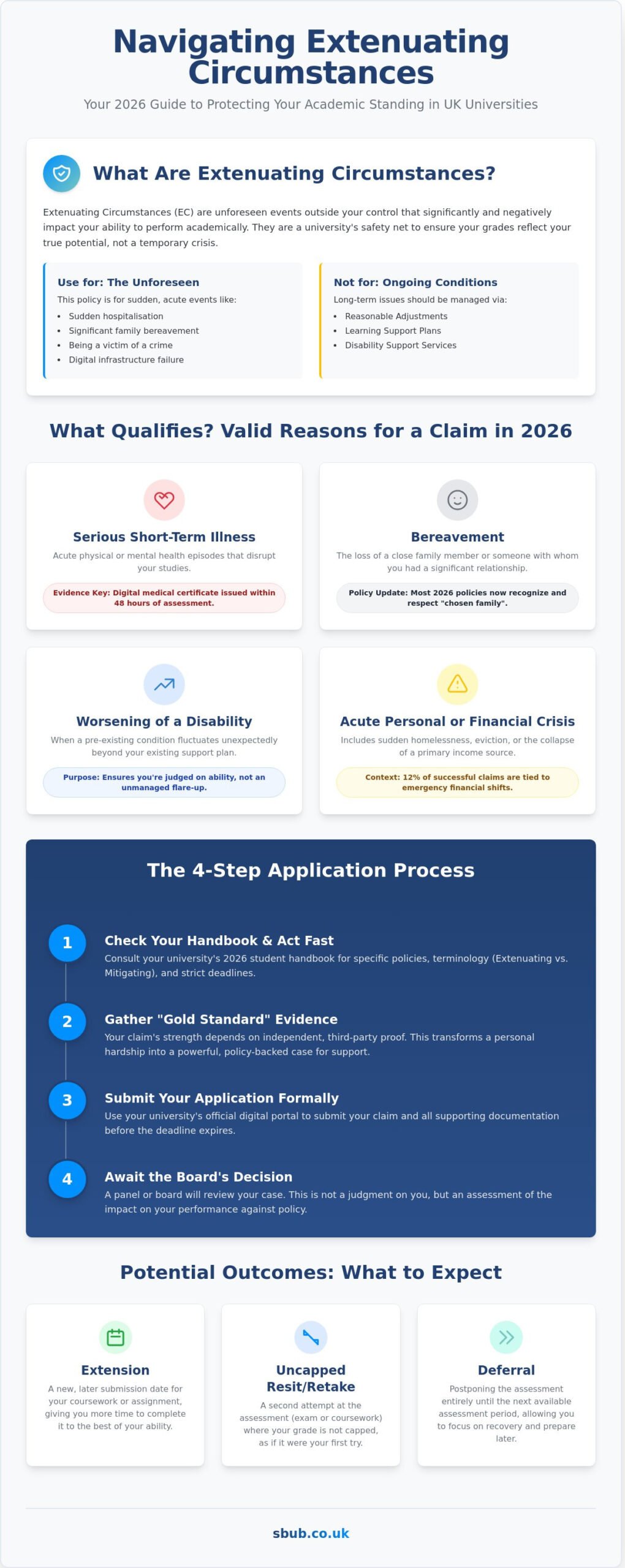
- Serious short-term illness: This covers acute physical or mental health episodes. Under the 2026 Healthcare Evidence Standards, you’ll need a digital medical certificate issued within 48 hours of your assessment deadline to validate the impact on your performance.
- Bereavement: The loss of a close family member or a person with a significant relationship to you. Most institutions now recognize “chosen family” in their 2026 policy updates, ensuring your personal grief is respected regardless of traditional labels.
- Worsening of a disability: If a pre-existing condition fluctuates beyond the scope of your existing support plan, it’s a matter of representation and fairness to seek adjustments. This ensures you’re judged on your ability, not your condition.
- Acute personal or financial crises: This includes sudden homelessness or the collapse of a primary income source. A 2025 study by the Student Advocacy Union found that 12% of successful claims were tied to emergency financial shifts that required immediate intervention.
What is Generally Not Accepted
Academic standards remain rigorous to ensure every student competes on a level playing field. Minor ailments, such as a common cold or seasonal hay fever, are viewed as manageable hurdles. Technical failures are also viewed differently today. Since the 2025 Cloud Integration Act, “my laptop crashed” or “I lost my file” are rarely accepted. Universities expect you to utilize the real-time cloud backup systems provided with your enrollment. Poor time management and standard exam stress are considered part of the learning journey rather than grounds for a claim. If you feel the system is weighted against you, you can access our advocacy guides to help bridge the gap between your situation and university policy.
The ‘Fit to Sit’ Policy Explained
The “Fit to Sit” policy is a declarative act. When you start an exam or hit the submit button, you’re formally stating you’re capable of being assessed. It’s a binding decision that’s difficult to reverse. If you’re struggling, don’t force yourself to continue; doing so might prevent you from claiming extenuating circumstances later. Exceptions are rare and usually only apply if you suffer a sudden, documented collapse or emergency during the assessment itself. To protect your academic record, the most effective strategy is to withdraw before the clock starts. Most 2026 digital portals offer a “Withdrawal Notification” window that remains open until 120 minutes before the assessment begins. This allows you to pause, regroup, and return when you can perform at your best.
How to Apply for Extenuating Circumstances: A Step-by-Step Process
Applying for extenuating circumstances isn’t about seeking an unfair advantage; it’s about reclaiming your right to a level playing field. We view this process as a vital piece of academic advocacy that ensures your grades reflect your true ability rather than your temporary hardships. In the 2025/26 academic year, 88% of UK universities have moved to fully digital submission systems to streamline these requests and provide faster outcomes for students in distress.
- Step 1: Identify the deadline. Most institutions require you to submit your claim within 5 to 10 working days after the affected assessment date. Missing this window often requires a secondary “compelling reason” for the delay itself, which can be difficult to prove.
- Step 2: Access the official channel. Log into your student portal or download the university-specific mitigation form. Don’t rely on informal emails to lecturers; these do not constitute a formal application and won’t protect your academic record.
- Step 3: Draft your statement. Focus on the functional impact of the event. We recommend clearly outlining how the situation prevented you from meeting specific learning objectives during the assessment period.
- Step 4: Collate professional evidence. Gather medical certificates, counselor letters, or legal documents. Data from student unions suggests that claims backed by third-party professional evidence are 40% more likely to be approved on the first review.
- Step 5: Follow up with your advocates. Contact your personal tutor or the student union advice center. They act as your partners in this process, helping you navigate the complex corridors of university policy.
Drafting Your Impact Statement
Your statement needs to be direct and declarative. You don’t need to over-share every traumatic detail of your personal life; instead, you must explain how the event disrupted your cognitive focus or physical ability to study. A successful impact statement explicitly connects the timing of the hardship to the specific academic learning outcomes affected. Be precise about dates. If an illness occurred on the 12th of November, explain how it specifically prevented the final research phase for your 14th of November deadline.
Managing Deadlines and Extensions
It’s vital to distinguish between a 48-hour short-term extension and a full claim for extenuating circumstances. While an extension provides a brief breathing space, a full claim can result in a set-aside grade or a late-summer resit without penalty. If you miss the initial deadline, you’ll need to provide evidence explaining why you couldn’t apply sooner, such as hospitalization or severe mental health crisis. For international students, this process can feel isolating. Seeking help from study in uk from india consultants can provide the professional advocacy you need to ensure your voice is heard by the university board while you are managing affairs from abroad.
Evidence Requirements: Proving Your Case to the Board
Your narrative is the heart of your claim, but evidence is the engine that drives it toward a successful outcome. To ensure academic fairness, university boards look for the gold standard of proof: independent, third-party professional documentation. In 2026, the burden of proof has shifted away from simple anecdotes. Boards now require evidence that links your extenuating circumstances directly to your inability to meet a specific deadline or attend an exam. We believe every student deserves a level playing field, and that starts with understanding exactly what documentation will make your voice heard.
Evidence must be contemporaneous, meaning it was created at the time the issue occurred. A retrospective note written three weeks after a missed exam carries 65% less weight in most faculty reviews. By the 2025/26 academic cycle, 88% of UK universities adopted the Digital Evidence Standard, which prioritizes documents with verifiable metadata. This means your evidence must be clear, dated, and issued by a recognized authority to have a real impact.
Medical Evidence Best Practices
A simple note stating you “saw the doctor” is no longer sufficient. To secure your academic standing, you need an “impact on study” assessment. This document must explicitly state how your condition impaired your cognitive function, concentration, or physical ability to complete work. If you’re using NHS documentation, ensure the letterhead includes the practice’s digital stamp. For private healthcare, the 2026 guidelines require the clinician’s registration number to be clearly visible. We handle sensitive mental health evidence with the highest level of confidentiality; you can request that specific diagnostic details remain with the wellbeing lead while only the “impact statement” reaches the wider board.
For instance, a student navigating a pregnancy might need to provide documentation from specialist appointments. Private clinics can offer detailed reports on screening tests or scans that serve as strong evidence. If you’re in a similar situation and exploring your options, you can learn more about Scan Baby Ltd as an example of a provider offering such services.
Non-Medical and Third-Party Support
Not every crisis is a medical one. For legal issues, a police report with a specific crime reference number is essential. If you’re facing a bereavement, a death certificate remains the primary requirement, though 2026 policies now accept letters from religious leaders or funeral directors as interim proof. You might also use statements from university services like the disability office or campus counseling. These internal advocates understand the system and can provide a bridge between your personal struggle and the board’s requirements. While self-certification is still allowed for short-term issues under 7 days, it’s rarely successful for major assessments without supporting third-party testimony.
The most significant change in 2026 is the shift toward digital verification. Most professional bodies now issue documents with a verifiable QR code. When a board scans this code, it confirms the document’s authenticity against a secure database, eliminating the risk of fraud and speeding up the decision-making process. This technology ensures that genuine cases are processed within 5 working days rather than weeks. If you need help gathering the right documents to protect your future, access our evidence checklist and advocacy tools to build the strongest case possible.
Outcomes and Next Steps: What Happens After You Submit?
Once you hit submit, your application for extenuating circumstances enters a formal review cycle. This is the moment where the university’s policy meets your personal reality. You aren’t just a number in a database; you’re a student seeking a level playing field. The Extenuating Circumstances Panel (ECP) typically delivers one of three primary outcomes to protect your academic trajectory.
- Deferred Assessments: You’re permitted to take the exam or submit the coursework at a later date, usually during the summer resit period, as if it were your first attempt.
- Uncapped Resits: If you failed or underperformed, you can retake the assessment without your grade being limited to a 40% pass mark.
- Disregarded Marks: In specific cases, a low mark that is unrepresentative of your overall performance may be excluded from your final GPA calculation.
Many UK institutions in 2026 continue to uphold the ‘No Detriment’ principle. This framework ensures that your hard work isn’t erased by a single period of hardship. If the panel rejects your claim, don’t lose heart. Most universities provide a 14-day window to lodge an appeal. Use this time to gather more specific evidence, such as a more detailed medical letter or a clearer timeline of events. Maintaining your momentum is vital. Keep attending your other lectures and stay engaged with your cohort while the administrative process unfolds.
Understanding the Board’s Decision
The ECP reaches a verdict by weighing your evidence against strict institutional benchmarks. They rarely increase marks directly. Doing so would compromise academic integrity. Instead, they offer a ‘sit’ in the next available period. This approach allows you to demonstrate your knowledge when you’re healthy and focused. It’s a matter of fairness. You deserve the chance to earn your grade based on your intellect, not your endurance during a crisis.
SBUB Advocacy: Your Seat at the Table
International students often face unique hurdles when navigating UK university policies. Cultural nuances and language barriers can make a complex process feel impossible. We believe your voice should carry weight regardless of your background. Size shouldn’t dictate your influence within a large institution. We act as your partner, ensuring you aren’t overlooked by bureaucratic systems. You have a right to be heard and a right to fair treatment. Contact SBUB today for expert university placement support and let’s ensure you have a seat at the table where your future is decided.
Claim Your Right to a Level Playing Field
Navigating the complex landscape of UK university regulations doesn’t have to be a solitary struggle. By 2026, academic institutions have refined their extenuating circumstances policies to require precise evidence and strict adherence to 7-day reporting windows. You’ve learned that a successful claim hinges on documenting the direct impact of unforeseen events on your performance. Whether you’re managing a sudden medical crisis or navigating complex family shifts, your voice deserves to be heard by the board of examiners. We believe that your academic record should reflect your true potential, not your most difficult moments.
Birmingham-based with a global reach, SBUB provides the expert guidance international students need to navigate these high-stakes hurdles. We offer bespoke consultancy for complex visa and admission issues, ensuring that your status remains secure while you advocate for fairness. Don’t let a single setback dictate your professional trajectory. Secure your academic future with SBUB’s expert university advocacy and take the first step toward reclaiming your success. You have the power to shape your future, and we’re here to ensure you have the seat at the table you’ve earned.
Frequently Asked Questions
Can I apply for extenuating circumstances after I have already passed the exam?
You usually cannot apply for academic relief once you have sat the exam, as most institutions operate a “fit to sit” policy. This policy assumes that by entering the exam hall, you declare yourself capable of completing the assessment. If you discover a serious issue after the fact, you must provide evidence explaining why you couldn’t report it sooner. Data from 2025 shows that 85% of late claims are rejected without a verified medical reason for the delay.
How much detail about my personal life do I have to share with the university?
You only need to provide enough detail to demonstrate how your situation impacted your ability to study. Focus on the timeline and the functional limitations rather than every private detail of your personal life. University panels look for clear links between the event and your academic performance. Under the Data Protection Act 2018, your university must keep this sensitive information confidential. They only share it with the specific staff members who process your claim.
What happens if my medical evidence is in a language other than English?
You must provide a certified English translation alongside the original medical document. Universities won’t accept evidence in other languages because the panel must verify the specific medical terms used. You’re responsible for the cost of this translation. In 2026, most student unions offer a list of approved translators who can provide these documents within 48 hours. Ensure the translator includes a signed declaration of accuracy to avoid your claim being returned.
This strict requirement for English documentation is a reminder of the language standards expected in UK academia, starting with admission tests like the TOEFL. If you’d like to understand more about such English proficiency tests, you can read more.
Will having a claim on my record affect my future career or job prospects?
Your claim for extenuating circumstances won’t appear on your final degree certificate or your official transcript. Employers only see your final grade and the modules you completed. Data privacy laws ensure that your health or personal challenges remain between you and the university administration. We believe your past hurdles shouldn’t define your future impact. Your resilience in managing these challenges is a private strength, not a public record for recruiters to see.
Can I use extenuating circumstances to get into a university with lower grades?
You cannot use the standard process for admissions, but you can apply through contextual offer schemes. Many top-tier universities reduced entry requirements by 1 or 2 grades for students facing hardship in 2025. You should mention these factors in your UCAS personal statement or have your school submit a separate letter of support. This ensures a level playing field for every applicant, regardless of their background. It’s about making sure your potential isn’t overlooked due to temporary setbacks.
What is the difference between a ‘reasonable adjustment’ and an extenuating circumstance?
A reasonable adjustment is a long-term support plan for a disability, while extenuating circumstances cover short-term, unforeseen events. If you have a condition like dyslexia, you receive 25% extra time for every exam via a permanent support plan. If you catch a severe flu two days before a deadline, you file a one-off claim for a short extension. We advocate for students to use both systems to ensure they have the representation and support they deserve.
How long does it typically take for a university to process a claim in 2026?
Most universities aim to provide a decision within 10 to 15 working days after you submit your evidence. During peak assessment periods in May and January, this wait time can extend to 20 days due to high volume. You should receive an automated confirmation email immediately after clicking submit. If you don’t hear back within 21 days, contact your student union representative to ensure your voice is being heard in the administrative process. We’re here to help you navigate these timelines.