
Cheap Country to Study Abroad: Top Destinations for 2026
Choosing a cheap country to study abroad doesn't mean compromising on quality education. In 2026, international students have more opportunities than ever to access world-class universities whilst managing tight budgets. From tuition-free European nations to Asian countries with exceptionally low living costs, the global education landscape offers diverse options for those seeking value without sacrificing academic excellence. This guide explores the most affordable destinations, breaking down costs, admission requirements, and strategic considerations to help you make an informed decision about where to pursue your international education journey.
Understanding the True Cost of Studying Abroad
When evaluating a cheap country to study abroad, you must look beyond tuition fees alone. The total cost of education encompasses multiple factors that significantly impact your budget over several years.
Breaking Down Study Abroad Expenses
International students typically face four major expense categories: tuition fees, accommodation, daily living costs, and administrative expenses. Tuition varies dramatically, from free public universities in Germany and Norway to countries charging nominal fees under £5,000 annually. Accommodation costs depend heavily on whether you choose university halls, private rentals, or shared housing arrangements.
Key expense categories include:
- Tuition and registration fees
- Rent and utilities
- Food and groceries
- Transportation (local and international travel)
- Health insurance and medical costs
- Visa and administrative fees
- Books, materials, and technology
- Personal expenses and entertainment
Living costs can differ substantially even within the same country. Capital cities almost always command higher prices than smaller university towns. According to Global Admissions’ analysis of affordable study destinations, students can save 40-60% on living expenses by choosing universities in regional areas rather than major metropolitan centres.

Hidden Costs That Impact Your Budget
Beyond the obvious expenses, several hidden costs can catch unprepared students off guard. Visa application fees, document translation and attestation, medical examinations, and travel insurance all add up before you even arrive at your destination. Once there, currency exchange fluctuations can significantly affect your purchasing power, particularly in countries with volatile economies.
| Expense Type | Estimated Annual Cost (GBP) | Frequency |
|---|---|---|
| Student Visa | £150-400 | Once (renewable) |
| Health Insurance | £300-800 | Annual |
| Flight Tickets | £400-1,200 | 2-4 times yearly |
| Document Processing | £200-500 | One-time |
| Emergency Fund | £500-1,000 | As needed |
Europe's Most Affordable Study Destinations
Europe stands out for offering some of the world's most economical study options, particularly in countries that maintain free or low-cost public education systems for international students.
Germany: The Tuition-Free Powerhouse
Germany remains the gold standard for affordable quality education. Most public universities charge zero tuition fees for both EU and international students at undergraduate and doctoral levels, with only nominal semester contributions of €250-350 covering administration and public transport. Master's programmes occasionally carry fees, but these rarely exceed €2,000 annually.
Living costs in German cities vary considerably. Munich and Frankfurt rank amongst the most expensive, requiring approximately €900-1,200 monthly, whilst smaller cities like Leipzig, Dresden, or Göttingen allow comfortable living on €700-850 monthly. Students can work up to 120 full days or 240 half days annually, providing substantial income opportunities.
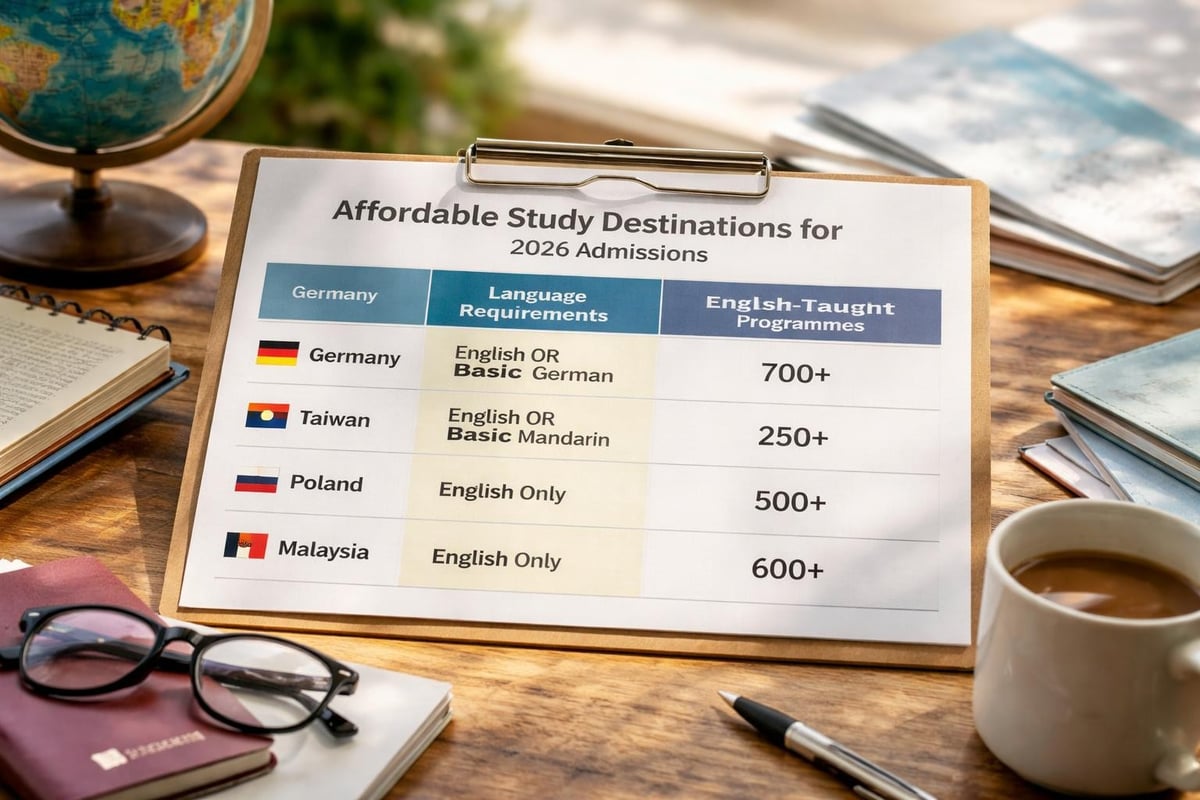
The catch? Most undergraduate programmes are taught in German, requiring language proficiency certificates (TestDaF or DSH). However, over 1,500 English-taught programmes exist at postgraduate level, making Germany an excellent cheap country to study abroad for master's and PhD candidates.
Poland: Eastern Europe's Educational Gem
Poland has emerged as an increasingly popular destination for budget-conscious international students. Public universities charge approximately €2,000-4,000 annually for English-taught programmes, whilst living costs remain remarkably low at £400-600 monthly for accommodation, food, and entertainment combined.
Advantages of studying in Poland:
- EU-recognized degrees with strong international reputation
- Vibrant student cities like Warsaw, Kraków, and Wrocław
- Central European location enabling easy travel
- Growing number of English-taught programmes
- Part-time work opportunities for EU students
Cities like Łódź and Lublin offer particularly affordable living, with shared accommodation available for under £200 monthly. Poland's membership in the European Union ensures degree recognition across the continent, whilst low-cost study abroad programmes frequently feature Polish universities for semester-abroad options.
Other Budget-Friendly European Options
Norway and Iceland offer tuition-free education at public universities, though living costs are substantially higher than elsewhere in Europe. Greece, Portugal, and Spain provide affordable tuition (€1,000-3,000 annually) combined with moderate living expenses, particularly outside major tourist centres. Czech Republic and Hungary present similar value propositions, with Prague and Budapest offering cosmopolitan student experiences at reasonable costs.

Asia's Exceptional Value Destinations
Asian countries increasingly attract international students seeking quality education at a fraction of Western costs, with several nations offering world-class universities alongside remarkably low living expenses.
Taiwan: Quality Education at Unbeatable Prices
Taiwan stands out as possibly the most underrated cheap country to study abroad in Asia. Public universities charge approximately £2,000-3,500 annually for international students, whilst private institutions rarely exceed £5,000. Living costs average just £400-550 monthly, including accommodation, food, transport, and entertainment.
Taiwan's government actively recruits international students through generous scholarship programmes covering full or partial tuition plus monthly stipends. The island nation boasts over 120 programmes taught entirely in English, particularly in engineering, business, and Chinese language studies. Its strategic location, advanced technology sector, and safe environment make Taiwan particularly attractive for STEM students and those interested in Asian business dynamics.
Malaysia: Multilingual and Multi-Cultural
Malaysia combines affordable education with exceptional cultural diversity and English-language instruction. Tuition at public universities ranges from £1,500-4,000 annually, whilst highly-regarded private institutions like Taylor's University or INTI charge £4,000-8,000, still significantly below Western equivalents. Monthly living costs in Kuala Lumpur average £350-500, with smaller cities like Penang or Johor Bahru even cheaper.
The country offers unique "twinning programmes" allowing students to complete portions of their degrees in Malaysia before transferring to partner universities in Australia, the UK, or the USA, drastically reducing overall education costs. According to Educatly’s analysis of affordable countries, Malaysia ranks consistently amongst the top five for international student value.
India: Massive Scale, Minimal Cost
India's prestigious institutions like IITs (Indian Institutes of Technology) and NITs (National Institutes of Technology) charge international students approximately £2,500-5,000 annually, whilst private universities range from £3,000-8,000. Living costs remain extraordinarily low, with £200-350 monthly sufficient for comfortable student life in most cities.
India's sheer scale means students can choose from thousands of institutions across diverse climates, cultures, and specialisations. English serves as the primary instruction medium in most universities, eliminating language barriers. However, admission to top-tier institutions proves highly competitive, requiring strong academic credentials and standardized test scores.
The Americas on a Budget
Whilst North America rarely appears on lists of cheap countries to study abroad, several destinations in Central and South America offer compelling value propositions.
Mexico: Proximity Meets Affordability
Mexican public universities charge minimal tuition (£500-1,500 annually) even for international students, whilst respected private institutions like ITESM (Tec de Monterrey) cost £6,000-10,000, roughly half of comparable US universities. Living costs vary by region but typically range from £400-700 monthly, with smaller cities like Guanajuato, Puebla, or Querétaro offering particularly good value.
Mexico's proximity to the United States, combined with strong engineering and business programmes, makes it attractive for North American students. UNAM (National Autonomous University of Mexico) ranks amongst Latin America's top universities whilst charging negligible fees. Spanish language skills enhance the experience significantly, though English-taught programmes are increasingly available.
Argentina: European Culture, Latin American Prices
Argentina's public universities charge zero tuition for both domestic and international students, making it an exceptionally cheap country to study abroad. Buenos Aires offers a cosmopolitan European-style city experience with monthly living costs of £450-650, whilst regional cities cost even less.
The caveat involves language, as most undergraduate programmes teach exclusively in Spanish. However, the Universidad de Buenos Aires (UBA) and other institutions offer intensive Spanish courses to prepare international students. Argentina's rich cultural scene, passionate student life, and relatively stable academic environment attract growing numbers of international students annually.
Balancing Cost With Educational Quality
Choosing an affordable destination shouldn't mean accepting inferior education. Several factors help assess whether a cheap country to study abroad maintains academic standards worth your time and investment.
Accreditation and Recognition
Always verify that your chosen institution holds proper accreditation from recognized bodies. Degrees from unaccredited universities may prove worthless when seeking employment or further education. Research whether your home country's employers and educational authorities recognize qualifications from your target destination.
Key accreditation checks:
- National ministry of education approval
- International accreditation bodies (AACSB for business, ABET for engineering)
- Regional recognition agreements (Bologna Process in Europe, Washington Accord globally)
- Professional body authorization for regulated careers
- Previous graduate employment rates and further study acceptance
The comprehensive guide by IMFS on affordable countries emphasizes accreditation as a critical decision factor, noting that low costs mean nothing if degrees lack international recognition.
University Rankings and Reputation
Whilst rankings shouldn't be your sole criterion, they provide useful quality indicators. Many affordable destinations house world-class institutions. Germany's TU Munich, Taiwan's National Taiwan University, and Poland's University of Warsaw all rank within global top 500 whilst maintaining low fees.
| Country | Top-Ranked University | Global Ranking | Annual Tuition (GBP) |
|---|---|---|---|
| Germany | TU Munich | Top 50 | £0-300 (public) |
| Taiwan | National Taiwan University | Top 100 | £2,000-3,500 |
| Poland | University of Warsaw | Top 400 | £2,500-4,000 |
| Malaysia | University of Malaya | Top 100 | £1,800-3,500 |
| Mexico | UNAM | Top 150 | £500-1,000 |
For students seeking guidance through the complex process of selecting affordable yet reputable institutions, working with experienced advisors can prove invaluable. SBUB Group's admissions team specializes in identifying universities that balance cost-effectiveness with academic quality, helping students secure offers from institutions that match their budget without compromising their career prospects.

Language of Instruction Considerations
English-taught programmes expand your options significantly, particularly in non-English-speaking countries. Germany, Netherlands, Sweden, and Taiwan offer thousands of English programmes at postgraduate level. However, learning the local language enhances your experience, improves employment prospects, and often unlocks additional scholarship opportunities.
Consider whether you're willing to invest time in language learning. Some countries like Germany offer intensive language courses before degree commencement, whilst others expect proficiency upon arrival. Career counselling services can help align language requirements with your long-term professional goals.
Scholarship Opportunities That Make Study Even More Affordable
Even in already affordable countries, scholarships can further reduce costs or eliminate them entirely. Understanding available funding mechanisms transforms a cheap country to study abroad into a virtually free opportunity.
Government-Funded Scholarships
Many countries offer generous government scholarships to attract international talent. Taiwan's Ministry of Education scholarship provides full tuition plus NT$30,000 (approximately £750) monthly stipend. Germany's DAAD scholarships cover living costs and health insurance for postgraduate students. The Turkish government's Türkiye Scholarships programme funds thousands of international students annually with comprehensive support.
Poland, Czech Republic, and Hungary offer Visegrad Scholarships for students from specific regions. Mexico's government provides scholarships through various bilateral agreements. These competitive programmes typically require strong academic records, clear study plans, and sometimes language proficiency.
University-Specific Financial Aid
Individual institutions often provide merit-based scholarships, particularly for exceptional students. Malaysian universities frequently offer 25-50% tuition reductions for high-achieving international applicants. Taiwan's top universities provide research assistantships for postgraduate students, covering tuition whilst providing stipends.
Scholarship application strategy:
- Research early (12-18 months before intended start date)
- Prepare strong academic transcripts and standardized test scores
- Develop compelling personal statements explaining financial need and merit
- Secure strong recommendation letters from professors or employers
- Apply to multiple programmes and scholarship opportunities simultaneously
- Meet all deadlines without exception
The AmberStudent guide to cheapest countries highlights that scholarship availability often correlates with national priorities, with STEM fields receiving particularly generous funding in Asian countries.
Work Opportunities to Support Your Studies
Part-time work transforms education budgets by supplementing savings with earned income. However, work rights vary dramatically between countries and visa types.
Student Work Regulations
Germany permits international students to work 120 full days or 240 half days annually without special permission, with many students earning €450-800 monthly in part-time roles. Poland allows EU students to work without restrictions, whilst non-EU students face more limitations. Taiwan permits 20 hours weekly during term and full-time during holidays, with hourly wages around NT$180-200 (£4.50-5).
Malaysia restricts student employment to specific sectors and hours, primarily during holiday periods. Mexico allows limited work with proper authorization, though bureaucratic processes can prove challenging. Understanding these regulations before arrival prevents visa complications and financial disappointments.
Post-Study Work Rights
Long-term value extends beyond degree completion. Germany offers 18 months' post-study work visa for job seeking, with straightforward pathways to permanent residence for employed graduates. Taiwan provides one year for job hunting, whilst Poland offers EU Blue Card eligibility for qualified professionals.
These opportunities significantly impact return on investment. A cheap country to study abroad that facilitates post-graduation employment often proves more valuable than slightly lower-cost destinations with restrictive immigration policies. When evaluating destinations, consider whether you might want to work there after completing your studies.
Visa Requirements and Application Processes
Visa procedures vary in complexity, costs, and success rates across affordable destinations. Understanding requirements prevents last-minute complications that could derail your plans.
Documentation Standards
Most countries require similar core documents: valid passport, university admission letter, proof of financial capacity, health insurance, and clean criminal record. However, specifics vary considerably. Germany requires blocked bank accounts showing €11,208 for one year's living expenses. Taiwan accepts various financial proof forms, including sponsor letters. Poland requires specific insurance coverage amounts meeting EU standards.
Financial proof requirements often exceed actual living costs, creating barriers for students from developing countries. Some affordable destinations like Taiwan and Malaysia maintain more flexible financial requirements, recognizing that students often work or receive family support throughout their studies.
Processing Times and Success Rates
German student visa processing typically takes 6-12 weeks, whilst Taiwan processes most applications within 4-6 weeks. Poland's EU membership streamlines procedures for EU citizens whilst adding complexity for others. Planning visa applications 3-6 months before intended departure provides comfortable margin for unexpected delays.
According to Academia Mag’s analysis of cheapest study destinations, visa rejection rates correlate more with application quality than destination choice. Thorough documentation, clear financial proof, and genuine academic intentions ensure high approval rates even for traditionally strict countries.
Strategic Decision-Making for Affordable Study Abroad
Selecting your ideal cheap country to study abroad requires balancing multiple factors beyond simple cost comparison. A systematic approach ensures you choose destinations aligned with your academic, professional, and personal priorities.
Creating Your Decision Matrix
Develop a weighted scoring system evaluating each potential destination across relevant criteria. Assign importance percentages to factors like total cost (perhaps 30%), programme quality (25%), language requirements (15%), work opportunities (15%), climate and culture (10%), and visa ease (5%).
Research thoroughly using multiple sources. University websites provide official information, whilst student forums and social media groups offer candid insights into daily life. Current students from your home country can provide particularly relevant perspectives on cultural adjustment challenges and practical tips.
The Application Timeline
- 18-24 months before: Research destinations, programmes, and scholarships; begin language learning if necessary
- 12-18 months before: Shortlist universities; prepare for required tests (IELTS, TOEFL, GRE, etc.); gather recommendation letters
- 9-12 months before: Submit applications; apply for scholarships
- 6-9 months before: Receive admission decisions; accept offers; begin visa preparation
- 3-6 months before: Complete visa applications; arrange accommodation; book flights
- 1-3 months before: Attend pre-departure orientations; finalize logistics; prepare culturally
For students navigating these complex processes, particularly when applying to multiple countries simultaneously, professional admissions guidance can streamline applications and improve outcomes significantly.
Beyond the Bachelor's Degree
Consider your complete educational trajectory. Some cheap countries to study abroad excel for specific degree levels. Germany shines for postgraduate research, offering paid PhD positions. Taiwan provides excellent undergraduate value with growing postgraduate opportunities. Poland offers consistent affordability across all levels.
If you're planning eventual postgraduate study in expensive countries like the USA or UK, completing undergraduate degrees in affordable destinations preserves financial resources for later. Conversely, some students pursue affordable master's programmes after expensive undergraduate degrees to minimize total education debt.
Regional Considerations and Cultural Fit
Financial affordability means little if you're miserable in your chosen destination. Cultural adaptation, climate preferences, and lifestyle compatibility significantly impact academic success and personal wellbeing.
Climate and Environmental Factors
Taiwan's subtropical climate contrasts sharply with Poland's continental winters or Germany's temperate seasons. Malaysia's year-round heat and humidity suit some students whilst others prefer distinct seasons. Consider whether you adapt easily to different climates or whether specific weather patterns affect your mood, health, or productivity.
Environmental factors extend beyond weather. Air quality in some Asian cities poses health concerns for sensitive individuals. Altitude affects some South American destinations. Researching these practical realities prevents unpleasant surprises.
Cultural Distance and Adaptation
Students from Western backgrounds often adapt more easily to European destinations despite language barriers, whilst Asian countries require greater cultural adjustment. Conversely, students from Asian backgrounds might find Taiwan or Malaysia more comfortable initially than Germany or Poland.
Neither choice is inherently superior, but understanding your adaptability and support needs informs wise decisions. Some students thrive on dramatic cultural differences, viewing them as enriching challenges, whilst others prefer gradual adjustments that don't compound academic pressures with extreme culture shock.
Safety and Quality of Life
Most affordable study destinations maintain excellent safety records for international students. Taiwan ranks amongst the world's safest countries, whilst German cities generally offer secure environments. Research specific cities rather than judging entire countries, as safety varies regionally.
Quality of life encompasses healthcare access, public transportation, internet connectivity, food safety, and recreational opportunities. The Dolphin Education Consultancy guide emphasizes that quality of life significantly impacts academic performance and mental health, making it worthy of serious consideration alongside financial factors.
Making Your Final Choice
After extensive research, you'll likely identify 2-4 strong candidates that balance affordability with your academic and personal priorities. Making your final decision involves both rational analysis and intuitive assessment of where you'll thrive.
The Financial Reality Check
Create detailed budgets for each shortlisted destination, including every foreseeable expense category. Build in 15-20% contingency for unexpected costs. Compare these totals against your available resources: savings, family support, scholarship possibilities, and realistic part-time earning potential.
Honest financial assessment prevents mid-degree crises forcing premature programme abandonment. Some students overestimate their ability to work whilst studying full-time, whilst others underestimate expenses like international travel home or emergency medical costs.
Trust Your Instincts
After rational analysis, consider your emotional responses. Which destination excites you most? Where can you envision yourself thriving academically and personally? Sometimes the slightly more expensive option that genuinely inspires you proves wiser than the absolute cheapest country to study abroad that feels uninspiring.
Your education represents years of your life and significant resources. Choosing a destination where you'll engage deeply with studies, culture, and opportunities maximizes returns beyond simple cost calculations. The right environment fosters academic excellence, personal growth, and professional network building that justify modest additional expenses.
Selecting a cheap country to study abroad requires balancing cost-effectiveness with academic quality, personal compatibility, and long-term career prospects. The destinations explored here offer genuine value, combining affordable education with international recognition and enriching experiences. Whether you choose Germany's tuition-free universities, Taiwan's exceptional value proposition, Poland's emerging excellence, or Malaysia's multicultural environment, thorough research and strategic planning ensure your investment yields maximum returns. SBUB Group Ltd. provides comprehensive support throughout this journey, from identifying the most suitable affordable destinations to securing admissions, navigating visa processes, and arranging accommodation, ensuring your study abroad dreams become reality within your budget constraints.